
Update2026.11.09 (월)


[Morgan Stanley: “Chinese Stocks Still Have 10–15% Left to Hit Bottom”]
The Chinese economy is facing severe downward pressure simultaneously from both financial markets and real consumption. Morgan Stanley warned that offshore-listed Chinese equities could drop another 10% to 15% before reaching historical valuation troughs. Within the Chinese automotive industry, projections have emerged that domestic passenger vehicle sales this year could plummet by around 22% compared to last year, falling even below the levels of 2020 during the peak spread of COVID-19. With equity markets lowering their expectations for future growth and consumers tightening their purse strings, the structural crisis gripping the Chinese economy is becoming increasingly evident.
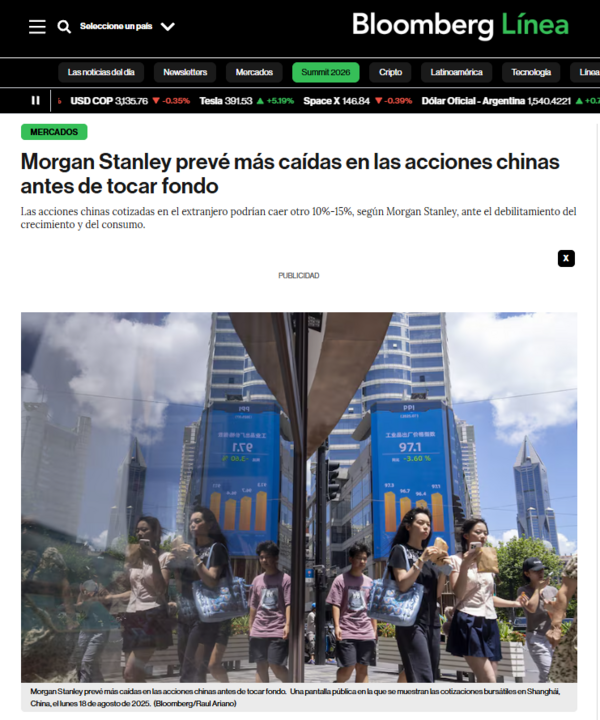
Citing a Morgan Stanley report on the 26th, Bloomberg reported that "Chinese equities have room to fall further before reaching valuation troughs," noting that "a Morgan Stanley analyst team including Laura Wang projected in an Oct. 25 report that offshore-listed Chinese stocks could drop another 10% to 15%, while onshore-listed A-shares are also likely to undergo a valuation de-rating."
According to Bloomberg, the benchmark metric cited in the report is the forward price-to-earnings ratio (forward P/E) calculated on consensus 12-month forward earnings. The analysis indicates that further declines are needed for the forward P/E of offshore Chinese equities to reach past trough levels of around 8x. The forward P/E for onshore A-shares is expected to decline to around 10x to 11x.
In simple terms, investors are pricing in lower multiples for the future earnings generated by Chinese firms. Morgan Stanley highlighted selling pressures stemming from offshore trust taxation, regulatory and margin headwinds in the e-commerce sector, macroeconomic deceleration, and heightened global market volatility as drivers behind the correction.
[China’s Nasdaq Plummets 40%… The ‘AI Growth Myth’ Shaken]
Instability in China's financial markets is most visible across cutting-edge technology stocks. Reuters reported on the 26th that "the STAR Market 50 Index, focused on Chinese tech innovators, plunged roughly 40% in less than four months, wiping out approximately $480 billion in market capitalization," adding that "the CSI 300 Index, tracking blue-chip mainland equities, has also dropped around 20% from its June highs."
According to Reuters, while high expectations for artificial intelligence (AI), semiconductors, and robotics previously propelled the market higher, investors are now questioning whether real corporate earnings can justify elevated valuations. Looming US export controls on technology and cutthroat domestic price competition have also weighed heavily on investor sentiment.
The primary concern is that an extended tech drawdown could disrupt corporate capital raising. While equity financing and IPOs are straightforward during bull runs, cooling market conditions prompt investors to demand much stricter terms. This poses a major headwind for the AI and semiconductor firms that China has prioritized as strategic national industries.
[Taxation on Affluent Offshore Trusts… Mounting Selling Pressure on Individual Stocks]
Beijing’s heightened tax enforcement on offshore assets is another catalyst rattling market stability. Reuters reported on the 16th that "some wealthy Chinese individuals are liquidating offshore trusts or selling equity holdings ahead of income reporting deadlines," noting that "Chinese tax authorities set an October 22 deadline for reporting offshore trust income, imposing a 20% tax rate on related gains."
When founders and controlling shareholders of Chinese companies listed in Hong Kong or the US hold equity stakes via offshore trusts, they may be forced to offload shares to fund tax liabilities. Share dumps by major blockholders create direct downward pressure on the underlying equities.
However, the degree to which offshore trust taxation dragged down the broader Hong Kong exchange remains a separate question. Bank of America (BofA) assessed that "while stepped-up tax enforcement introduces short-term risk for specific names, it is unlikely to be the dominant driver steering the broader Hong Kong market."
This measure serves policy objectives of combating tax avoidance and enhancing fiscal equity. At the same time, amid mounting fiscal strain from the property downturn and strained local government balance sheets, it reflects the central government's urgent need to broaden revenue collection via offshore assets.
[Automobile Sales Projected to Plunge 22%… Falling Below COVID-19 Levels]
Alongside volatile financial markets, auto sales are sounding an acute alarm across China's real economy. Reuters reported on the 26th that "Cui Dongshu, Secretary General of the China Passenger Car Association (CPCA), projected domestic passenger vehicle retail sales in China to reach 18.5 million units this year," adding that "this represents a drop of roughly 5.2 million units, or about 22%, compared to approximately 23.7 million units last year." Should this projection materialize, annual sales will fail to reach the previous low of 19.29 million units recorded in 2020. This indicates that domestic demand in the world's largest automotive market could slip below levels seen during the height of the COVID-19 pandemic.
Data confirming this annual contraction is already apparent. According to CPCA data, domestic passenger car retail sales from January to September totaled approximately 13.33 million units, down 21.7% year-on-year. September sales alone reached 1.618 million units, a 28% drop compared to the same month last year. Reaching the projected 18.5 million units requires selling about 5.17 million vehicles across the final three months (October to December)—an average of 1.72 million units per month. The projection itself already assumes a profound downturn.
[Consumption Pulled Forward by Subsidies… Market Rattled as Demand Fades]
The sluggish automotive sector stems from subdued consumer confidence coupled with the fading efficacy of government trade-in subsidies. Beijing promoted car purchases by rolling out scrap-and-replace subsidies for older vehicles. While this policy initially boosted sales volumes, it essentially pulled forward future replacement demand from consumers who would have upgraded later.
Consequently, after pulling forward demand into 2024 and 2025, sales fell sharply once the stimulative impact waned this year. As falling real estate valuations erode household net worth and cloud income and employment prospects, more households are naturally postponing big-ticket purchases like automobiles.
A Reuters analysis on the 25th similarly highlighted that falling home prices are eroding household wealth while job insecurity is driving up precautionary savings. Even as high-tech manufacturing and exports expand, domestic private consumption continues to languish.
[Behind the 4.5% Growth Rate… Property and Investment in Deep Stagnation]
The Chinese economy is not collapsing uniformly across all fronts. China's official third-quarter gross domestic product (GDP) grew by 4.5% year-on-year, buoyed primarily by export volumes and manufacturing output. However, fixed-asset investment fell 7.2% year-on-year from January to September, while property development investment plummeted 20.6%. Retail sales growth for September slowed to a meager 1.1%.
These figures reveal severe structural imbalances rather than an outright, immediate economic collapse. While exports and advanced manufacturing continue to expand, household consumption, real estate activity, and private investment remain thoroughly depressed. Directing state capital into factory floors and technology research to boost output is entirely different from instilling consumer confidence so households spend freely. When capacity expands without commensurate domestic absorption, manufacturers are forced to slash prices or rely even more heavily on foreign export markets. Prolonging this imbalance will progressively strain corporate profit margins, employment stability, and household disposable income.
[Why Times Insight | A Synchronized Warning from Stocks and Autos]
The core link connecting China's stock market distress to its auto sales slump is the erosion of confidence in the future. While institutional investors question the earnings visibility of Chinese corporations, everyday consumers delay car purchases because they lack confidence in their future earnings and asset values. Though equity declines and auto sales contractions stem from multiple interacting causes, both markets distinctly signal fading confidence across the Chinese economic landscape.
The steep drop in auto demand is particularly painful. Beijing has championed electric vehicles and battery technology as flagship achievements of its industrial policy. Yet the domestic market that forms the foundation of this industry is shrinking dramatically. While manufacturers can seek growth overseas, exports alone cannot offset the domestic shortfall for every market player. As predatory price wars drag on, the divergence between surviving firms and failing ones will widen significantly.
The taxation of offshore trusts illustrates another policy dilemma. Strengthening tax equity and formalizing oversight over foreign income are legitimate administrative necessities. However, when controlling shareholders dump shares to raise liquid tax reserves, downward pressure hits individual equities. Fiscal revenue generation and capital market stability do not always move in tandem. Still, this friction should not be overextended as the sole cause behind broader market corrections in Hong Kong.
The mandate for Xi Jinping's leadership extends beyond merely hitting headline GDP targets. Policymakers must bridge the widening gap between ramping up production in state-preferred high-tech industries and restoring consumer confidence so people willingly spend on their future. In an environment where households worry over property valuations, job security, and retirement stability, consumption subsidies merely pull purchases forward without securing a sustained, organic rebound in domestic demand.
There is no definitive basis to claim an imminent economic collapse. Yet synchronized warnings—from equity valuation de-ratings to steep projected auto sales contractions—demonstrate that vulnerabilities are accumulating simultaneously across both the financial and real spheres. In short, a systemic shock would hardly be surprising. If Beijing continues to prioritize industrial output and exports while sidelining household sentiment, the principal risk China faces will not simply be an abrupt crash, but a prolonged structural stagnation defined by declining asset values and entrenched consumer retrenchment.


-중국 푸단대학교 한국연구원 객좌교수
-전 EDUIN News 대표
-전 OUR NEWS 대표
-제17대 대통령직인수위원회 정책기획팀장
-전 대통령실 홍보기획비서관
-사단법인 한국가정상담연구소 이사장
-저서: 북한급변사태와 한반도통일, 2012 다시우파다, 선거마케팅, 한국의 정치광고, 국회의원 선거매뉴얼 등 50여권