Update2026.11.09 (월)


['The Liberty Times' Spotlights the 'Mafia Boss' Criticism]
The Chinese Communist Party placed the strengthening of party discipline and governing control at the forefront of the 5th Plenum, which convened on the 26th. Amid an ongoing purge reaching the highest echelons of the military, the "mafia boss" critique leveled six years ago by Cai Xia, a former professor at the Central Party School, prompts a reassessment of the Xi Jinping regime. Has concentrating power in the supreme leader enhanced organizational cohesion, or has it impaired the capacity to correct flawed judgments? The crux of understanding China today extends beyond how powerful Xi Jinping is to how many channels remain capable of checking that power.
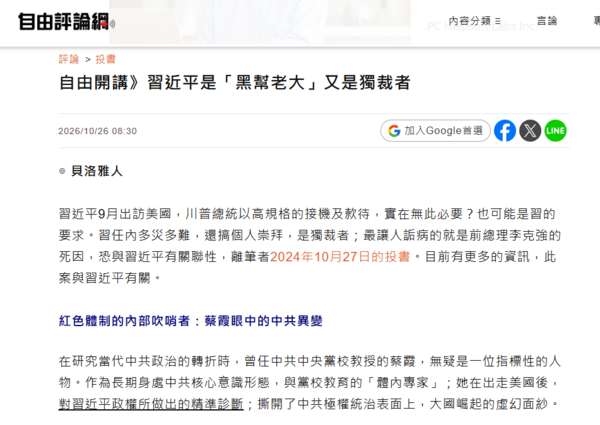
On the 26th, Taiwan’s daily newspaper The Liberty Times published a guest column directly criticizing the Xi Jinping regime. The central pillar of the column rests on the diagnosis offered by Cai Xia, a former professor at the Chinese Communist Party's Central Party School. The column characterized Cai Xia as an "insider expert" with long-standing direct experience in the party's core ideology and Party School education.
It also assessed that the analyses she published after moving to the United States exposed the realities of totalitarian rule concealed beneath the facade of a "rising great power." According to the column, Xi broke the political covenant of collective leadership through prolonged "selective anti-corruption," and in Cai Xia’s assessment, his governing logic is indistinguishable from that of an organized crime boss.
The writer also noted criticism in overseas public opinion concerning Xi Jinping’s intellectual depth. However, this column was an opinion piece synthesizing Cai Xia’s previously known statements rather than a new investigative report. What stands out is its timing: published on the eve of the third anniversary of former Premier Li Keqiang’s death, directly following Xi Jinping’s state visit to the United States, and amid continuing purges among the People's Liberation Army’s top brass.
[The Origin of the 'Mafia Boss' Remark: The Leaked 2020 Recording]
The phrase "mafia boss" (黑幫老大, heibang laoda) traces back six years. In June 2020, a 20-minute audio recording of Cai Xia speaking in a private setting circulated on YouTube, a platform effectively blocked in mainland China. In the recording, she described the Communist Party as a "political zombie" and Xi Jinping as a "mafia boss."
In the recording, Cai criticized Xi for disregarding party discipline and national laws by arbitrarily fabricating offenses such as "improperly discussing the central authorities." As a result, she argued, the party had transformed into an organization where the boss disposes of subordinates at will. Regarding the condition of party members, she stated, "90 million party members have become slaves and personal tools."
She also proposed a solution: the Politburo Standing Committee should pass a resolution by majority rule to force Xi to step down, allowing him to retire to the second line to preserve dignity and live out his remaining years. The cost of that leaked audio was steep. On August 17 of that year, the CCP expelled Cai Xia from the party and stripped her retirement pension. Cai told U.S. media at the time that depriving her of her pension amounted to stripping away her right to livelihood, noting that the punitive measure sent shockwaves throughout Chinese society.
[An Insider Who Was Both a 'Red Second Generation' and a Party-Building Expert]
The weight behind Cai Xia’s critique stems from her professional background. From 1998 to 2012, she served as a professor of political theory at the CCP Central Party School in Beijing. She directly taught provincial and municipal leaders as well as minister-level senior cadres, and upon her retirement in 2012, she was a professor at the Party Building Research Center of the Central Party School. Coming from a family of revolutionary elders as a member of the "Red Second Generation" (Hongerdai) further lends insider gravity to her remarks. She was not a dissident from the outset.
She called herself an "ardent Marxist" and initially hoped, when Xi took power in 2012, that he would be the leader to steer necessary reforms. The turning point that shattered her expectations was the case of businessman Ren Zhiqiang, who was branded "anti-party" and sentenced to 18 years in prison after criticizing Xi. The abolition of presidential term limits was another measure she found unacceptable. In a 2020 interview with Radio Free Asia (RFA), Cai stated: "All the hopes we harbored for reform were overturned. The system regressed into totalitarianism."
[From Collective Leadership to One-Man Rule: The Structure of 'Unchecked Power']
Cai Xia’s core thesis centers on a qualitative shift in the structure of power. Under Jiang Zemin and Hu Jintao, the Communist Party remained a one-party dictatorship; however, a collective leadership system operated to a degree, where factions within the Politburo Standing Committee checked one another and divided vested interests. Her diagnosis is that Xi dismantled this equilibrium using anti-corruption as a spearhead. In her interview with RFA, she defined Xi’s inner circle as the networks formed during his tenure as party secretary of Zhejiang Province—the so-called "New Zhijiang Army." She further pointed out that those who possessed the voice to speak out when Xi took power chose silence instead, and that bystander complicity ultimately sustained the repression. Consequently, no checks and balances existed by the time Xi consolidated rule. This assessment was systematized in her 2022 essay for the American foreign affairs journal Foreign Affairs, titled "The Weakness of Xi Jinping: How Arrogance and Paranoia Threaten China's Future." In that essay, she argued that while Xi had likely lost the backing of virtually every faction, he kept opponents quiet through fear. She also projected that instead of empowering the private sector, he would press forward aggressively with statist economic policies.
[August Interview This Year: "What He Fears Most Is the Truth"]
Cai Xia’s criticisms continued this year. In August, The Liberty Times highlighted her recent analysis. In it, Cai assessed that Xi ascended to the apex without notable academic or administrative capabilities or concrete policy accomplishments, relying purely on "survival instincts" and factional infighting. She added that extreme insecurity lurks behind the sweeping digital surveillance apparatus and frequent internal purges. She also traced the milestones leading to her break with the system: disillusionment with judicial justice following the Lei Yang incident in 2016, and despair over media censorship following the death of Dr. Li Wenliang in the early days of COVID-19. She noted that what Xi truly fears is neither corrupt cadres nor formidable foreign adversaries, but the "truth" itself and intellectuals offering rational criticism. Furthermore, she observed that the moment internal elites see through the narrative of a "strong leader driving national rejuvenation," the foundation of his power will be shaken.
[An Indicator of Purges: Central Military Commission 'Reduced from Seven to Two']
The "rule of fear" described by Cai Xia is reflected in the numbers. On January 24 of this year, China's Ministry of National Defense announced that General Zhang Youxia, the top-ranking military officer and Vice Chairman of the Central Military Commission (CMC), was under investigation. This marked the highest-ranking purge targeting military leadership to date. Reuters characterized Zhang Youxia as a long-standing comrade of Xi who had remained in key posts past standard retirement age. An assessment by the U.S. Air Force’s China Aerospace Studies Institute (CASI) was even more pointed: this investigation left Xi increasingly isolated in receiving military counsel. The CMC, which comprised seven members in 2023, has contracted to just two in 2026, leaving its core command effectively hollowed out, while over 100 two- and three-star generals have been dismissed or disappeared on corruption charges since 2022. The signal that even intimate associates are not exempt aligns directly with the mechanics of "absolute loyalty" and "fear" articulated by Cai.
The transformation of the Central Party School itself is equally symbolic. Cai Qi, a Politburo Standing Committee member serving as Xi's de facto chief of staff, took over as president of the Central Party School in June of this year. Bloomberg interpreted this as an expansion of influence by Xi's closest circle. The very institution where Cai Xia taught "party building" for 15 years has effectively been placed under the direct control of the supreme leader’s chief of staff.
[Lavish Reception During the September U.S. Visit and External Imagery]
The column also took issue with the "high-specification reception" extended by President Trump during Xi's state visit in September. Xi conducted a state visit to the United States from September 23 to 25. It marked the first state visit to the U.S. since the Obama administration's invitation in September 2015, with American media reporting that Trump would personally greet him on the tarmac at Joint Base Andrews in Maryland.
According to the Associated Press (AP), Trump escorted Xi to the National Archives, showcasing foundational documents symbolic of American democracy. In his concluding remarks, Xi expressed gratitude for the highest courtesies and meticulous preparations, assessing the visit as highly successful. The columnist surmised that this protocol might have been requested by Xi, though no supporting evidence was provided. The simultaneous display of projecting the image of a "great power leader" abroad while purging internal elites at home illustrates the gulf Cai Xia highlighted between the "rejuvenation narrative" and "internal anxiety."
[Third Anniversary of Li Keqiang's Death and Unresolved Suspicions]
The heaviest subject addressed by the column was the death of former Premier Li Keqiang. The official record is clear: on October 26, 2023, Li suffered a sudden heart attack while swimming at the Dongjiao State Guest Hotel in Shanghai and passed away at 00:10 the following morning at the age of 68. Despite being more than two years younger than the informal retirement age of 70, he had been excluded from the Politburo Standing Committee at the Party Congress the previous year. At the time of his passing, state media downplayed the coverage, and Xinhua’s brief dispatch contained no formal appraisal from the party. The columnist argued that circumstantial indications linking this death to Xi Jinping are mounting. However, this assertion remains an unverified suspicion not substantiated by major international news outlets.
[Why Times Insight | The Power to Eliminate Opponents Differs from the Ability to Run a Nation]
The reason Cai Xia’s diagnoses are read anew six years later is that the structures she foretold are being corroborated one by one through concrete real-world indicators. In her 2022 Foreign Affairs essay, she warned of a "vicious cycle of arrogance and paranoia." The contraction of the Central Military Commission in 2026 to essentially just Xi Jinping and a single discipline official stands as the clearest evidence of that downward spiral.
The paradox of this situation is that the concentration of power inherently breeds an informational vacuum. When loyalty testing supplants competence vetting, information ascending to the supreme leader becomes filtered and distorted. A military that has lost its final generation of battle-tested generals, a Party School commanded by the leader's chief of staff, and a silenced bureaucracy mean that avenues for candid counsel during crises have ceased to exist. This is precisely the focal point of Cai Xia's greatest apprehension regarding the Taiwan issue.
In that regard, the sharpest question Cai Xia’s warning poses today is this: while there are many who will execute Xi Jinping’s commands, does anyone remain who can tell him when those commands are wrong?

-중국 푸단대학교 한국연구원 객좌교수
-전 EDUIN News 대표
-전 OUR NEWS 대표
-제17대 대통령직인수위원회 정책기획팀장
-전 대통령실 홍보기획비서관
-사단법인 한국가정상담연구소 이사장
-저서: 북한급변사태와 한반도통일, 2012 다시우파다, 선거마케팅, 한국의 정치광고, 국회의원 선거매뉴얼 등 50여권