Update2026.10.24 (토)

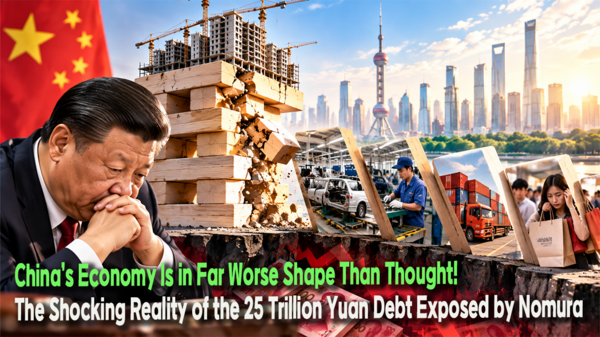
[Evergrande’s liquidation stalls… No end in sight for China’s real estate crisis]
Warnings have emerged that the Chinese economy is trapped in a structural crisis far more severe than what appears on the surface. In a recent report, Japan’s Nomura Securities analyzed that the amount owed by Chinese real estate developers to construction companies and material suppliers has reached a staggering 25 trillion yuan ($3.5 trillion), with 7.8 trillion yuan of that amount classified as high-risk distressed debt. The real estate crisis is escalating into a massive credit crunch that spills over into construction and manufacturing, placing heavy pressure on employment and consumption. As news spreads that China's central bank has begun providing financial support to clear unpaid accounts between enterprises, all eyes are on whether China can extricate itself from this colossal debt trap.

Further news highlighting the depth of China's real estate crisis has surfaced. Reuters reported on October 9 (local time) that "liquidators of Chinese property giant Evergrande Group need to recover approximately $45 billion for creditors, but assets sold through August amounted to only about $255 million," adding that "it remains highly uncertain how much money creditors will actually recover."
Reuters noted, "The Evergrande case is critical because it is not merely an isolated problem of a single real estate firm. When a developer collapses, the damage ripples sequentially—not only to banks and bond investors, but also to construction contractors, manufacturing suppliers of cement and glass, and site workers. This demonstrates how China's real estate crisis expands beyond financial markets into the broader real economy."
[Nomura exposes 25 trillion yuan… Hidden debt outside official banking statistics]
In September, Nomura Securities released a 32-page report titled "Clearing Inter-Enterprise Arrears: The Key to Rescuing China's Economy," laying bare another major risk within the Chinese economy. Nomura estimated that "debts owed by Chinese property developers to trading partners, such as construction firms and material suppliers, total approximately 25 trillion yuan." This represents roughly 30% of the entire real estate sector's debt—a figure exceeding one-sixth of China's gross domestic product (GDP).
Even more alarming is Nomura's analysis that approximately 7.8 trillion yuan of this debt is exposed to default risk. Because a significant portion of debtors are already facing severe financial distress, recovering these funds will be challenging—though it does not mean the entire sum is confirmed as an unrecoverable loss. Unlike bank loans, these liabilities remain embedded in corporate transactions as accounts payable, commercial paper, and unpaid construction fees. This explains why official non-performing loan (NPL) bank statistics fail to capture the true magnitude of the crisis.
The core issue highlighted by Nomura is that "property developers delayed payments to suppliers, effectively forcing those suppliers to fund them." In essence, construction firms and materials suppliers unwittingly stepped into the role of "shadow banks" for real estate developers.
[From real estate collapse to manufacturing… The financial arteries of the economy are blocked]
For a long time, China's real estate sector expanded by leveraging other people's money. Developers borrowed from banks, collected advance payments from homebuyers, and delayed payments to construction firms and suppliers. This model functioned smoothly during the real estate boom.
However, in 2020, President Xi Jinping's administration introduced the strict "Three Red Lines" borrowing rules for real estate developers. As property sales plummeted shortly after, cash flows froze. When developers fail to pay construction companies, construction companies cannot pay subcontractors. Subcontractors, in turn, cannot pay material suppliers, passing the financial shock down to small factories and low-income workers.
According to Nomura, accounts payable in China's construction sector doubled in just five years—rising from about 6 trillion yuan in 2019 to over 12 trillion yuan in 2024. Official statistics also reflect this liquidity burden: according to China's National Bureau of Statistics, accounts receivable for industrial enterprises above a designated size reached approximately 28.6 trillion yuan at the end of June 2026, up 8.1% year-on-year, with an average collection period extending to 71.7 days. While accounts receivable are not inherently non-performing debts, a growing balance of uncollected revenue puts severe strain on corporate cash management.
[People's Bank of China steps in… A rerun of the 35-year-old 'Triangular Debt' nightmare?]
The Chinese government has begun taking steps to address the inter-enterprise payment arrears. Bloomberg reported on September 29 that "the People's Bank of China (PBOC) has initiated low-interest funding programs to support local government-affiliated entities in settling back pay and overdue debts."
According to Bloomberg, the PBOC is supplying low-cost funds to commercial and policy banks, encouraging them to extend loans to Local Government Financing Vehicles (LGFVs) and related enterprises. Notably, no preset cap was placed on the funding support.
These measures draw intense scrutiny because China faced a similar crisis 35 years ago. In the early 1990s, China suffered from a severe "triangular debt" (三角債) problem, where companies were tangled in mutual non-payment chain reactions. In the first half of 1991, inter-company defaults exceeded 300 billion yuan. Vice Premier Zhu Rongji injected government and bank liquidity to clear unpaid debts for key enterprises, triggering a chain liquidation process as paid businesses cleared their liabilities to others. Today, however, debt relationships are far more complex. While the 1990s crisis centered on state-owned enterprises, today's network involves private developers, contractors, and countless small and medium-sized enterprises (SMEs). Furthermore, many developers are completely insolvent, meaning simple liquidity injections cannot solve the problem.
[Why monetary easing is failing to revive the economy]
The Nomura report strongly emphasizes the limitations of traditional economic stimulus measures. The Chinese government has repeatedly cut interest rates, relaxed home-buying restrictions, and expanded credit support. On September 29, the PBOC lowered the rate on Pledged Supplementary Lending (PSL) by 0.25 percentage points and announced expanded credit support for SMEs and private firms. Yet, these policy moves alone cannot resolve the massive buildup of inter-enterprise arrears.
If a construction firm cannot pay worker wages because it hasn't been paid for completed projects, its immediate need is receiving outstanding payments, not taking on new loans. Expanding credit does not erase the losses of insolvent real estate developers.
The ultimate question is: Who will absorb these losses? Decisions must be made on whether banks, local governments, or the central government's fiscal treasury will absorb the unpaid obligations of developers. However, local governments are already suffering from declining land sales revenue and existing debt loads amid the real estate slump. Attempting to solve developer distress by taking on new debt risks creating an even bigger financial hazard.
[A bitter winter for China's economy… Corporate collapse triggers consumer collapse]
Even more concerning is that this credit crunch directly squeezes employment and consumption. When developers default on construction payments, contractors have no choice but to scale back new projects and lay off workers. Suppliers must cut production or delay employee pay. The most vulnerable small businesses and laborers bear the brunt of these adjustments.
An analysis citing the Nomura report indicates that employment in China's construction sector dropped from approximately 68 million workers in 2023 to about 51 million in 2025—a reduction of nearly 17 million workers in just two years. While this drop cannot be attributed solely to inter-enterprise arrears—as the decline in overall real estate construction volume played a major role—the impact remains severe.
The drop in worker income inevitably leads to reduced consumer spending. Households facing job losses or delayed wages postpone buying cars and appliances, while cutting back on dining out and travel. No matter how many consumption-boosting policies Beijing introduces, consumer recovery will remain constrained as long as citizens lack confidence in their future earnings.
Ultimately, the key to revitalizing China's economy does not lie in luring home buyers back into sales offices. It requires restoring normal cash flow to the construction companies and suppliers that completed work but never received payment.
[Why Times Insight | What Xi Jinping should truly fear is not debt, but the collapse of trust]
The most ominous warning delivered by the Nomura report is not the 25 trillion yuan headline figure itself; it is the fact that the inter-enterprise credit structure supporting China's economy is disintegrating.
First, China's economic crisis has expanded beyond real estate into a crisis of trust across the real economy. When companies sell products but cannot collect cash, they are forced to cut back production and hiring. Falling worker incomes suppress consumer spending, worsening corporate distress in a vicious cycle. If this prolongs, economic recovery will remain sluggish even after the real estate market stabilizes.
Second, the Xi Jinping administration must decide who will absorb the losses. Resolving non-performing debt requires developers, banks, local governments, or the central government to bear immense costs. However, acknowledging losses exposes hidden distress and increases fiscal burdens—the most difficult dilemma facing Chinese policymakers today.
Third, the most dangerous risk is the erosion of faith in economic recovery. If businesses lose trust in commercial partners and citizens lack confidence in future income, monetary expansion will fail to stimulate investment or consumption. This structural deadlock lies at the heart of fears that China may enter a Japanese-style long-term economic stagnation.
Ultimately, the fate of the Chinese economy will not be decided solely by the size of stimulus packages. It hinges on whether Xi Jinping acknowledges hidden non-performing assets and successfully restarts the broken credit mechanism. If that effort fails, China's economic winter could be far longer than expected.


-중국 푸단대학교 한국연구원 객좌교수
-전 EDUIN News 대표
-전 OUR NEWS 대표
-제17대 대통령직인수위원회 정책기획팀장
-전 대통령실 홍보기획비서관
-사단법인 한국가정상담연구소 이사장
-저서: 북한급변사태와 한반도통일, 2012 다시우파다, 선거마케팅, 한국의 정치광고, 국회의원 선거매뉴얼 등 50여권