Update2026.10.24 (토)

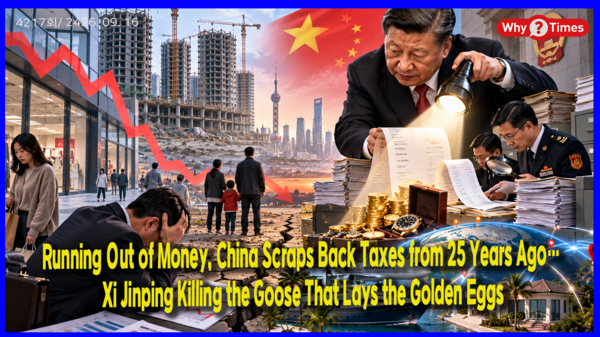
[What Happened to China's Economy in August… Consumption, Investment, and Real Estate Fall Simultaneously]
China's economy is in far more serious trouble than expected. In the economic indicators for August released on the 15th, consumption and investment cooled sharply at the same time, while real estate investment plunged nearly 20%. Yet, in the midst of this exact situation, the Chinese government is aggressively pursuing back taxes from corporations and scouring wealth records—including overseas assets of the wealthy—going back as far as 25 years.
The issue is that these two phenomena are not separate events. As the economy cools, the existing tax base weakens. With the collapse of the real estate market drying up local governments' main revenue sources, authorities are attempting to plug fiscal deficits by digging into the past income of corporations and individuals. It is a vicious cycle: opening the wallets of economic actors to fill immediate coffers further depresses consumption and investment, which ultimately weakens the foundation for future tax revenues.
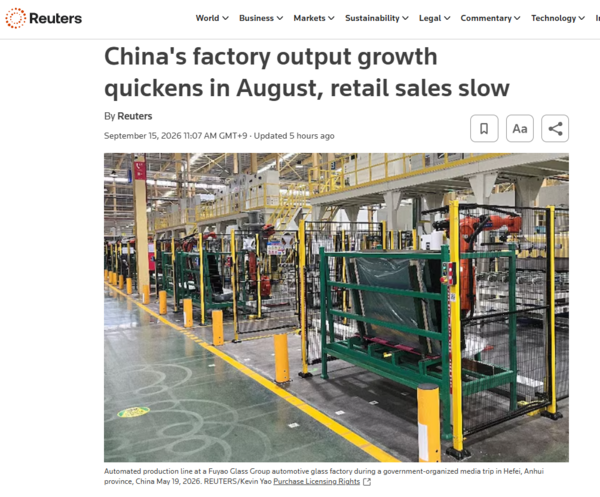
Most striking is consumption. Retail sales in August grew by a mere 0.4% year-on-year, dropping further from July's 0.6% and coming in at half the market expectation of 0.8%, while declining 0.13% month-on-month. Although the Chinese government has made boosting consumption its top economic priority, Chinese citizens are showing little willingness to open their wallets.
Investment is even more serious. Fixed asset investment from January to August fell 7.2% compared to the same period last year, widening its drop from the -6.7% seen in January–July. Investment in the Northeast region slumped by a staggering 25.5%, while foreign firm investment also dropped 4.3%. This indicates that economic actors are not putting money in based on China's future, but rather pulling back on existing investments.
Real estate, the biggest Achilles' heel of China's economy, shows no signs of recovery. Real estate development investment from January to August plunged 19.9% year-on-year, and new home prices in August dropped again month-on-month. Around 4 million unsold homes remain across China, and residential sales area from January to August declined 12.1% year-on-year. The real estate crash has moved beyond a problem for developers, squeezing both local government finances and household wealth simultaneously.
Warning lights have also turned on in the labor market. According to official data from the National Bureau of Statistics, the urban surveyed unemployment rate in August rose by 0.1 percentage point to 5.3%. While the Chinese government attributes this to seasonal factors, growing employment anxiety amid simultaneous declines in consumption, real estate, and investment leaves households with no choice but to favor saving over spending. Ultimately, this threatens to spark another vicious loop: job insecurity → reduced consumption → lower corporate revenues → declining investment.
[Yet Factories Are Running Fine… The Stranger Picture of China's Economy]
Even more intriguing is China's factory sector. Industrial production in August actually increased by 5.2%, showing a notable improvement from July's 4.5%. High-tech manufacturing production soared 16.7%, while computer, communication, and electronic equipment manufacturing grew 17.2%. High-tech manufacturing, where the Chinese government is pouring massive capital, continues to grow rapidly.
It is precisely here that the distorted nature of the current Chinese economy lies. Factories are running, but consumers aren't spending. Goods are being produced, but businesses and households aren't investing. While manufacturing and exports prop up the macro economy, consumption, real estate, and private investment inside China are weakening at the same time, reflecting deepening economic imbalances. Second-quarter growth had already slowed to 4.3%, its lowest level in over three years.
[Even When Money Is Poured Out, No One Wants to Borrow]
Looking at the financial indicators released on the 14th makes the situation even clearer. New yuan loans issued by Chinese banks in August stood at just 60 billion yuan—drastically below market expectations of 400 billion yuan. Only 15% of the expected loan volume materialized. In July, new loans suffered a net contraction of 340 billion yuan for the first time in history, while household loans fell for the sixth consecutive month in August.
This figure is perhaps far more dangerous than the 0.4% retail sales number. It is not that banks lack money to lend, but that households and businesses have lost the desire to borrow money to buy houses, consume, or invest. New loans from January to August totaled 10.44 trillion yuan, down significantly from 13.46 trillion yuan in the same period last year, while the growth rate of outstanding yuan loans fell to a record low of 4.9%.
[Beijing Begins Digging Up Taxes from 25 Years Ago]
It is against this backdrop that the Chinese government's massive back-tax collection drive must be understood. As the real estate collapse and cooling consumption and investment sap the existing fiscal base, Chinese tax authorities have begun digging into corporations' historical tax records. In the first half of this year alone, over 100 listed Chinese companies were hit with approximately 7.7 billion yuan in back taxes and late fees.
Even more shocking is the scale. The amount collected in the first six months of this year exceeded the total back taxes levied on listed companies over the entire 14-year period since Xi Jinping took power in 2012. Most notably, Heilongjiang Agriculture, an affiliate of Beidahuang, was hit with 1.41 billion yuan in back taxes, swinging into a first-half net loss for the first time since its listing.
After corporations come the wealthy. Chinese authorities are investigating high-net-worth individuals' investment income from overseas real estate, stocks, precious metals, cryptocurrencies, and offshore trusts, with some inquiries tracing back over 25 years. Taxing foreign-sourced income is not abnormal in itself. However, the fact that authorities have begun scrutinizing records decades old at this precise moment of simultaneous economic and fiscal strain carries significant weight.
Compounding this, starting in September, China abolished the dividend tax exemption for foreigners that had been maintained for 32 years since 1994, imposing a 20% personal income tax. The scope of revenue extraction continues to expand: from corporations to the wealthy, to overseas assets, and now to foreign investors.
[Why Times Insight—Scarier Than Having No Money: The 'Tax-Paying Economy' Is Dying]
China's true crisis is not merely that state coffers are running low. During the real estate boom, local governments simply had to sell land. When businesses grew, corporate taxes flowed in; when foreign capital entered, investments and jobs were created. Growth generated the next year's tax revenue.
Now, however, that virtuous cycle has reversed. Land won't sell, so authorities look for back taxes. They squeeze more out of corporations and dig through 25-year-old overseas assets of the wealthy. They have started taxing foreign dividend income after 32 years of exemption. Money flows in for the immediate present. But when excessive retroactive clawbacks are slapped on companies, businesses are forced to prioritize cash preservation over investment. The wealthy shift from spending to asset protection, and foreign firms become even more cautious about new investments.
Ultimately, this threatens a vicious loop: fiscal hardship → intensified tax clawbacks → contracting consumption and investment → shrinking corporate profits → declining tax revenues → even harsher tax enforcement. The numbers released on the 15th clearly illustrate this danger: consumption grew by just 0.4%, investment fell 7.2%, and real estate investment collapsed nearly 20%. Even when banks loosen money, households have reduced borrowing for six consecutive months.
Therefore, what the Chinese government is doing right now should not be viewed merely as a "tax hike." It is closer to borrowing against tomorrow's tax revenues to spend today. It resembles slaughtering the goose that lays golden eggs because one cannot wait for the next egg and wants to cut open its belly to pull out whatever is inside right now.
Doing so may fill today's coffers. But after the goose is dead, what will be left to tax? This is where the true crisis facing the Chinese economy lies today.

-중국 푸단대학교 한국연구원 객좌교수
-전 EDUIN News 대표
-전 OUR NEWS 대표
-제17대 대통령직인수위원회 정책기획팀장
-전 대통령실 홍보기획비서관
-사단법인 한국가정상담연구소 이사장
-저서: 북한급변사태와 한반도통일, 2012 다시우파다, 선거마케팅, 한국의 정치광고, 국회의원 선거매뉴얼 등 50여권