Update2026.10.24 (토)

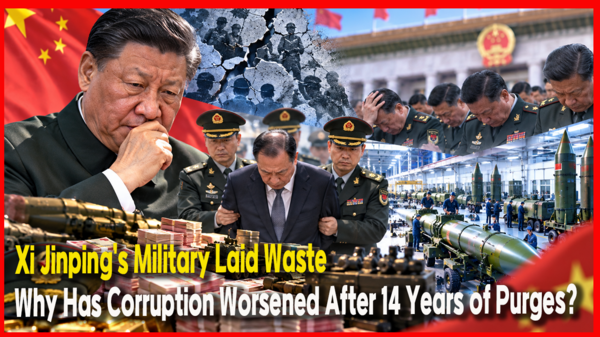
[Sept. 8 Defense Enterprise Corruption Crackdown: Former Chairman from CSGC Under Investigation]
The anti-corruption storm sweeping through the Chinese military is now penetrating the foundation of the defense industrial base. On September 8, China’s top anti-graft agencies launched an investigation into a former chairman of a key defense enterprise. Just ten days prior, the Central Military Commission (CMC)—China’s supreme military command body—was reduced to virtually two active members following a series of purges. Meanwhile, three years into the anti-graft drive targeting the Rocket Force, authorities are soliciting public tips to uncover corruption across the entire procurement cycle. Why does corruption repeatedly resurface in Xi Jinping’s military after 14 years of waging war against it? The fundamental issue is no longer just a few corrupt generals, but the party-army system itself.
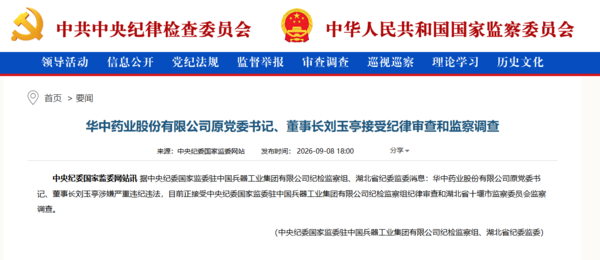
On September 8, the Central Commission for Discipline Inspection (CCDI) and the National Supervisory Commission (NSC) officially announced that Liu Yuting, former Party Secretary and Chairman of Huazhong Pharmaceutical, is under investigation for “serious violations of discipline and law.” The announcement noted that the inspection group dispatched directly by the CCDI/NSC to China North Industries Group Corporation (NORINCO) is leading the probe.
This incident is notable beyond Liu Yuting's personal involvement. Entities like Huazhong Pharmaceutical long operated under the China South Industries Group Corporation (CSGC). However, this investigation is being handled not by CSGC’s inspection unit, but by the unit dispatched to its rival, NORINCO.
CSGC historically maintained a heavy emphasis on civilian and commercial operations, such as Changan Automobile, alongside its arms production. Following a 2025 restructuring, its automotive sector was spun off into the China Changan Automobile Group, while its remaining operations and equity stakes were integrated into NORINCO. NORINCO produces heavy army weaponry, artillery, armored vehicles, and guided missiles. Put simply, CSGC represented "equipment" while NORINCO represented "defense industry." The current probe signals that last year's restructuring of these two defense giants has expanded beyond organizational charts to integrate their oversight and disciplinary enforcement under NORINCO.
[Ten Days Prior, Top Military Leadership Collapsed]
An even more striking development unfolded ten days earlier. On August 28, China removed Vice Chairman Zhang Youxia and Joint Staff Chief Liu Zhenli from the State Central Military Commission. Reuters noted that with these removals, only two active members—including Xi Jinping himself—remain on what was originally a seven-member body, marking an unprecedented contraction of China's top military leadership.
Crucially, the purges are no longer confined to specific service branches. Disruption has cascaded from the Central Military Commission and joint command down through the Rocket Force, defense procurement, and now into state-owned defense conglomerates. The "head" (top leadership), the "fist" (the Rocket Force), and the defense industrial engine that arms them are now all within the crosshairs of anti-corruption investigators.
[Rocket Force Still Soliciting Corruption Tips]
On August 25, a symbolic event occurred: the military publicly solicited external whistleblowing tips to root out procurement corruption in the Rocket Force, which oversees China’s strategic nuclear and conventional ballistic missile arsenals. According to Reuters, the scope covers material procurement, construction projects, food supply, and medical equipment.
More remarkable is the breadth of the investigation. Rather than targeting individual bribe recipients, authorities requested reports on violations across the entire procurement lifecycle—from demand planning and bid evaluation to contract execution and online transactions. Despite massive purges shaking the Rocket Force leadership since 2023, the entire procurement ecosystem is being audited again in 2026.
This highlights the significance of the latest defense industry probes. If corruption in the Rocket Force extends beyond generals taking payoffs, it directly affects who ordered the weapons, who won the contracts, and the actual quality of the hardware delivered. Consequently, as anti-corruption investigations spread from the Rocket Force to defense contractors, the credibility of the PLA’s entire defense acquisition system comes into question.
Amid these developments, irregularity surfaced within CSGC leadership. Chairman Xu Xianping vanished from major public events beginning in early 2025, alongside a series of sudden leadership shifts and vacancies in general manager and chief inspector posts. Because Beijing has not formally announced an investigation into Xu, it remains most accurate to describe his status as "absent from public view for an extended period" rather than confirming an arrest.
[Purged for 14 Years… Why Does Corruption Persist?]
This brings to light the most glaring vulnerability of the Xi Jinping administration. Since taking power in 2012, Xi made anti-corruption his signature political campaign and overhauled the armed forces. Yet 14 years into his tenure, China is once again purging top military leaders, sweeping the Rocket Force’s supply chains, and investigating executives at major defense firms. Within a single two-week span, three major events unfolded: the Rocket Force procurement probe on August 25, the removal of top military commanders on August 28, and the investigation into a former defense executive on September 8.
The question must shift from "How many corrupt generals have been caught?" to "Why does corruption persist no matter how many are purged?"
The People's Liberation Army (PLA) operates as a party-army under the absolute command of the Chinese Communist Party (CCP). Political loyalty is the foundational requirement in its command and personnel structures. However, in a system reliant on internal party discipline rather than independent legislative oversight, free press, or civil society, the question arises whether tightening party control alone can eliminate the structural incentives for corruption.
[Handpicked by Xi Jinping, Purged by Xi Jinping]
The element of time creates a distinct irony. Early in Xi's tenure, purges could be framed as clearing away corrupt networks inherited from previous administrations. But 14 years on, many senior figures in the PLA and the defense sector built their careers entirely within the Xi era.
Expanding the scope of these purges creates a political paradox for Xi. While announcing new corruption busts projects a commitment to discipline, it simultaneously raises the question of why 14 years of vetting and oversight failed to prevent it. Ultimately, that scrutiny moves beyond individual bad actors to the system itself: Are individuals inherently corruptible, or is the architecture of selection, promotion, and oversight actively reproducing corruption?
[Why Times Insight — The Real Threat Is an "Untrustworthy Military," Not Just a "Corrupt Military"]
Viewing this wave of purges merely as another Chinese anti-corruption story misses the larger operational implication: combat effectiveness. Military capability is not determined solely by missile inventories, fighter counts, or naval hulls. In actual conflict, operational success depends on whether weapons meet exact specifications, deliver required performance, avoid budget diversion during procurement, promote commanders based on merit, and report truthful training metrics to high command.
Yet today, China’s primary strategic strike force—the Rocket Force—is re-auditing its entire procurement chain. At the same time, high-ranking flag officers face removal, and major defense suppliers are under active investigation. In a cross-strait conflict scenario, the PLA would need to orchestrate complex joint operations across domain forces—rocket, naval, air, ground, space, cyber, and electronic warfare. Executing such complex joint maneuvers demands trust in the chain of command, verified intelligence, dependable logistics, and professional leadership.
This creates a stark paradox within the current purge cycle. The more aggressively corruption is targeted, the more structural vulnerabilities inside the PLA are laid bare.
Xi Jinping has controlled, restructured, and purged the military for 14 years. Yet in 2026, his administration remains consumed by auditing strategic force procurement, purging top commanders, and investigating the defense industrial base.
For Xi, one central question remains: "Why does the military I have commanded and reshaped for 14 years remain in this state?" For external observers, a more immediate question arises: If the supreme leadership must repeatedly purge its top command and audit its primary strategic forces due to lack of trust, how reliable would that military prove in actual warfare?
The PLA's core challenge is not simply the loss of a few generals. The fundamental issue is whether Xi Jinping can truly trust a military that he feels compelled to endlessly suspect and purge.

-중국 푸단대학교 한국연구원 객좌교수
-전 EDUIN News 대표
-전 OUR NEWS 대표
-제17대 대통령직인수위원회 정책기획팀장
-전 대통령실 홍보기획비서관
-사단법인 한국가정상담연구소 이사장
-저서: 북한급변사태와 한반도통일, 2012 다시우파다, 선거마케팅, 한국의 정치광고, 국회의원 선거매뉴얼 등 50여권