Update2026.10.24 (토)


[China, Raised by Reform and Opening-Up, Now Narrows Its Borders Fearing the Drain of People, Money, and Technology]
China has officially begun incorporating its citizens' physical mobility into the framework of national security. Under the new exit and entry administrative framework promulgated via State Council Decree No. 841—signed by Premier Li Qiang on July 31 and set to take effect on September 15—Chinese citizens suspected of endangering national industrial or technological security through violations of export controls or technology transfer regulations can be restricted from leaving the country. Crucially, unlike other standard grounds for travel bans, this specific provision specifies no explicit statutory upper time limit.
This policy shift unfolds alongside a sharp drop in foreign direct investment, the strategic retreat of Western financial firms, increased crackdowns on offshore assets held by wealthy citizens, and heightened restrictions on the international movement of advanced tech talent. If China's era of Reform and Opening-Up was defined by wide-open borders designed to attract global capital, technology, and expertise, the Xi Jinping administration is now narrowing those gates out of deep concern over capital and talent flight. This serves as a clear symbol of the anxiety gripping Beijing's leadership.
The 19-article Regulations on Exit and Entry Administration explicitly states in Article 1 that one of its primary objectives is safeguarding national "sovereignty, security, and development interests."
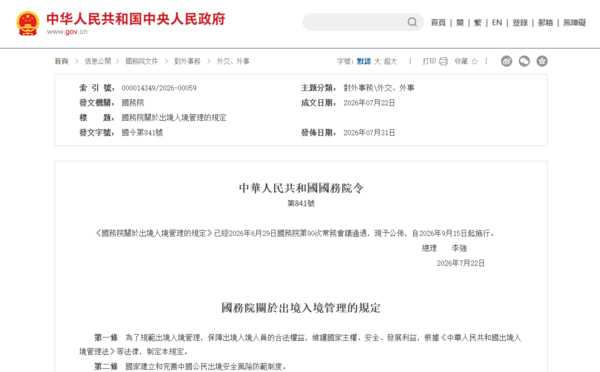
The provision governing travel restrictions for Chinese nationals stands out. While citizens who commit security-damaging crimes abroad face exit bans capped at six months to three years upon return, those flagged for potential violations involving export controls and tech security face indefinite restrictions without a fixed statutory ceiling. International observers, including Reuters, evaluate this measure as a deliberate mechanism enabling Beijing to block the departure of individuals deemed potential threats to national technological security.
This does not mean ordinary Chinese citizens face a blanket ban on foreign travel starting September 15. It is not a complete prohibition on general outbound tourism. However, the core development remains undeniable: the Chinese government has formally codified its legal authority to control individual freedom of movement under the umbrella of high-tech protection and industrial security.
[What Happened to the Founder of AI Startup Manus: "Not Just Technology, Even People Cannot Leave"]
Such administrative controls were already being actively enforced prior to the new regulation's formal implementation. As reported by the Wall Street Journal, a notable case involved Manus, an AI agent company. Originally founded in China before relocating its corporate headquarters to Singapore, Manus was subsequently acquired by Meta. In March, Chinese regulatory authorities summoned co-founders Xiao Hong and Ji Yichao for questioning, instructing them not to leave China while regulatory reviews were underway. While both founders retained freedom of domestic movement, they were barred from departing the country.
According to the Wall Street Journal, Beijing’s sensitive reaction stems from a clear precedent. While Manus's core initial technology was engineered by Chinese developers, the firm subsequently shifted its operations to Singapore and was eventually acquired by a U.S. tech giant. Regulatory authorities in Beijing grew concerned that if this trajectory became established as a successful "exit-from-China" corporate template, other domestic deep-tech startups would follow suit. Following the Manus incident, founders across China's AI startup ecosystem began systematically re-evaluating their corporate structures and overseas expansion strategies.
Beijing ultimately pressured the parties to roll back Meta’s acquisition of Manus. The Financial Times noted that Chinese authorities pushed to unwind the approximately $2 billion transaction, sending an unambiguous message designed to block Chinese-born AI technology and talent from being absorbed by American technology corporations.
[From Tech Executives to Schoolteachers Handing in Passports: Exit Controls Reach the Base of Society]
Exit management extends far beyond high-tech entrepreneurs. In China, the practice of "personal foreign travel management"—which requires individuals to surrender their passports to their employing institutions and seek formal approval for every international trip—has expanded beyond civil servants and state-owned enterprise (SOE) personnel to encompass public school teachers and broader public sector employees. The Financial Times reports that teachers at various public schools and lower-level public sector workers are increasingly required to hand in their passports, with international travel requests facing rigorous scrutiny and frequent denials.
While unverified claims circulating on social media regarding a "total passport recall across 13 occupations" should not be treated as confirmed fact, the broader trajectory is unmistakable. Combining the expansion of routine travel oversight to educators and public servants with institutionalized, security-driven exit bans creates a clear picture: personal international mobility is increasingly viewed through the lens of national security and regime maintenance.
[Why Now? World Capital Is Already Pulling Out of China]
To understand why Xi's leadership has become so sensitive to the movement of people and technology, one must look at recent developments in the Chinese economy. An analysis by the Financial Times of Dealogic and PitchBook data revealed that the world's top 10 private equity firms—including Blackstone, KKR, and Warburg Pincus—made zero public new equity investments in mainland China through July 2026. This represents a dramatic collapse compared to 2021, when such transactions were frequent. Global investment capital is diverting toward markets like Japan, India, and Australia.
Major global asset managers are making similar strategic shifts. According to Reuters, Fidelity International, managing $1.18 trillion in assets, is evaluating the closure of its wholly-owned onshore China subsidiary just three years after its launch. This follows business scale-backs or complete withdrawals by major firms such as Schroders, Legal & General, and Vanguard. Although the Chinese government opened its markets to attract foreign financial institutions, global players are retreating due to deteriorating profitability and a complex regulatory climate.
[Tracking Money That Has Already Moved Abroad]
Monitoring of overseas assets held by wealthy Chinese citizens has intensified significantly. According to Reuters, Chinese tax authorities are cracking down on taxable income derived from offshore trusts and foreign insurance policies purchased in jurisdictions like Hong Kong. Estimates suggest that up to $1.2 trillion in offshore assets owned by Chinese nationals could fall within the scope of these enforcement actions. By levying a 20% tax on income from offshore trusts and auditing foreign insurance returns, authorities are tightening the surveillance network surrounding capital flight.
This serves both to shore up fiscal revenues and enforce stricter border control over capital flows. Utilizing international automatic information exchange frameworks alongside domestic tax intelligence databases, China is actively tracing offshore assets including foreign real estate, insurance products, and trusts. State control has systematically expanded from private enterprises to capital, from capital to proprietary technology, and now directly to individual physical mobility.
[Internal Economic Stress: Neither Corporations Nor Households Are Borrowing]
Underlying this regulatory crackdown is a domestic economic backdrop showing signs of stress. The Financial Times highlights that China’s 10-year government bond yield dropped to 1.67%, marking a 13-month low. The core concern lies in the cause of this decline: private sector demand for capital has weakened as domestic corporations defer capital expenditures and households actively reduce leverage. New bank lending contracted, while private enterprises remain hesitant to expand capital investments or hiring.
For the Xi administration, this combination presents a serious challenge. Beyond the drop in foreign direct investment, if domestic businesses and consumers lose confidence in future prospects and refrain from spending or investing, broader economic recovery becomes increasingly difficult. Under these conditions, an accelerating outward drain of private capital, advanced technology, and high-skilled talent transforms from a purely economic issue into a broader challenge to system stability.
[Raised by Reform and Opening-Up, Now Closing the Doors Again]
Since Deng Xiaoping, the central driver that elevated China into the world's second-largest economy was "opening up." China actively welcomed foreign investment, sent scholars and engineers abroad to absorb advanced expertise, and integrated its domestic economy with global markets. Following its accession to the World Trade Organization (WTO), the unhindered flow of people, capital, and technology functioned as the primary engine of China's economic expansion.
Under Xi Jinping, China is pivoting in the opposite direction. Following the expansion of the Counter-Espionage Law, the National Security Law, and data security regulations—alongside heightened Communist Party oversight over private enterprise—the state now views foreign assets, critical technologies, and key personnel through the framework of national security. While official messaging frames these updates as necessary measures to safeguard national sovereignty and development interests, the imperative to restrict individual outbound travel underscores the degree of concern within China's current leadership.
[Why Times Insight — What Xi Fears Is Not 'Departure' But 'Decoupling']
The core issue does not center on claims of a total, blanket ban on foreign travel for all citizens starting September 15. Such assertions do not reflect the actual text of the regulations. The primary shift is that the state has formally institutionalized the physical movement of people as an issue of core national security.
When connected, these recent trends reveal a distinct pattern:
-Foreign investment into China has slowed significantly.
-Global financial firms are scaling back or exiting onshore operations.
-Wealthy domestic individuals accumulated substantial offshore assets, which Beijing is now actively auditing.
-Advanced tech startups born in China attempted to rebase overseas in locations like Singapore, and when top engineering talent moved toward U.S. tech acquirers, the state intervened to restrict individual exit and unwind transactions.
What Beijing seeks to contain is not routine international tourism, but the broader trend of decoupling: capital leaving China, enterprises shifting headquarters abroad, technology transferring overseas, talent emigrating, and a growing loss of confidence in the long-term trajectory of the domestic economic model.
Modern China remains deeply integrated into global trade networks and continues to pull in selective foreign investment. However, the balance of priorities has clearly shifted: favor has moved toward control over open markets, security over raw growth, and regime stability over unfettered international mobility.
China's rapid economic rise was built on opening its borders; today, concerns over the outbound drain of talent, capital, and technology are leading to tighter border management. Confident nations typically do not restrict their citizens' ability to travel, operating on the assumption that expertise and capital will naturally return. As border controls tighten, the central question remains: what driving factors are prompting this shift in Beijing's approach to national security and global integration?


-중국 푸단대학교 한국연구원 객좌교수
-전 EDUIN News 대표
-전 OUR NEWS 대표
-제17대 대통령직인수위원회 정책기획팀장
-전 대통령실 홍보기획비서관
-사단법인 한국가정상담연구소 이사장
-저서: 북한급변사태와 한반도통일, 2012 다시우파다, 선거마케팅, 한국의 정치광고, 국회의원 선거매뉴얼 등 50여권