Update2026.10.24 (토)

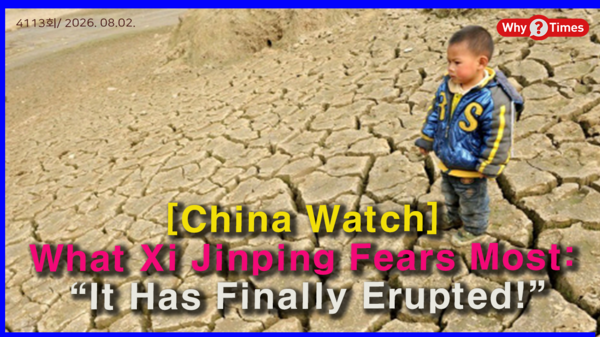
[North China Groundwater, South-to-North Water Diversion, and Food Import Reliance Pressuring China's Heartlands]
The true threat that the Xi Jinping regime should fear is not merely military tension in the Taiwan Strait or the U.S. high-tech containment. It is the fact that China's entire industrial and agricultural heartland in North China—including Beijing, home to the Communist Party of China (CPC) leadership and the People's Liberation Army (PLA) command—rests upon a foundation of chronic water scarcity.
The fact that the CPC listed the "Water Network" at the very top of its national infrastructure investment priorities last April demonstrates that water security has emerged as an urgent, non-negotiable national security agenda. While the South-to-North Water Diversion Project has helped raise groundwater levels, its trade-off is an increased dependence on southern river systems and the heavy burden of regulating agricultural water use in North China. Ultimately, the water crisis is less a single explosive bomb that will instantly topple China, and more of a "slow-burning time bomb" that continuously drains the Xi Jinping regime from within.
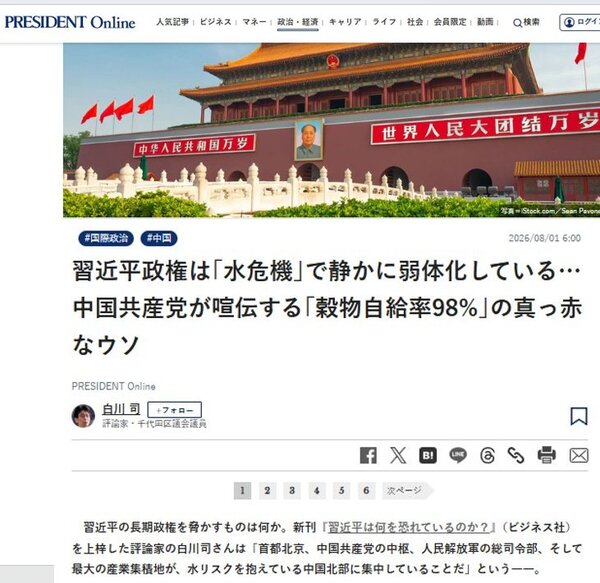
On August 1, the Japanese political journal President Online published a piece by Tsukasa Shirakawa, diagnosing that "the Xi Jinping administration is quietly deteriorating due to a water crisis." Shirakawa noted:
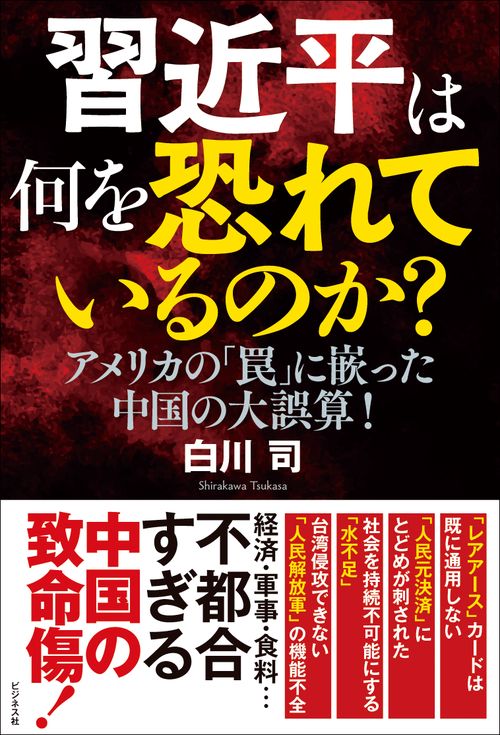
"The political and military core of the CPC, the PLA command structure, and China's largest industrial and agricultural regions are all concentrated in the northern region, which suffers from chronic water shortages."
Citing his book What Does Xi Jinping Fear?, Shirakawa argued that the concentration of China’s political, military, and industrial core in water-stressed regions represents the structural Achilles' heel of the Xi regime.
[‘Water Network’ Mentioned Before AI… Chinese Leadership Recognizes the Crisis]
The People's Daily reported that "the Politburo of the CPC Central Committee announced on April 28 plans to strengthen six major infrastructure networks: the water network, new power grid, computing power network, next-generation telecom network, urban underground pipeline network, and logistics network." It added that "the State Council detailed these plans in May, with the National Development and Reform Commission (NDRC) estimating total related investments to exceed 7 trillion yuan."
Given that Chinese authorities listed the water network ahead of all other infrastructure projects, Shirakawa interpreted this as a sign that "the water issue has emerged as a top-tier priority equal to AI and telecom networks." However, the order of listing does not necessarily imply official policy ranking. Rather than an emergency response targeting water alone, the announced projects resemble a broad infrastructure investment stimulus package aimed at economic recovery and the 15th Five-Year Plan.
Nevertheless, the top placement of the water network is significant. It strongly suggests that Beijing leadership views North China’s chronic water shortages as a national vulnerability that can no longer be ignored.
[Water Is in the South, Power and Granaries Concentrated in the North]
The root cause of China's water crisis lies in an inherently unbalanced geographical distribution of resources. According to NDRC data, regions south of the Yangtze River account for 36.5% of the total land area but possess about 81% of the nation's total water resources. Conversely, regions north of the Huai River and the Northwest account for 63.5% of the land area, but only about 19% of total water resources.
In particular, the Hai River and Huai River basins contain nearly a quarter of China's cultivated land, yet hold only about 4% of its water resources. Mega-cities like Beijing, Tianjin, and Shijiazhuang, along with steel, chemical, high-tech manufacturing bases, and key agricultural regions, are all densely packed into water-scarce zones.
Agriculture consumes approximately 60% of China's total water, with double-cropping (winter wheat and summer corn) on the North China Plain relying heavily on intensive irrigation. As shallow aquifers depleted, tapping into deep groundwater—or "fossil water" that cannot be naturally replenished easily—became routine.
Studies analyzing NASA's GRACE satellite gravity data revealed that North China lost roughly 8.3 billion cubic meters of groundwater annually between 2003 and 2010. While groundwater levels in some areas later recovered due to a mix of the South-to-North Water Diversion, increased rainfall, extraction restrictions, and adjusted irrigation areas, China's Xinhua News Agency reported that the Eastern and Middle routes of the diversion project have transferred over 89.2 billion cubic meters of water, benefiting around 195 million people.
However, this does not mean the water crisis is solved. It simply shifts the burden by patching up northern deficits with southern supplies, while capping groundwater use and irrigation. If climate change increases the flow volatility of the Yangtze and Han River basins, the long-term stability of the South-to-North Water Diversion will also be compromised.
[Vulnerability Hidden Behind the '98% Grain Self-Sufficiency' Claim]
Water scarcity directly exposes vulnerabilities in national food security. Xi Jinping has repeatedly emphasized that "the rice bowl of the Chinese people must be held firmly in their own hands." The Chinese government highlights that grain production exceeded 700 million tons for the first time in 2024, and that self-sufficiency in the three major staple grains (rice, wheat, and corn) remains at 98%.
However, 98% is not the overall food self-sufficiency rate. When including soybeans, edible oils, and livestock feed, China's reliance on imports skyrockets. China's soybean self-sufficiency rate plummeted from 62.4% in 2000 to 16.6% in 2020, while barley and sorghum self-sufficiency hovered around 20%. Reliance on imported edible oils stands near 70%.
The Council on Foreign Relations (CFR) analyzed that "China's overall food self-sufficiency rate fell from 93.6% in 2000 to 65.8% in 2020." The report noted:
"China became a net food importer in 2004 and the world's largest food importer by 2021. While it boasts a 98% staple grain self-sufficiency rate on the surface, its actual food ecosystem heavily relies on overseas supply chains for soybeans, feed, and edible oils."
[Sichuan Drought Demonstrates the Destructive Power of Water Crisis]
The 2022 drought in Sichuan Province served as a preview of how water shortages can escalate into industrial crises. At the time, the Yangtze River basin suffered its longest heatwave and drought since records began in 1961, with rainfall dropping by nearly 40% compared to average years. In Sichuan, where hydropower supplies over 80% of electricity, generation capacity plummeted just as energy demand surged.
As a result, major factories operated by Volkswagen, Toyota, BOE, and CATL came to a standstill, while Panasonic and Denso plants in neighboring Chongqing also faced severe operational disruptions. This incident revealed that water shortages are not merely a drinking water issue, but a critical hazard capable of paralyzing entire supply chains across power, semiconductors, automobiles, and batteries simultaneously.
Furthermore, glaciers on the Tibetan Plateau—known as the "Water Tower of Asia"—are retreating rapidly. According to China's Third Glacier Inventory, the total area of glaciers in China decreased by about 26% from the 1960s to 2020, with roughly 7,000 small glaciers disappearing altogether. While glacier loss cannot be directly blamed for an immediate drop in water diversion volumes, it undoubtedly degrades the long-term stability of China's major river basins.
[Xi’s Dilemma That Mega-Dams Cannot Cover]
China has historically addressed water and power shortages through massive civil engineering projects such as the South-to-North Water Diversion, the Three Gorges Dam, and the Yarlung Zangbo mega-hydropower project. Chinese Premier Li Qiang even referred to the Yarlung Zangbo project as the "project of the century."
Yet, massive dams and canals cannot be the ultimate answer. Structural solutions require shifting away from water-intensive crops, recycling industrial water, enforcing pollution regulations, and expanding efficient irrigation technologies. The dilemma is that these policies simultaneously strain agricultural output, farmers' incomes, and industrial output.
Cutting agricultural water use threatens food production; restricting groundwater extraction lowers farmers' revenue; and controlling industrial water usage hurts economic growth rates and manufacturing competitiveness. Whichever path Xi Jinping chooses, his administration would have to admit that past growth, food, and infrastructure policies contained fundamental flaws.
[Why Times Insight]
China’s water crisis does not mean the immediate collapse of the Xi Jinping regime. It is true that groundwater levels in parts of North China have partially recovered and the South-to-North Water Diversion has achieved noticeable results. However, this recovery is not because water scarcity has vanished, but because the burden was shifted elsewhere through reliance on southern river basins, groundwater restrictions, and irrigation adjustments.
The real crisis lies in the fact that water scarcity, food security, power generation, and industrial safety are tightly bound together in a single chain. Whenever the Chinese leadership attempts to resolve an issue on one side, a new burden flares up on another. Furthermore, given the nature of an authoritarian regime where admitting policy failures is difficult, Beijing is likely to repeat symptomatic remedies—such as mega civil engineering projects—rather than pursuing fundamental structural reform.
Ultimately, the water crisis is not an acute emergency that will destroy China overnight; it is a structural drain that continuously eats away at the Xi regime's resources and choices year after year. As pressure surrounding water and food mounts, the leadership's anxiety that "time is not on China's side" will only grow. What Xi Jinping should truly fear is not just the drying up of water itself, but the reality that China's time is rapidly running out alongside it.


-중국 푸단대학교 한국연구원 객좌교수
-전 EDUIN News 대표
-전 OUR NEWS 대표
-제17대 대통령직인수위원회 정책기획팀장
-전 대통령실 홍보기획비서관
-사단법인 한국가정상담연구소 이사장
-저서: 북한급변사태와 한반도통일, 2012 다시우파다, 선거마케팅, 한국의 정치광고, 국회의원 선거매뉴얼 등 50여권