
Update2026.10.24 (토)


[The Reservoir is Drying Up—The Reality of June 2026 Captured by the SCMP]
China’s employment collapse runs far deeper and wider than official figures suggest. As the real estate crisis worsens into its fifth year, construction sites have ground to a halt. Behind the official figure of 7.62 million unemployed construction workers lie tens of millions outside official statistics who have quietly vanished. Analysts warn that with 300 million flexible workers standing on the precipice without any safety nets, widespread social anxiety is spiraling into a structural crisis.
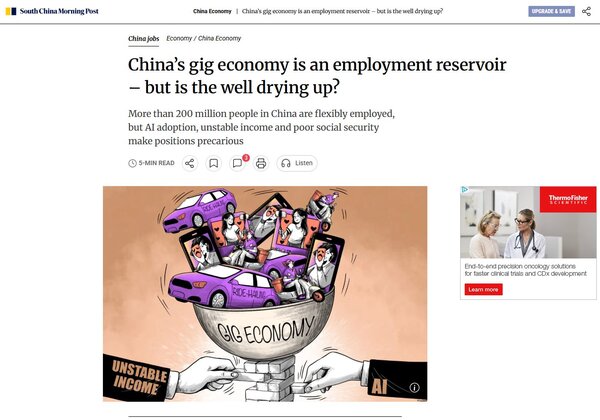
On June 7, Hong Kong’s South China Morning Post (SCMP) featured an in-depth field report from Guangdong, noting:
"The gig economy—composed of ride-hailing drivers, food delivery riders, and digital content creators—has until now evolved from a sideline into a massive reservoir absorbing China’s unemployment pressures."
The SCMP highlighted, however, that "the bottom of this very reservoir is beginning to show." It cited the case of Wu Shutian, an actor holding a master’s degree in directing from the UK’s prestigious University of Sussex. Showing up to a film set at 3:30 AM to play a rural villain, Wu remarked, "In an era where AI could quietly replace me at any moment, simply having work is a salvation." Wu is just one of China’s more than 200 million flexible workers, barely scraping by day to day amid volatile income and a total lack of social security.
The SCMP further pointed out that "this landscape is not merely a reflection of individual hardship, but the product of a structural crisis." In a separate article published in April, the SCMP reported: "China's gig economy has experienced explosive growth as workers flocked to flexible employment following a wave of mass layoffs and wage cuts in a volatile job market; currently, over 200 million people, representing more than 27% of the workforce, fall into this category."
The actual scale is even larger. According to the '2025 Blue-Collar Employment Research Report' by the China New Employment Forms Research Center, as of 2026, the flexible employment population has reached 320 million, accounting for 44% of the total workforce. This reflects a staggering annual surge of 40 million workers since the population first surpassed 200 million in 2021. Yet, the average monthly income for these flexible workers stands at a meager $563 (approx. 760,000 KRW), entirely devoid of social insurance. The reservoir is overflowing, but the water within it is drying up.
[Crumbling Houses, Halted Construction Sites—The June Alarm]
The reason behind the drying reservoir is clear. On June 3, Reuters reported: "China’s property management companies are seeing their revenue bases collapse as they fail to collect management fees from disgruntled homeowners." The report noted that while some property owners simply cannot afford to pay, others are withholding payments to pressure companies into lowering fees. Consequently, management firms are terminating contracts in some complexes, leaving trash piled up and security guards gone.
Regarding this trend, real estate research firm CRIC revealed: "The average management fee collection rate among China’s top 500 property management companies plummeted from 89% in 2021 to 71% in 2025." An expert quoted by Reuters warned that "it could take decades for this housing crisis to be resolved."
Economic indicators consistently point in the same direction. According to the finalized 2025 annual statistics released by the National Bureau of Statistics (NBS) in January, property development investment fell by 17.2% year-on-year, and new residential housing starts plummeted by 19.8%. There has been no rebound in 2026. During the January–February period, new construction starts plunged an additional 23.1%, with the decline widening to 13.7% in April. As of April 2026, new home prices across 70 major cities nationwide have dropped for 34 consecutive months, falling 3.5% year-on-year. Market research firm GlobalData reported that in the first quarter of 2026, land acquisition by the top 100 real estate developers crashed by 49.4%, signaling that developers are extremely reluctant to break ground on new projects. When real estate stalls, construction sites freeze; and when construction sites freeze, the livelihoods of those dependent on them fall apart.
[7.62 Million is No Lie—But It Is Just the Beginning]
According to statistics from the China Construction Industry Association, the number of direct employees in the construction sector shrank by 7.62 million in a single year, dropping from 58.77 million at the end of 2025 to 51.14 million. This represents a 12.97% decline—nearly one out of every five workers. However, this 7.62 million figure only accounts for formal employees listed on corporate rosters with legal contracts. The job losses of migrant workers (mingong), who sustained these construction sites on daily wages without formal contracts, are completely omitted from this figure.
As the SCMP explicitly stated, China’s official urban unemployment rate excludes the vast majority of its 149 million self-employed individuals and nearly 300 million migrant workers, failing to fully reflect the true state of employment. According to the NBS 2025 annual statistics, the total number of migrant workers nationwide stands at 301.15 million, with 180.06 million leaving their hometowns to work elsewhere. Historically, the construction industry has absorbed roughly 20% of these outgoing migrant workers, meaning over 36 million individuals have relied on construction sites.
With sites shutting down, no one knows exactly how many have lost their income. Lacking formal contracts, they are invisible in statistics; lacking unemployment insurance, they do not show up at unemployment benefit windows. When construction sites stop, migrant workers pack their bags and return to their villages. Because the concept of "unemployment" does not statistically exist in rural areas, losing their livelihood simply means they disappear from the numbers.
In April, the SCMP pointed out that "experts argue the lack of comprehensive data on informal employment, migrant workers, and discouraged job seekers fundamentally prevents a complete understanding of China’s employment situation," labeling this phenomenon "hidden unemployment."
["Employed if You Work 1 Hour a Week"—What the 5.2% Conceals]
The average annual urban surveyed unemployment rate for 2025 was recorded at 5.2%. However, a fatal blind spot hides behind this figure. Under the International Labour Organization (ILO) standards followed by China, an individual is classified as "employed" if they perform just one hour of paid work per week.
A former construction site manager who used to earn 8 million KRW a month is considered "employed" if they now carry boxes once or twice a week.
A bricklayer with 20 years of experience is "employed" if they pick up a minor repair job once a month.
A former site supervisor turned delivery rider is "employed" if they ride for one hour a week.
None of these individuals appear in unemployment statistics. Some economists estimate that if discouraged workers and involuntary part-time employees are included, the actual youth unemployment rate exceeds 40%.
The group most marginalized by this crisis is migrant workers aged 50 and older. NPR, citing NBS data, noted that "nearly 30% of migrant workers are over the age of 50, totaling almost 90 million people," adding that "when sites downsize, they are the first to be let go." Regulations enacted in 2022 ban men over 60 from working on construction sites. Having engaged in informal labor for decades, these individuals have virtually no savings or official pensions.
Liu Zhongxian (58), interviewed by NPR, said, "I want to retire, but I have to find a way to make money first. You can't survive without money in today's world." Meanwhile, Mr. Zhao (60) was rejected at a job interview with the blunt statement: "We don't hire anyone over 55." His response—"My body is perfectly fine, why won't they give me anything?"—was a mix of anger and resignation. Ultimately, these workers return to their hometowns after 20 to 30 years away. Because the concept of rural unemployment does not exist, they escape all statistics. Their income is cut off, but they do not exist in the numbers.
[The 'Iron Rice Bowl' is Broken—State-Owned Enterprises and Public Broadcasters Collapse]
The crisis has now penetrated the sectors China once boasted were its most stable. The "Iron Rice Bowl" (tie fan wan)—state-owned enterprises (SOEs) and state-run broadcasting stations—has not escaped the chilling wind of downsizing. According to internal documents obtained by the China Media Project, multiple provincial TV stations are shuttering subordinate channels in response to financial crises, while surviving staff have seen their wages slashed by at least one-third. An official within the Party’s propaganda department privately described the situation: "Everyone, including CCTV and major satellite networks, is living like beggars."
Hubei TV officially announced on June 10: "We will permanently close two television channels and three radio frequencies effective June 30." Jiangsu Broadcasting, historically considered a model of fiscal health, has also reportedly carried out mass layoffs. Private Big Tech is no exception either; Alibaba slashed its workforce by 34% in 2025, while Baidu cut roughly 7%, and BYD downsized by about 10%.
[Delivery Rider Strikes and the Communist Party’s Fear]
Discontent has already spilled into the streets. Last December, hundreds of delivery riders gathered in Changsha to protest restrictions on entering apartment complexes. From late March to early April of this year, delivery workers in Chongqing staged a days-long strike protesting plunging commission rates and exploitative platform practices. Although related videos were immediately scrubbed from domestic social media, they spread rapidly via VPNs. The Communist Party views this momentum as a direct threat to the regime.
In late April, the General Office of the CPC Central Committee and the State Council issued joint directives to tighten management over "workers in new forms of employment"—such as delivery riders, ride-hailing drivers, and live-streamers. The directive repeatedly emphasized compliance with the Xi Jinping line, urging workers to "listen to and follow the Party." According to Bloomberg, the guidelines mandate the achievement of standardized contracts, fair wages, and algorithmic transparency by 2027. However, skepticism remains high over whether this dual strategy of pursuing both labor protection and social control can alter the harsh reality faced by 300 million flexible workers.
[China’s Unspoken State of Emergency]
In summary, the SCMP observed: "The officially recorded 7.62 million unemployed construction workers represent merely the tip of the iceberg above the surface." When combining the tens of millions of contractless migrant workers who left the sites, the 320 million flexible workers whose incomes have been slashed in half, and the 90 million elderly laborers erased from statistics upon returning to their villages, the actual magnitude of the shock is incomparably larger than any official figure suggests.
Premier Li Qiang emphasized in his 2025 National People's Congress report that "structural employment issues are becoming more severe" and that "we must prevent a large-scale relapse into poverty." This phrasing amounts to an open admission of the crisis by China’s top leadership itself.
For a long time, if real estate was the engine of China's growth, employment was the ultimate safety valve for social stability. Now, both pillars are shaking simultaneously. The core issue is that China’s unemployment is not just a statistical glitch. If the discontent of migrant workers and flexible laborers who have vanished from official data begins to spill over into the streets and online spaces, it could evolve beyond an economic crisis into a political challenge that tests the very governing legitimacy of the Communist Party. As the SCMP questioned, China’s "employment reservoir" has begun to dry up—and when a reservoir empties, the first thing exposed is the bedrock.


-중국 푸단대학교 한국연구원 객좌교수
-전 EDUIN News 대표
-전 OUR NEWS 대표
-제17대 대통령직인수위원회 정책기획팀장
-전 대통령실 홍보기획비서관
-사단법인 한국가정상담연구소 이사장
-저서: 북한급변사태와 한반도통일, 2012 다시우파다, 선거마케팅, 한국의 정치광고, 국회의원 선거매뉴얼 등 50여권