
Update2026.06.10 (수)

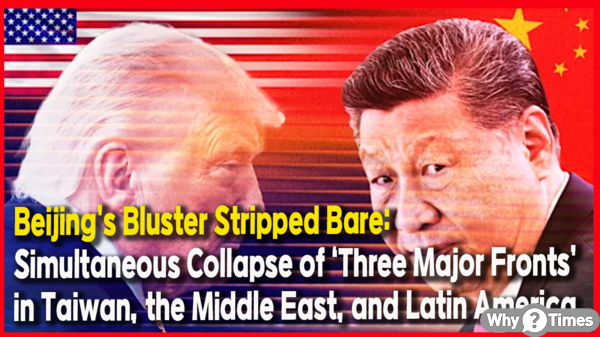
[The Reality of China’s ‘Three Major Fronts’ Exposed in Venezuela, Iran, and Taiwan]
While the Chinese Communist Party (CCP) continues to escalate the intensity of its ‘stern warnings’ against the United States across the three fronts of Taiwan, the Middle East, and Latin America, the reality shows a different picture. China failed to prevent the collapse of its Venezuelan ally, remained a bystander during the Iran crisis, and has failed to change the status quo in the Taiwan Strait for nearly 80 years. Analysts suggest that the harsh rhetoric and threats of retaliation recently poured out by the CCP toward the international community are closer to the operation of a sophisticated ‘Rage Machine’ rather than a practical projection of national power. In short, the CCP’s politics of rage serves as proof of a systemic crisis.
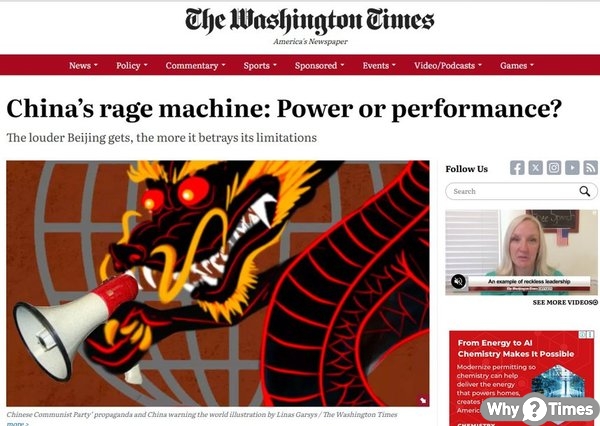
The Washington Times recently drew attention by providing a detailed analysis of the reality of the CCP’s politics of rage through the ‘Red Horizon’ column by Miles Yu, Director of the China Center at the Hudson Institute.
Beginning with the sentence, “The CCP has started shouting at high volume again,” Yu argued, “The more aggressive Beijing’s warnings become, the more clearly their actual strategic constraints are revealed.” This contribution received particular attention as it was published just two weeks before U.S. President Trump’s visit to China. This provides context for the analysis that China is attempting to increase its bargaining power by speaking as loudly as possible on various fronts before the two sides sit at the negotiating table.
Yu asserted, “The CCP’s anger is not an expression of confidence, but a symptom of suppressed capability.” It is a paradox where the stronger the rhetoric, the more apparent the poverty of execution becomes.
[Front 1: Latin America – A ‘Strategic Partner’ in Name Only; Failure to Prevent Maduro’s Arrest]
In Yu’s analysis, Latin America is the front where the gap between China’s rhetoric and reality is most dramatically revealed. For a long time, China built Venezuela as a stronghold for the anti-U.S. front in Latin America, providing loans reaching $10 billion and securing access to the world’s largest oil reserves. Venezuela was the only Latin American country granted an ‘All-Weather Strategic Partnership,’ the highest tier in Chinese diplomacy.
However, this entire plan was shaken at once on January 3, when U.S. special forces entered Caracas and arrested President Nicolás Maduro. China condemned the U.S. operation and demanded Maduro’s immediate release, but offered nothing beyond diplomatic protests. Military intervention was not even an option. Parsifal D’Sola Alvarado, Executive Director of the Andrés Bello Foundation in Bogotá, Colombia, analyzed, “China’s lukewarm response is consistent with its long-standing strategic constraints,” and “China is likely to maintain its existing strategy of focusing on economic ties and resource access while avoiding security and military cooperation as much as possible.”
Regarding this, Yun Sun, Director of the China Program at the Stimson Center, noted, “The ousting of Maduro imprinted on China that the U.S. will for military intervention is still a reality,” adding, “Beijing can no longer view the U.S. as a paper tiger.”
This incident starkly exposed the structural vulnerabilities of China’s Latin American strategy. China’s influence is concentrated on economic leverage—funding for roads, ports, and railways, and large-scale raw material purchases. The moment that influence is exposed to military threats, Beijing has virtually no cards to play. The distance between the rhetoric China uses annually to criticize U.S. ‘interference’ in Latin America and the reality of being helpless when the U.S. actually exercised military force was too vast.
[Front 2: Middle East – What China Could Actually Do During the Iran Crisis]
The same pattern was repeated in the Middle East. Starting in early 2026, the Middle East crisis intensified as anti-government protests within Iran and U.S. military pressure escalated simultaneously. The U.S. deployed three aircraft carrier strike groups to waters near Iran and strengthened sanctions on oil export vessels. China strongly condemned the U.S. actions as ‘hegemonic acts’ and poured out statements demanding respect for international law and Iranian sovereignty.
However, it was the U.S. that actually controlled the sea lanes, deployed carrier groups, and executed the blockade. Miles Yu focuses on this point. While China has deep economic interests as Iran’s largest oil importer, the role of defining the security landscape of the Persian Gulf is still monopolized by the U.S. It is the epitome of irony that China criticizes U.S. military action against Iran while lacking the security capability to fill that space.
The fact that the Iran issue is one of the core agendas of the 2026 U.S.-China summit should also be read in this context. The structure itself—where the U.S. side requests China’s cooperation in the nuclear negotiation process and China uses this as a bargaining chip—shows that China’s role is that of an intermediary, not an independent actor.
[Front 3: Taiwan – 80 Years of Status Quo; The Paradox of Military Shows of Force]
In Yu’s analysis, Taiwan is where the discrepancy between China’s rhetoric and reality has accumulated for the longest time. From late 2025 to early 2026, the People’s Liberation Army (PLA) repeatedly simulated Taiwan blockade scenarios through ‘Joint Sword-2025A’ and ‘Mission Justice-2025’ exercises. Live-fire rocket launches and Taiwan encirclement maneuvers were conducted, and provocative incursions by PLA aircraft crossing the median line of the Taiwan Strait continued. The Center for International Security and Strategy (CISS) at Tsinghua University selected “the escalation of tension in the Taiwan Strait” as the number one external risk facing China in 2026 in its annual report. Paradoxically, this figure is a self-admission that the Taiwan issue is a risk for China as well.
Nevertheless, the basic reality has not changed. Taiwan has not come under the control of the CCP. On May 1, 2026, the U.S. Congress adopted a bipartisan resolution calling for peace and stability in the Taiwan Strait, reaffirming the common concern of both parties regarding China’s military threats. In particular, by specifying in the resolution that China is attempting to change the status quo through coercion or force, the U.S. Congress clarified its will for deterrence against China.
Of course, there are variables. To counter China’s military pressure, the Taiwan government organized a special defense budget of approximately $40 billion (58.5 trillion KRW), but the opposition-controlled Legislative Yuan cut this by about one-third, approving only 36.5 trillion KRW. The U.S. State Department unusually criticized this publicly as a “concession to the CCP.” For the Trump administration, one justification for strongly defending Taiwan has disappeared.
Meanwhile, China employed a diplomatic detour strategy alongside military exercises. On April 10, 2026, Xi Jinping met with Chairman Cheng Li-wun of the opposition Kuomintang (KMT) at the Great Hall of the People in Beijing. This is the revival of the KMT-CCP summit after 10 years since 2016. Chairman Cheng, a pro-China figure, made a conciliatory gesture, saying, “The sky should be filled with birds, not missiles.” Beijing has laid the groundwork to divide internal public opinion in Taiwan and shake the relationship between the Democratic Progressive Party (DPP) government and the U.S.
[The Logic of Regime Survival – High Volume Mandated by the ‘Infallibility Myth’]
Why does China repeat these hollow warnings? Miles Yu finds structural causes in the survival logic of the CCP regime. The political legitimacy of the CCP is based on the myth of being ‘absolutely right and never defeated.’ This logic seems to operate identically on the economic front. Global investment banks (IBs) are presenting China’s 2026 economic growth forecast at 4.3–4.8%. With the long-term slump in the real estate market, a recovery in consumer sentiment is virtually difficult, and while investment sluggishness continues, exports to the U.S. in the first four months of 2026 decreased by 10.2% year-on-year due to the aftermath of U.S.-China trade conflicts. Nevertheless, the growth target officially presented by the Chinese government is set at around 5%, higher than market forecasts. In a system where even economic indicators become part of the political narrative, hardline external rhetoric is also a tool for strengthening internal solidarity.
Regarding this, Yu pointed out, “Repeated ‘stern warnings’ are losing their meaning,” and “Threats that have never been implemented fall to background noise, which proves to Beijing itself that it has no viable options.”
The point Yu emphasizes most is, paradoxically, a warning to the U.S. and its allies. It does not mean that China is weak. Its military power is growing, its technical capabilities are improving, and its global ambitions are clear. However, ambition is not identical to dominance, and rhetoric cannot be evidence of capability. The real danger lies in ‘misreading’ the signals. If Washington and its allies accept Beijing’s words as evidence of an imminent conflict and hesitate or make concessions, that is the only effect the CCP is aiming for.
Ahead of the U.S.-China summit, this warning carries particular weight. Experts believe that trade tariffs, the Iran issue, technology regulations, rare earths, and agricultural purchases will be treated as core agendas in this meeting. However, if structural differences surface, the possibility of the negotiations breaking down cannot be ruled out. Some analyses suggest the two countries are likely to seek a transactional agreement, such as exchanging the easing of technology restrictions for increased energy and agricultural purchases. In this process, it is certain that China will try to put the Taiwan issue on the negotiating table. This is why the series of actions—the resumption of the KMT-CCP summit, the cut in Taiwan’s defense budget, and repeated military exercises—are interpreted as groundwork for this table.
Regarding this, Yu quipped, “What we are witnessing is not the composure of a confident and stable superpower, but the sound raised by a regime that must cover its own limits with a display of strength,” adding, “This tiger still roars, but the sound is becoming increasingly hollow. It is closer to the groan of an old, irritable, and passive-aggressive panda.”
[Outlook – The Watershed is the Trump-Xi Summit]
Yu’s prescription is clear. Instead of being flustered or making concessions, Washington must maintain unwavering consistency. It must continue support for Taiwan, maintain a military presence in key regions, and strengthen alliances to solidify deterrence. He emphasizes, “Take the CCP’s capabilities seriously, but there is no need to be swayed by the performance.”
The Trump-Xi summit in Beijing, scheduled for the 14th and 15th, is the biggest variable in this trend. Experts believe this meeting will be a watershed that defines the long-term structure of U.S.-China relations beyond short-term transactional agreements. If the U.S. makes substantial concessions to China on the Taiwan issue or Iran cooperation, the exact opposite scenario warned by Yu will become a reality. It is a structure where, even while knowing Beijing’s warning is a ‘performance,’ the moment one reacts to that performance, the performance becomes a capability.
Ultimately, the one question that penetrates all these situations is this: Will Beijing’s roar end as a hollow echo, or will it establish itself as a new strategic reality amidst Washington’s hesitation? The answer is being decided at this very moment.
-중국 푸단대학교 한국연구원 객좌교수
-전 EDUIN News 대표
-전 OUR NEWS 대표
-제17대 대통령직인수위원회 정책기획팀장
-전 대통령실 홍보기획비서관
-사단법인 한국가정상담연구소 이사장
-저서: 북한급변사태와 한반도통일, 2012 다시우파다, 선거마케팅, 한국의 정치광고, 국회의원 선거매뉴얼 등 50여권