


Update2026.11.20 (금)

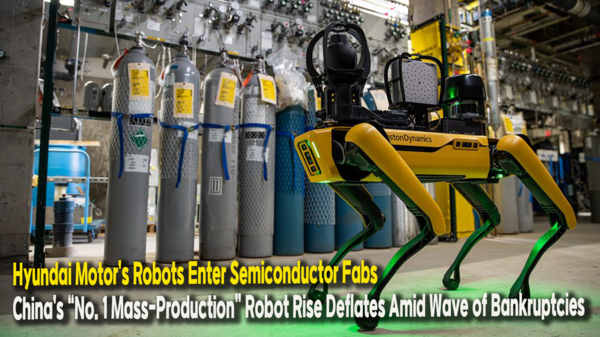
[Atlas Stands at the Threshold of a Semiconductor Fab]
Boston Dynamics, an affiliate of Hyundai Motor Group, is launching its first real-world pilot bringing its humanoid robot “Atlas” beyond automotive plants and into a semiconductor manufacturing facility. With this move, the benchmark for the South Korea–China humanoid race is shifting from “how many can be built” to “how reliably they can be deployed on the factory floor.” China is a mass-production powerhouse accounting for nearly 80 percent of global humanoid shipments. Yet beneath an industrial base inflated by state-backed capital and local government subsidies, more than 20 robotics firms have gone bankrupt or entered liquidation, and investment deals were cut in half in a single month. The contrast between Hyundai Motor Group—expanding its reach through step-by-step validation—and China’s robotics push, which prioritized scale around political targets, illustrates that victory in the physical AI era will ultimately be decided by on-site reliability and sustainable profitability.
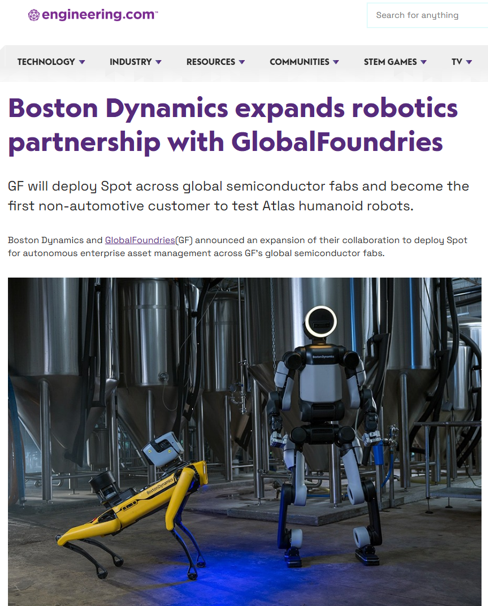
According to the U.S. manufacturing trade publication Engineering.com on the 18th, “Hyundai Motor Group’s U.S. robotics subsidiary Boston Dynamics is partnering with GlobalFoundries to begin field testing of its humanoid ‘Atlas’ at a semiconductor manufacturing facility in early 2027,” calling it “Atlas’s first customer deployment outside the automotive industry.” The partnership announced by the two companies on the 17th has two tracks. One is expanding the deployment of the quadruped robot “Spot,” already in operation, to facilities in New York and Vermont in the U.S., Dresden in Germany, and Singapore. The other is identifying tasks for Atlas, reviewing integration requirements with existing equipment, and conducting testing and training. The specific tasks Atlas will perform have not yet been disclosed.
Spot was the first to earn its report card. After operating Spot at its Vermont plant for more than four years, GlobalFoundries expanded deployment to Singapore. Since April, two Spot units in Singapore have traveled roughly 900 kilometers through the “sub-fab”—the utility and support level beneath the cleanroom production floor—carrying out more than 90,000 inspections. According to the company, the mission success rate reached 99 percent. In a semiconductor fab, even a minor equipment anomaly can trigger major production disruptions. Introducing a new robot therefore requires validating not only task execution, but also transit safety, equipment interoperability, and error-recovery protocols. The critical test is whether tasks proven in one plant can be replicated at the same standard in another. Spot demonstrated the commercial viability of this model, and Atlas must now prove it can do the same.
[South Korea’s Progress Validated Simultaneously on Auto and Chip Production Floors]
Zack Jackowski, Chief Product and Technology Officer (CPTO) at Boston Dynamics, emphasized that “companies like GlobalFoundries are generating tangible operational value through robotics while simultaneously accumulating data to drive future manufacturing innovation.” Hyundai Motor Group’s roadmap follows the same “validation-first” principle. The group unveiled the production-ready version of Atlas at CES 2026 in January this year. Its schedule calls for deploying Atlas at Hyundai Motor Group Metaplant America (HMGMA) in Georgia starting with parts sequencing in 2028 and expanding into assembly operations by 2030. Over the long term, the group plans to deploy more than 25,000 units across Hyundai and Kia factories and build annual production capacity of up to 30,000 units. However, analysts note that this year’s production output has been allocated entirely to partner firms, with no external commercial sales—meaning large-scale delivery performance remains to be proven.
[China’s 97% Shipment Dominance and the Trap of “1 Billion Yuan in Orders”]
China’s mass-production capability is evident in the numbers. According to market research firm Smart Analytics Global (SAG), cited by Bloomberg, Chinese companies accounted for more than 97 percent of global humanoid shipments in the third quarter of this year. Data from the International Federation of Robotics (IFR) shows that China installed 354,000 new industrial robots last year, representing 59 percent of global installations—a strength underpinned by agile supply chains and a massive domestic manufacturing base. However, shipment volume alone does not reveal where those robots are working, what tasks they perform, or how long they stay operational. According to Reuters, Geely Auto’s EV brand Zeekr tested UBTECH humanoids for material sorting and box transport at its Ningbo plant, yet core assembly line tasks are still handled by conventional robotic arms and automated guided vehicles. Even China’s front-runners remain at the stage of figuring out practical factory utility.
[The Shadow of China’s Robot Rise… Eight Months of the “Genius Corps”]
Behind the headline-grabbing shipment figures, the broader industrial foundation is cracking. Founded in February this year in Nanjing, quadruped robotics startup Wujing Dongli (无境动力) was hailed at launch as a “genius corps” composed of graduates from Tsinghua University, Zhejiang University, and Harbin Institute of Technology. Within four months of its founding, the firm signed framework agreements worth roughly 500 million yuan (about 100 billion won) with central state-owned enterprises and touted “1 billion yuan in orders” by adding preliminary local contracts. None of it was confirmed revenue. Even a 110 million yuan (about 22 billion won) investment publicized on the Jiangning District government’s website never materialized, as the promised industrial fund failed to disburse the capital. According to Chinese tech outlet 36Kr, the company began falling behind on wages in August and completely halted operations in October, leaving roughly 8 million yuan (about 1.6 billion won) in unpaid salaries owed to 30 to 40 employees.
Wujing Dongli is merely the tip of the iceberg. Yinghe Robotics (盈合机器人), backed by ByteDance and Meituan, posted a net loss of 67 million yuan (about 13.4 billion won) on revenue of just 4.33 million yuan (about 870 million won) last year. In late August, the Shenzhen Intermediate People’s Court accepted the company’s bankruptcy filing. DeepBlue Robotics (深兰机器人), once valued at 14 billion yuan (about 2.8 trillion won), also entered bankruptcy liquidation in May. A review of public reports and court filings indicates that over the 19 months since February 2025, more than 20 robotics companies across at least 11 subsectors have gone bankrupt, dissolved, entered liquidation, or shut their doors.
[State Capital That Drowned Out the Warnings]
This shakeout was entirely foreseeable. In its 2025 Government Work Report, Beijing designated “embodied intelligence” as a “future industry.” In November of that year, National Development and Reform Commission (NDRC) spokesperson Li Chao warned that the number of humanoid robotics firms had surpassed 150, cautioning that “a flood of similar products could erode research and development capacity.” Yet capital continued to pour in at an accelerating pace. From January to August this year, investment in China’s robotics sector reached 124.51 billion yuan (about 25 trillion won)—double the full-year figure for 2025—with local state-owned capital and government industrial funds leading many of the largest funding rounds. The same dynamic applies to AI chips, the “brains” of these robots. The U.S. Department of Justice recently indicted individuals over the illicit diversion of roughly $2.5 billion (about 3.3 trillion won) worth of Supermicro servers to China—stark evidence that despite slogans of “technological self-reliance,” China still depends heavily on American chips.
[Why Times Insight]
In Why Times’ assessment, what separates the two trajectories is less a technological gap than a difference in growth models. Hyundai Motor Group is expanding Atlas’s operational scope step by step, building on more than four years of operational data and customer trust earned through Spot.
By contrast, Xi Jinping’s leadership elevated robotics into a political mandate under the banner of “new quality productive forces.” As a result, local governments were evaluated not on actual industrial outcomes, but on investment-attraction headlines. Wujing Dongli—featured twice on its district government’s website while promoting framework agreements as firm orders and undelivered funds as completed investments—is a microcosm of that structural flaw.
For Xi’s leadership, the current turn of events is deeply awkward. The foundation of a sector officially designated as a “future industry” has begun to wobble in less than a year, while semiconductor smuggling cases have exposed the limits of Beijing’s “self-reliance” narrative. Both pillars of China’s technological rise have revealed vulnerabilities simultaneously. Why Times believes the leadership is likely treating this as a serious setback, as the capital poured into these ventures translates directly into losses for central development funds and local government coffers. Still, this does not signal the collapse of China’s entire robotics industry. Top-tier players such as Unitree remain formidable, and firms that survive the shakeout could emerge even more competitive on the back of cheaper components and deep domestic supply chains.
The implications for South Korea are equally clear. Atlas has yet to enter full-scale mass production, and Hyundai must back up its post-2028 targets with actual deliveries. Dismissing China’s mass production and price offensive as mere “bubble” would be a strategic miscalculation. If Hyundai Motor Group can accumulate real-world validation data inside demanding semiconductor fabs and prove both reliability and return on investment, it can carve out a distinct position as the provider of “proven humanoids”—setting itself apart from China’s volume-driven approach. Ultimately, the winner in physical AI will not be decided by who builds the most robots first, but by who survives on the factory floor until the end.


-중국 푸단대학교 한국연구원 객좌교수
-전 EDUIN News 대표
-전 OUR NEWS 대표
-제17대 대통령직인수위원회 정책기획팀장
-전 대통령실 홍보기획비서관
-사단법인 한국가정상담연구소 이사장
-저서: 북한급변사태와 한반도통일, 2012 다시우파다, 선거마케팅, 한국의 정치광고, 국회의원 선거매뉴얼 등 50여권



