Update2026.11.19 (목)

[Carney, Who Won Power Defying Trump, Seeks Gains in Beijing]
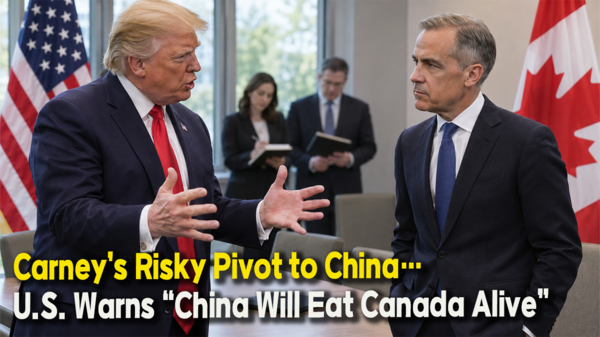
Canadian Prime Minister Mark Carney is colliding head-on with Washington after playing the “China card” as leverage to break through trade friction with the United States. On the 17th, Carney met with Chinese President Xi Jinping in Shenzhen, China, expanding an agreement to mutually lower tariffs, shortly after declaring that Canada could turn to Chinese automakers if negotiations with the U.S. fall apart. White House trade advisor Peter Navarro issued a blunt warning, stating that “China will eat Canada alive.” Criticism is mounting both at home and abroad that Carney’s outreach to Beijing—built on the back of anti-American sentiment—could endanger not only the U.S. market, which is the lifeline of Canada’s economy, but also national security.
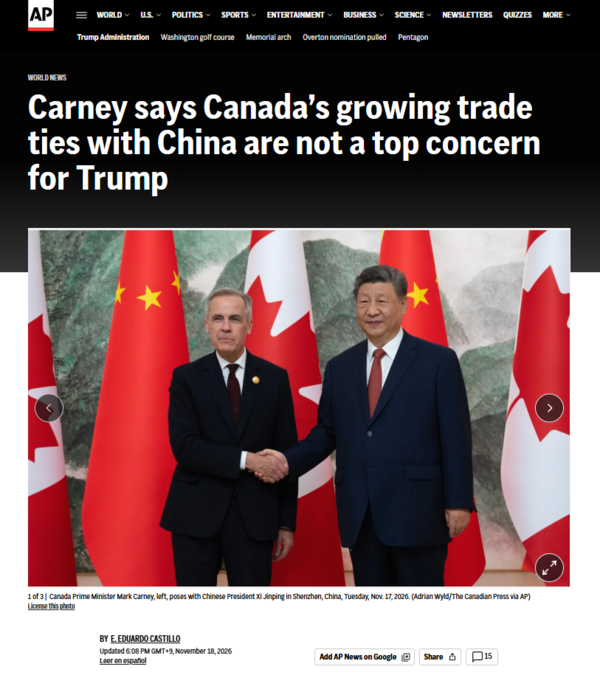
According to the Associated Press (AP) on the 18th (local time), “Canadian Prime Minister Mark Carney is colliding head-on with Washington after playing the 'China card' as leverage to break through trade friction with the United States,” adding that “Carney met with Chinese President Xi Jinping in Shenzhen on the 17th to expand an agreement to mutually lower tariffs, shortly after declaring that he could turn to Chinese automakers if talks with the U.S. collapse.”
The summit took place at the Qilin Villa State Guest House in Shenzhen ahead of the opening of the APEC Economic Leaders' Meeting. This marked the second time Carney has met Xi in China this year; his visit to Beijing in January was the first meeting between a Canadian prime minister and a Chinese president in eight years.
According to Reuters, China agreed to further reduce tariffs on approximately 400 million Canadian dollars (about 372.4 billion won) worth of Canadian exports, including frozen pork, fish, and seafood. Carney praised the move, stating that “greater predictability and stability have been established in bilateral relations,” and added, “We are well ahead of schedule on our goal to increase exports to China by 50 percent by 2030.”
The quid pro quo was equally clear. According to the Canadian daily The Globe and Mail, Canada reciprocated by extending for two years its remission of the 25 percent tariff on Chinese steel and aluminum facing domestic supply shortages, while adding 32 new product categories. In effect, Ottawa stepped back from the tariffs on Chinese steel that it had previously aligned with the United States.
The tariff war between the two countries began in October 2024 when Canada followed the U.S. in imposing 100 percent tariffs on Chinese electric vehicles (EVs) and 25 percent tariffs on Chinese steel and aluminum. Beijing retaliated with tariffs on Canadian canola, pork, and seafood. The tide shifted during Carney’s January visit to Beijing, where Canada secured tariff cuts on canola in exchange for allowing up to 49,000 Chinese EVs into the country annually at a 6.1 percent tariff rate. According to the Canadian Broadcasting Corporation (CBC), 16,211 Chinese EVs have entered Canada since March, roughly half of which were low-cost models priced at 35,000 Canadian dollars or less.
[“Chinese Cars If Talks Fail”… White House Strikes Back Head-On]
Yet what triggered the real political storm was not the tariff deal itself, but Carney’s remarks just prior to the summit. The AP reported that “Carney said in Phnom Penh, Cambodia, on the 16th that if negotiations with President Trump fail to preserve the integration of the North American auto industry, Canada could turn to Chinese automakers,” and that “when asked whether Chinese investment was being used as leverage in talks with the U.S., he replied, ‘It is not leverage,’ calling it simply ‘action and reaction.’” However, spoken amid U.S. threats of a 50 percent auto tariff, Washington interpreted the statement as an attempt to bring China in to check the United States.
White House advisor Navarro’s reaction was immediate. According to the CBC, “Navarro wrote on X, ‘Are you seriously threatening to pit China against the United States? Beyond insulting,’ warning that Carney should be far more worried about ‘China eating Canada alive.’” The CBC noted that Navarro posted the message in the form of a “memo” addressed to Prime Minister Carney. In the same post, he mocked Canada by writing, “It’s already happening. Vancouver is no longer British Columbia—it’s the People’s Republic of China.” British Columbia is Canada’s westernmost province on the Pacific coast, with Victoria as its capital and Vancouver as its largest city. U.S. Ambassador to Canada Pete Hoekstra amplified the message by reposting it.
This aligns with President Trump’s consistent stance. Immediately following Canada’s agreement with Beijing in January, Trump threatened 100 percent tariffs and ridiculed Ottawa, saying, “China is successfully and completely taking over Canada.” Carney was scheduled to meet with Trump for 20 minutes on the 18th, just before the APEC leaders' dinner, to continue trade discussions. Following the encounter, Carney stated that “President Trump wanted to gauge how far we have come with China and where we are heading,” while attempting to downplay its significance by claiming that “the China issue is by no means a top priority for President Trump.” Nevertheless, the very fact that Trump directly questioned Canada’s overtures to Beijing underscores Washington’s wariness.
[Revolt in Ontario, the Heartland of Auto Manufacturing]
Domestic pushback is being led by Ontario, the heartland of Canada’s automotive industry. Ontario Premier Doug Ford, who had previously supported Carney’s hardline stance against the U.S., urged the federal government to “handle the issue of Chinese involvement in the auto industry with caution.” According to Canada’s largest private broadcaster, CTV, Ford also demanded assurances that Chinese EV kits would not be assembled at the Brampton plant sold by Stellantis. Since the January agreement, Ford and the national union Unifor have warned that giving subsidized Chinese firms a foothold in the market would ultimately mean Canada is nurturing its own competitors. Ford also joined leaders of the Canadian Vehicle Manufacturers' Association (CVMA), the Automotive Parts Manufacturers' Association (APMA), and Unifor in calling for a boycott of Chinese EVs.
Criticism from a national security perspective is even more fundamental. Former diplomat Michael Kovrig, who was detained in China for over 1,000 days in retaliation for the arrest of Huawei CFO Meng Wanzhou, has warned that “China’s political agenda is hostile” and that “China must not be made the centerpiece of a trade diversification strategy.” During Carney’s visit to Beijing in January, Kovrig also remarked that “the Prime Minister’s tone and messaging are concerning.”
Contradictions are evident in Carney’s own record as well. In April 2025, Carney labeled China Canada’s “biggest security threat.” Earlier that same year, in January, a federal public inquiry identified China as the “most active perpetrator” of foreign interference targeting Canada’s democratic institutions. Yet within a year and a half, China has become a “strategic partner,” and security issues such as foreign interference were nowhere to be found among the publicly announced outcomes of the latest summit.
[The Ticking Time Bomb Known as USMCA]
The greatest risk involves the United States–Mexico–Canada Agreement (USMCA). According to the Council on Foreign Relations (CFR), U.S. Trade Representative (USTR) Jamieson Greer told Congress that “over the past year, only two countries have retaliated economically against the United States: China and Canada.” Article 32.10 of the USMCA provides a pathway for a member country to withdraw from the pact if another member pursues a free trade agreement with a “non-market economy” such as China. Carney has maintained that Canada is “not pursuing a free trade agreement with China.” However, as the list of tariff-reduced items expands and automotive cooperation is openly floated, it remains uncertain how persuasive that explanation will be in Washington.
[Why Times Insight]
Carney’s pivot toward China cannot be explained by economic logic alone. He rose to power in the 2025 general election riding a wave of anti-American sentiment—dubbed the “Elbows Up” mood—sparked by President Trump’s “51st state” remarks and tariff offensives. The image of a leader who refuses to bow to Trump is central to his political capital. Repeatedly touting deals with China as “achievements” and signaling to Washington that Canada “has alternatives” resonates with his domestic base as a symbol of defending national sovereignty. It is hard to deny that Carney’s China card serves simultaneously as a foreign policy strategy and a domestic political survival tactic.
The problem is that this calculation clashes directly with Canada’s structural interests. More than 70 percent of Canadian exports go to the United States. The newly secured tariff relief of 400 million Canadian dollars (about 372.4 billion won) pales in comparison to the scale of bilateral auto trade with the U.S. Opening the door to Chinese steel and creating the possibility of an influx of Chinese cars in exchange for such modest gains risks becoming an asymmetrical bargain—losing a massive market in pursuit of a small profit. China has already demonstrated its willingness to pressure Canada using tariffs on canola and pork. The deeper the dependence grows, the greater Beijing’s leverage becomes. Navarro’s phrase—“eaten alive”—may be crude, but it puts a finger directly on that asymmetry.
Anti-American sentiment that wins an election cannot substitute for a national strategy. With the fate of the USMCA hanging in the balance, the future of Canadian manufacturing will hinge on whether Prime Minister Carney chooses domestic approval ratings or the national interest.

-중국 푸단대학교 한국연구원 객좌교수
-전 EDUIN News 대표
-전 OUR NEWS 대표
-제17대 대통령직인수위원회 정책기획팀장
-전 대통령실 홍보기획비서관
-사단법인 한국가정상담연구소 이사장
-저서: 북한급변사태와 한반도통일, 2012 다시우파다, 선거마케팅, 한국의 정치광고, 국회의원 선거매뉴얼 등 50여권