Update2026.11.19 (목)

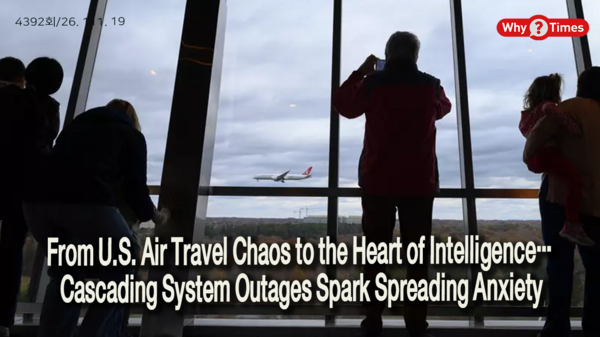
[Reaching the Heart of Intelligence… “Occurred During a Routine Patch”]
The U.S. National Security Agency’s (NSA) classified internal network, “NSANet,” was paralyzed on the 17th (local time) during a security patch operation. The chain of incidents that began on the 12th with a Microsoft (MS) cloud outage has now sequentially halted five pillars supporting the United States in just six days: corporate enterprise networks, air traffic control, financial payments, national intelligence networks, and consumer services. U.S. intelligence authorities drew a line against external hacking or a coordinated attack by a specific nation-state. Yet that very fact raises a heavier question, as it revealed that a superpower’s core systems can grind to a halt one after another through routine maintenance alone, without any enemy attack. At the heart of the problem lies a dual structure—modern software layered atop decades-old legacy hardware—combined with tightly interwoven networks. Compounded by the high-speed patch race of the artificial intelligence (AI) era, the “maintenance paradox,” in which the very act of fixing a system triggers an outage, has emerged as a new vulnerability in America’s digital infrastructure.
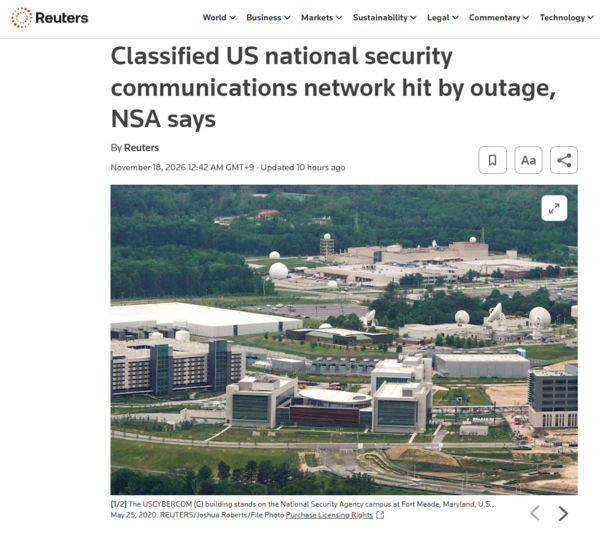
Reuters reported on the 18th that "an outage occurred on the U.S. National Security Agency’s classified internal communications network during routine maintenance," noting it came "four days after the Federal Aviation Administration (FAA) grounded flights nationwide due to an air traffic control network malfunction." Around the same time, Microsoft’s business services and some banking operations at JPMorgan Chase also experienced disruptions. The NSA stated that its core missions continued uninterrupted, and U.S. intelligence officials explained they found no signs of a coordinated cyberattack. Yet how did replacing telecommunications equipment at a single outlying facility bring takeoffs across the entire United States to a standstill?
NSANet is a top-secret closed network through which NSA personnel exchange classified information internally. When the network went down early that morning, the agency’s Fort Meade headquarters in Maryland staggered employee arrival times. CNN first reported the outage citing anonymous sources, and a U.S. government official familiar with the matter subsequently pointed to a “routine system patch” as the cause.
In a statement, the NSA said there was a “temporary performance degradation during scheduled routine maintenance,” adding that “mission-essential functions remain fully operational.” The New York Times (NYT) reported that “NSANet had already been unstable for weeks, fueling internal frustration.” Thanks to multi-layered redundant networks, intelligence briefings for President Donald Trump—currently on an Asian tour—and intelligence sharing with “Five Eyes” allies were reportedly unaffected. President Trump brushed off the incident, remarking, “Those things can happen.”
The nation’s intelligence chief also stepped in to quell concerns. In an interview with CNBC, Director of National Intelligence (DNI) Jay Clayton said, “It is not a cyberattack, nor is it a coordinated nation-state effort. We have looked at it very closely.” Speaking to Fox Business, he added that he was “fairly confident” because officials knew such attacks exist and actively looked for signs of one.
[Six Days of Dominoes… Different Causes, Same Structure]
The chain reaction began on the 12th at Microsoft. The outage that started that day halted Microsoft 365 services—including Outlook, Teams, and Copilot—with the final customer not restored until the 14th. Microsoft explained that an issue introduced during an earlier network capacity upgrade surfaced during a subsequent network change.
The following day, the 13th, the skies were shut down. According to the FAA, instability began at 17 of the nation’s 22 Air Route Traffic Control Centers and spread to several airport terminal radar approach control facilities. The cause was roughly 1,000 connection attempts every four to five seconds flooding the telecommunications infrastructure (FTI), destabilizing legacy equipment. A radar site in Amarillo, Texas, and a radio communications facility in El Dorado, Arkansas, were identified as the points of origin. In El Dorado in particular, network operator L3Harris Technologies was in the middle of installing a new router. The FAA subsequently disabled the corresponding feature on about 60 Juniper routers with the same function and halted installations—a single piece of new equipment had rattled the entire aging network. Roughly 3,500 aircraft airborne at the time of the incident all landed safely.
On the 16th, the financial sector was shaken. JPMorgan Chase, the largest U.S. bank, stated that a software bug in its on-premises hardware system was to blame. On Downdetector, a site that tracks internet service disruptions in real time via user reports, complaints involving Chase surged to nearly 5,000 around 2 p.m. Customers of Bank of America and Wells Fargo also experienced inconveniences, though most stemmed from delays in transactions linked to Chase—a single flaw spreading across payment rails to affect customers of other banks. That same day, United Airlines also suffered departure delays due to a temporary computer glitch. On the 17th, following the NSA, Apple experienced simultaneous outages across iCloud, the App Store, Apple Pay, and its internal virtual private network (VPN) immediately after an internal system update.
[Systems Layered Like Geological Strata… “Vulnerable Enough to Collapse Without an Attacker”]
The five major entities hit by outages varied in both their nature and the immediate triggers of their failures. Yet experts point to a common root. Having led the global digital industry earliest and longest, the United States evolved its banking, transportation, and administrative networks by layering new software atop mid-20th-century hardware and early programming languages. A prime example is COBOL, developed as a stopgap in 1959, which still processes more than $1 trillion (about 1,330 trillion won) in financial transactions every day. Having digitized first means standing on the oldest foundations—the price of moving ahead of everyone else, known as “first-mover debt.”
Christiaan Beek, a researcher at cybersecurity firm Rapid7, told Bloomberg that “complex systems fail far more often for boring, mundane reasons than because of external adversaries.” He warned, “Worryingly, this means the systems America relies on are fragile enough that we can take them down ourselves without an attacker.”
Cynthia Kaiser, a former Federal Bureau of Investigation (FBI) official now serving as vice president at security firm Halcyon, also told Reuters that “the recent large-scale outages across industries show how deeply interconnected America’s digital infrastructure is.” She assessed them as “a clear demonstration of how a single technical error or failed software update can cascade into massive consequences across critical systems.” The more tightly woven the system, the harder it becomes to contain a failure in one place.
AI has added another variable to the mix. Anticipating hackers armed with AI, companies and agencies are uncovering vulnerabilities in legacy systems at unprecedented speeds and rushing to deploy patches. According to domestic reports, the NSA itself suffered its outage while rolling out a patch to close a remote server control vulnerability discovered by AI. Director Clayton acknowledged that “everyone recognizes it is time to upgrade our systems,” while conceding that “just because you carry out an upgrade does not mean the system recovers as expected every time.” Joe Slowik, a director at threat intelligence firm Dataminr, pointed out that organizations “have neglected investing in redundant backup architectures that could step in and prevent a worst-case scenario—whether from an error, a bad update, or even a cyber incident.” Critics also note that recent sweeping layoffs at the FAA, United Airlines, and Microsoft have widened gaps in experienced personnel.
[Sold-Out Generators and Panic Buying… Technical Glitches Turn into Social Anxiety]
Technical failures quickly spilled over into consumer sentiment. According to Mizuho Securities, 21 out of 26 high-end generator models on Costco’s online store were sold out as of the 15th, including a $7,000 (about 9.32 million won) Kohler unit. Costco Chief Financial Officer (CFO) Gary Millerchip noted that “around late October, we began seeing increased purchasing in certain categories such as rice, canned foods, bottled water, paper products, generators, and batteries.” Mizuho raised its price target on Costco from $1,100 to $1,150. When the Federal Emergency Management Agency (FEMA) announced a routine test of the Emergency Alert System (EAS)—conducted at least once every three years—rumors of an impending “nationwide blackout” even circulated online.
Stockpiling movements had already been emerging overseas. Last month, the United Kingdom launched its “Be Ready” campaign encouraging citizens to keep three days’ worth of supplies on hand. According to retail market research firm Worldpanel by Numerator, sales of hand sanitizer rose 83%, bottled water 67%, and canned and jarred goods 37% afterward. In Japan, ahead of the launch of its Disaster Management Agency, Disaster Management Minister Goshi Hosono urged residents to stockpile at least three days—and ideally a week—of supplies, driving emergency food sales at retailer Cainz up more than tenfold. By contrast, Vice President JD Vance moved to calm public anxiety, saying, “A lot of friends have asked me if they should build a bunker or stockpile food and water, and my answer has been ‘no.’”
[A Warning from 26 Years Ago Repeats Itself]
This episode is not unfamiliar. From January 24 to 28, 2000, the NSA also suffered a shutdown of its internal computer network that halted intelligence processing. At the time, then-Director Michael Hayden pointed not to hackers or hostile nations, but to a software “anomaly” in a complex network operating near its capacity limits. The NSA’s post-mortem report likewise concluded there was no evidence of malicious activity, tracing the root cause to internal capability gaps in building, maintaining, and managing vast, intricate networks. A quarter-century has passed, yet the diagnosis remains virtually unchanged.
[Why Times Insight]
First, “no attack” is not grounds for reassurance—it is a warning. Ruling out a cyberattack is important as a matter of fact, yet strategically it leads to a far more uncomfortable conclusion. If critical networks can be halted without an external adversary lifting a finger, hostile actors can treat this chain of outages as a “free reconnaissance report” revealing single points of failure across U.S. infrastructure. The mere public exposure of which specific function on which router can destabilize the entire national air traffic control network carries a real security cost.
Second, patching cannot stop; the real issue is designing systems that can withstand disruption. Slowing down patch cycles is not an option in an AI-driven cyber threat race. Particularly as state-backed hacking groups in authoritarian countries such as China automate vulnerability discovery with AI, delaying updates invites far greater danger. The solution is not decelerating, but reinvesting in isolation architectures that contain failures within a single zone, redundancy, and skilled operational staff. Companies and agencies must examine whether efficiency-driven management focused on cost cutting and headcount reductions is eroding the invisible asset of resilience.
Third, South Korea is no exception. South Korea has already experienced similar lessons through the paralysis of its government administrative network in November 2023 and the fire at the National Information Resources Service in September 2025. Although South Korea started later than the United States, its compressed, rapid digitization accumulated its own debt by prioritizing expansion over redundancy. America’s six-day ordeal should be read as a signal for South Korea to re-examine the redundancy levels and fault-isolation frameworks of its public and financial infrastructure.

-중국 푸단대학교 한국연구원 객좌교수
-전 EDUIN News 대표
-전 OUR NEWS 대표
-제17대 대통령직인수위원회 정책기획팀장
-전 대통령실 홍보기획비서관
-사단법인 한국가정상담연구소 이사장
-저서: 북한급변사태와 한반도통일, 2012 다시우파다, 선거마케팅, 한국의 정치광고, 국회의원 선거매뉴얼 등 50여권