


Update2026.11.19 (목)

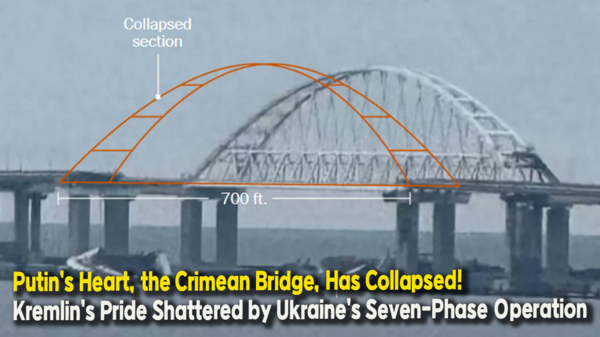
[The Bridge Putin Personally Crossed Collapses Arch and All]
The Crimean Bridge, long touted by President Vladimir Putin as a "trophy" of Russia's 2014 seizure of the Crimean Peninsula, collapsed in a precision Ukrainian strike early on November 17 (local time). In the final blow of a weeks-long, seven-phase operation, a 227-meter road arch plunged into the Kerch Strait, and the railway section also sustained heavy damage. For Putin, who personally drove a truck across the bridge at its 2018 opening ceremony, the incident is a political humiliation that goes far beyond a military loss. The Kremlin's boast that the bridge was the "most heavily defended facility on Earth" crumbled before Ukrainian-made missiles, unleashing a wave of mockery and anger toward the leadership inside Russia. With repairs projected to take more than a year, the Crimean Peninsula faces isolation, effectively cut off from the mainland like an island.
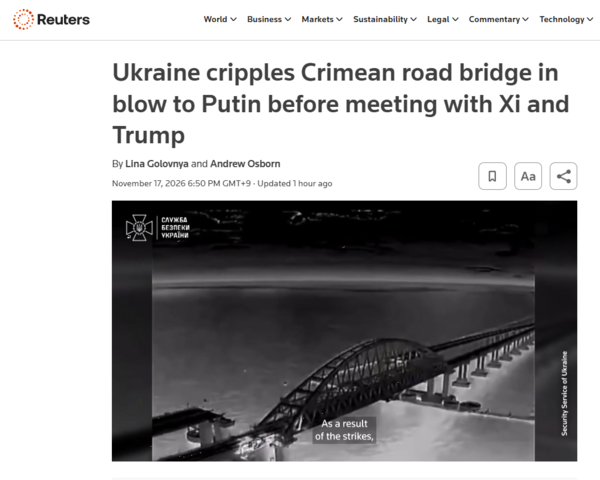
Reuters reported on November 17 (local time) that "the central road section of the Crimean Bridge was destroyed in a Ukrainian drone and missile attack." Videos and photos verified by Reuters showed a massive road arch fallen into the sea, leaving a gaping void in the middle of the bridge. Beyond mere surface damage, the strike caused a structural collapse that severed the road connection itself.
The 19-kilometer Crimean Bridge links southern Russia to the Crimean Peninsula across the Kerch Strait. Built after Russia's forcible annexation of Crimea in 2014, its road section was inaugurated in 2018 with Putin himself behind the wheel of a truck. It was a political declaration—that Crimea was permanently bound to Russia—cast in concrete and steel. Seeing the arch of that very bridge collapse is a particularly painful symbolic blow to Putin.
The Security Service of Ukraine (SBU) announced that "one metal arch and the road deck beneath it have been completely destroyed." An important distinction must be made here: the entire 19-kilometer Crimean Bridge did not collapse. Rather, a core structural span of the road section gave way, and the railway section was damaged.
[Not a Fluke Breach… A Month-Long ‘Seven-Phase Operation’]
Ukrainian President Volodymyr Zelenskyy stated that the attack was the "seventh phase of an operation that has been underway for weeks." He explained, "Our forces systematically destroyed air defense systems, radars, electronic warfare equipment, and other designated targets along the path to the final objective." In other words, Ukraine spent weeks dismantling surrounding air defenses before striking the bridge itself. In the final assault, Palianytsia drones targeted the road section, while Neptune cruise missiles, Ruta drones, and Fire Point's FP-5 Flamingo cruise missiles hit the railway section. Following drone strikes on November 16, the final barrage began around midnight. Vladyslav Vlasiuk, the Presidential Commissioner for Sanctions Policy, wrote on X: "Crimean Bridge. Sanctioned."
[Putin’s 'Trophy': Why This Bridge Matters]
From the outset, the Crimean Bridge was never merely a piece of transportation infrastructure. The $4 billion construction project, which broke ground in 2016, was awarded to Stroygazmontazh (SGM), a company owned by Putin's longtime judo partner Arkady Rotenberg. According to The Moscow Times, SGM had zero prior experience building bridges. To pour resources into this project, Russia even delayed domestic infrastructure initiatives, such as the Lena River bridge in Siberia. The international community condemned the bridge in UN General Assembly Resolution 73/194 in 2018 for facilitating the militarization of Crimea, and the United States and the European Union imposed sanctions on the companies involved in its construction.
The bridge was previously struck by a truck bomb in October 2022, sea drones in July 2023, and underwater explosives in June 2025. Following the June 2025 incident, Kremlin spokesperson Dmitry Peskov insisted that "nothing was damaged and the bridge is operating." This time, however, the steel arch spanning the shipping channel collapsed entirely into the water. The SBU pointedly remarked, "For years, Russia tried to convince the world that the Crimean Bridge was one of the most heavily protected facilities on Earth, yet today part of it lies at the bottom of the sea."
[“Putin’s Favorite Toy”… Anger Erupts Inside Russia]
The pro-government Telegram channel Rybar initially sought to downplay the incident, claiming the "damage is not critical." However, once photos of the collapse began circulating, the mood shifted sharply. Military blogger Yuri Kotenok lashed out at experts who had repeatedly assured the public that the bridge was virtually indestructible, telling them to "take down your signs and stop pretending to be experts." User comments were even harsher. Recalling Putin's past boast that Russia was "ready for war with the EU right now," one commenter jeered, "Yeah, Volodya [a diminutive for Putin], we're seeing just how ready you are!" Another referred to the bridge as "Putin's favorite toy." Another comment read, "The Crimean Bridge was built to suit the profit-making standards of the Rotenberg clan," criticizing how crony profiteering had created a glaring security vulnerability.
While the aviation channel Fighterbomber tried to reassure supporters by arguing that "the Crimean Bridge is not destroyed, only out of service," it estimated that "installing a new arch alone will take about 54 hours, plus another three weeks to secure it." The channel then asked, "And what is going to stop Ukraine from targeting a second arch the very next night?" Some called for retaliation, including the use of non-conventional weapons or strikes with Oreshnik missiles. A mix of helplessness and hardline fury is spreading among Kremlin supporters.
[NATO Reconnaissance Plane Controversy: “Did the U.S. Help?”]
Russian bloggers are pinning the blame for the failure on the West. According to the Kyiv Post, on November 16, a U.S. Air Force RC-135U Combat Sent electronic reconnaissance aircraft flew over the Black Sea to within about 80 kilometers south of Crimea, while a NATO E-3A airborne early warning aircraft orbited over Bulgaria. The Combat Sent is specialized in gathering intelligence on adversary air defense radars. Blogger Alexey Vasiliev claimed, "NATO reconnaissance planes assessed the capabilities of our air defense network without facing any hindrance." However, no evidence has been made public proving a direct link between the reconnaissance flights and the attack.
[Crimea Becoming an Island, Shifting the Negotiating Landscape]
Aviation expert Andrii Kharuk told The Kyiv Independent, "Restoring this section will take not months, but a year, or perhaps even longer," adding that it "effectively turns Crimea into an island." Although Russia has rerouted heavy cargo along the roughly 700-kilometer "Novorossiya Highway" running through occupied territory, that overland route remains a constant target for Ukrainian drones. Emil Kastehelmi of Finland's Black Bird Group noted, "This bridge was Russia's emergency corridor for urgent transport," and "that option is now gone."
The timing of the strike is also significant. Ukraine, Russia, and the United States had just agreed to a large-scale prisoner exchange during trilateral talks in Abu Dhabi on November 10–11. Tomas Jermalavičius of the International Centre for Defence and Security (ICDS) said, "This attack shakes up the fait accompli surrounding Crimea and strengthens Ukraine's negotiating position," describing Crimea for Moscow as "a suitcase without a handle." He added that "for Putin, this is a major dent in his image as a leader who always wins." Polish Foreign Minister Radosław Sikorski posted on X, "Looks like Ukraine holds a good hand of cards"—a direct retort to President Donald Trump's past remark that Ukraine "doesn't have the cards."
[Why Times Insight]
The Crimean Bridge was a physical monument in concrete and steel to Putin's political narrative as a leader who "reclaimed lost lands." Consequently, this collapse is far more than the severing of a supply line; it is the collapse of the very structure underpinning that narrative. The fact that Ukraine pulled this off using domestically produced weapons like the Flamingo and Neptune—without U.S. long-range munitions or German Taurus missiles—stings the Kremlin even more deeply, as it undermines Russia's calculation that "Ukraine will collapse once Western arms shipments stop."
Equally notable is that the bridge's origins as a lucrative contract handed to Putin's inner circle have become a focal point of domestic Russian criticism. If the perception that crony economics directly led to a major security failure is openly spreading among military bloggers, it represents a fracture that the Kremlin will struggle to contain. Moving forward, Russia's longstanding premise at the negotiating table—that "Crimea is off the table"—is likely to carry a far steeper price.


-중국 푸단대학교 한국연구원 객좌교수
-전 EDUIN News 대표
-전 OUR NEWS 대표
-제17대 대통령직인수위원회 정책기획팀장
-전 대통령실 홍보기획비서관
-사단법인 한국가정상담연구소 이사장
-저서: 북한급변사태와 한반도통일, 2012 다시우파다, 선거마케팅, 한국의 정치광고, 국회의원 선거매뉴얼 등 50여권



