Update2026.11.17 (화)

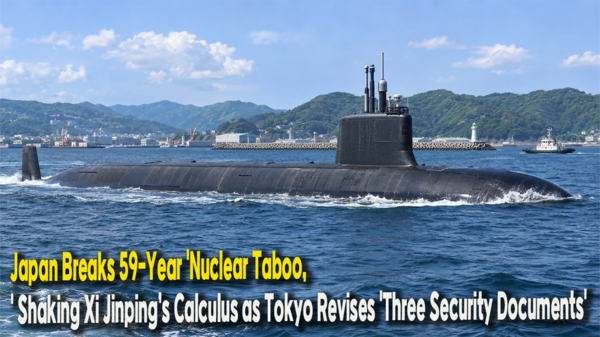
[Takaichi administration considers codifying wartime nuclear introduction exception in revised 'Three Security Documents']
Japan is considering establishing a wartime exception to its 59-year-old principle of not allowing nuclear weapons into its territory. The plan involves explicitly stating in security documents slated for revision at the end of the year that Japan could allow temporary port calls by U.S. vessels carrying nuclear weapons if deemed unavoidable for the country's defense. This effectively elevates an "informal leeway"—previously existing only in cabinet ministers' parliamentary responses—into a formal national strategy document. Behind this move lie China’s rapid expansion of nuclear and submarine forces, North Korea’s advancing nuclear capabilities, and deepening military cooperation among North Korea, China, and Russia. Beijing has been building up its nuclear arsenal to raise the cost of U.S. intervention. If Japan expands the operational options for U.S. nuclear forces, Beijing will be forced to recalculate how far the U.S. and Japan might go in a crisis.
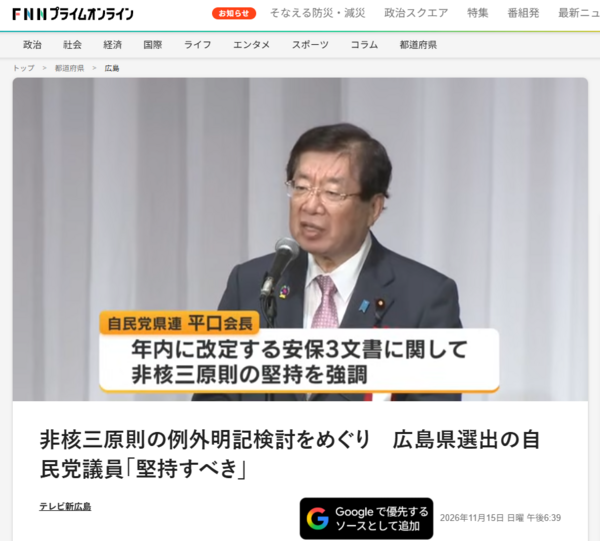
Japan’s Fuji News Network (FNN) reported on the 15th that "Hiroshi Hiraguchi, head of the Liberal Democratic Party’s (LDP) Hiroshima prefectural chapter, stated his position that the Three Non-Nuclear Principles must be upheld regarding the government's review of codifying a nuclear introduction exception." Minoru Terada, a House of Representatives member who leads an intra-party parliamentary group on atomic bomb issues, also insisted that "the principle of banning introduction must be maintained." Earlier, on the 14th, TBS reported that "there is a strong likelihood that the security documents will incorporate the spirit of a 2010 government parliamentary response that left room to allow temporary port calls in an emergency." Wording that was being reviewed inside the government has now spilled over into an open debate within the ruling party.
[History of a half-century 'national policy' and its long-standing fractures]
The Three Non-Nuclear Principles were introduced in 1967 by then-Prime Minister Eisaku Sato. Comprising pledges not to possess, not to manufacture, and not to permit the introduction of nuclear weapons, they became the foundational policy of postwar Japan’s nuclear stance following a 1971 Diet resolution. The current debate centers on the scope of the third principle.
From the outset, this principle existed in tension with the reality of relying on the U.S. nuclear umbrella. A 2010 investigation by the Democratic Party of Japan government officially confirmed that during the Cold War, the U.S. and Japan had entered into a secret pact that effectively exempted port calls and transits by nuclear-armed vessels from prior consultation. The issue receded from view after the George H.W. Bush administration removed tactical nuclear weapons from naval vessels in 1991.
However, the situation changed when the U.S. Navy decided to develop the nuclear-armed sea-launched cruise missile (SLCM-N) and deploy it aboard Virginia-class nuclear-powered attack submarines in the early 2030s. Under the current principles, these submarines could neither enter Japanese ports nor transit Japanese territorial waters. This is why Nippon Ishin no Kai (the Japan Innovation Party), in its June policy recommendations, cited the SLCM-N in calling for the establishment of conditions allowing port calls by nuclear-armed U.S. nuclear submarines.
[The language of 'lifting the taboo' built by Takaichi and Koizumi]
Prime Minister Sanae Takaichi’s views have long been consistent. In her books, she has argued that "while the bans on possession and manufacture must be kept, the 'ban on introduction,' which blocks even the entry of nuclear-armed vessels while relying on the U.S. nuclear umbrella, does not match reality." Her logic is that in an extreme crisis, this restriction could become an obstacle to national defense. At the same time, at the 81st anniversary ceremonies of the Hiroshima and Nagasaki atomic bombings in August, she reiterated that her government "upholds the three principles as a matter of policy." It is a dual strategy of preserving the banner of the principles while pragmatically altering their substance.
Cabinet discourse has also advanced step by step. On July 17, Defense Minister Shinjiro Koizumi remarked on the internet broadcast Genron TV that while nuclear issues are difficult to discuss in Japan, they are an unavoidable topic. Following a meeting with NATO Secretary General Mark Rutte in Brussels on the 22nd, Koizumi stated that "discussions on security policy, including nuclear deterrence, must move forward without taboos," citing France’s nuclear buildup and Finland’s lifting of its nuclear ban. Former Prime Minister Shinzo Abe had previously raised the idea of "nuclear sharing" with the United States in 2022, and former Defense Minister Itsunori Onodera also publicly urged a review of the three principles late last year.
[Why now? China tightens the vise simultaneously beneath the waves and in the skies]
What is accelerating Japan’s decision above all is China’s military expansion. According to Naval News, Vice Admiral Chris Cavanaugh, Commander of Submarine Force, U.S. Pacific Fleet, revealed at the Naval Submarine League’s 2026 Annual Symposium that "the Chinese Navy has commissioned eight Type 093B nuclear-powered attack submarines in less than four years."
The United States is closely watching the possibility that China could build another 20 to 40 submarines, including improved variants, over the next decade. The U.S. Office of Naval Intelligence (ONI) has assessed the Type 093B—equipped with 24 vertical launch tubes—as "the Chinese Navy’s most capable operational attack submarine." American undersea dominance can no longer be taken for granted.
Warning bells are ringing louder in the air as well. In a satellite imagery analysis released on the 11th, the Mitchell Institute for Aerospace Studies reported that approximately 279 aircraft were visible in the open across 11 air bases in western China. Including aircraft inside hangars, the total likely exceeds 300—roughly triple the usual deployment of 80 to 100 planes. The institute assessed this buildup as part of the People's Liberation Army Air Force’s large-scale annual exercise, "Red Sword 2026." Y-20 transport planes and aerial tankers arrived first in mid-October, followed by J-20 stealth fighters, J-10 and J-16 fighters, H-6 bombers, and KJ-500 airborne early warning aircraft. The sequence of laying down logistics infrastructure first before deploying mixed air wings indicates rehearsals for sustained air operations lasting several weeks. The scale also surpassed last year’s exercise, which involved around 200 to 250 aircraft across eight bases.
North Korea remains a constant threat. Estimates of North Korea’s nuclear warhead stockpile vary—from the 57 warheads mentioned by President Trump to the South Korean government’s assessment of 80 to 120—but there is no dispute that the arsenal is growing. Japan’s 2026 Defense White Paper noted that China’s DF-26 missiles put both Japan and Guam within range and are capable of carrying nuclear warheads. Meanwhile, existing restrictions have imposed costs on alliance cooperation. According to The EurAsian Times, the French nuclear-powered aircraft carrier Charles de Gaulle visited three Southeast Asian nations during its 2024–2025 Indo-Pacific deployment, yet never made a single port call in Japan.
[The 'nuclear latch' unlocked first in Europe]
Japan’s move is not an isolated development. On June 17, Finland’s parliament amended its Nuclear Energy Act and Criminal Code—which had imposed a blanket ban on the import, transit, and storage of nuclear weapons—to permit them when necessary for national defense. The bill passed by a vote of 125 to 61 and took effect in July. Defense Minister Antti Häkkänen declared that Finland is now "able to fully utilize NATO’s nuclear deterrence." On September 22, Lithuania’s parliament passed a bill by 99 votes to repeal Article 137 of its constitution, which prohibited weapons of mass destruction and foreign military bases, initiating the constitutional amendment process.
The catalyst was French President Emmanuel Macron unveiling a new nuclear doctrine in March that included the temporary deployment of nuclear-armed strategic air forces to allied nations. Sweden is also holding preliminary talks on nuclear cooperation with France and the United Kingdom and maintains that nuclear weapons could be stationed on its territory in wartime. Northern European nations bordering Russia and Japan—hemmed in by China, North Korea, and Russia—have arrived at the same conclusion: keep nuclear weapons out in peacetime, but leave the door open in an emergency.
[Last-minute variables in the Three Security Documents]
The revision of the three documents was also a key agenda item at the 2026 Korea-Japan International Academic Conference held in Seoul on the 13th. One participant observed, "With threats converging from three directions—North Korea, China, and Russia—there is a palpable sense of urgency in Japan that they no longer have any room to spare, unlike in the past." Another participant analyzed that the revision aims to integrate the U.S.-Japan alliance further at the operational level while broadening ties with Australia and the Philippines to hedge against U.S. uncertainties. Indeed, the U.S. and Japan are already restructuring their command architecture to designate U.S. Forces Japan as the counterpart to the Self-Defense Forces’ Joint Operations Command.
Money remains a key variable. Conference participants noted that defense spending increases could be constrained by potential friction with Prime Minister Takaichi’s signature pledge to cut the consumption tax on food, suggesting the five-year defense budget starting in fiscal 2027 is being negotiated around 60 trillion yen—10 trillion yen below the Defense Ministry’s target. Conversely, Reuters and the South China Morning Post (SCMP) reported that the government and ruling coalition are considering a budget of 70 trillion to 80 trillion yen, roughly 1.8 times the current plan of about 43 trillion yen, highlighting conflicting figures. Reports have also emerged that negotiations over host-nation support are hitting snags after the U.S. demanded Japan triple its financial contribution for hosting American troops. Within the LDP, concerns persist that port calls by nuclear-armed vessels could heighten tensions with neighboring countries, while Nippon Ishin no Kai is pushing for a more proactive debate, setting the stage for a tug-of-war over the final wording.
[The Korean Peninsula moves in the opposite direction… Diverging choices of South Korea and Japan]
South Korea is walking a different path. Since all U.S. tactical nuclear weapons were withdrawn at the end of 1991, calls for redeployment or nuclear sharing have persisted mainly among conservatives, yet the Lee Jae-myung administration has ruled out tactical nuclear redeployment, nuclear sharing, and indigenous nuclear armament alike. The Vice Minister of National Defense also testified before the National Assembly in September that none of the three options is under consideration. While Japan is putting in place a legal framework to open its ports and territorial waters to U.S. nuclear forces in an emergency, South Korea has chosen to keep that door firmly shut.
[Why Times Insight]
First, Beijing’s strategic calculus is being shaken. The essence of this measure is not "Japan’s nuclear armament," but legally securing "forward operating space" for U.S. nuclear forces. Until now, China could factor Japan’s Three Non-Nuclear Principles into its calculations as a kind of "padlock" placed on American nuclear deterrence. If U.S. nuclear submarines armed with SLCM-Ns are able to resupply at Yokosuka or Sasebo in a contingency and head straight into the East China Sea through Japanese territorial waters, the nuclear variables the Chinese Navy must contend with across the Taiwan Strait and the First Island Chain will multiply dramatically. As an asymmetric counter to the regional dominance Beijing has built through the mass production of Type 093B submarines and "Red Sword"-scale air exercises, this is unwelcome news for Beijing.
Second, framing the move as an "exception" makes it all the more potent. Scrapping the three principles outright would invite fierce domestic backlash and head-on criticism under the Nuclear Non-Proliferation Treaty (NPT) regime. Leaving the principles intact while carving out a wartime exception minimizes political costs while capturing virtually the full deterrent effect. It follows the exact same design as Finland’s rationale: unnecessary in peacetime, yet legally prepared for deterrence. The fact that this identical logic is spreading simultaneously across Europe and Asia in the same year marks the single biggest shift in the 2026 extended deterrence landscape.
Third, Seoul must carefully weigh the questions this poses for South Korea. If South Korea closes off all nuclear options on its own while Japan is integrated as an "operational hub" for U.S. nuclear forces, the center of gravity for American nuclear operations during a Korean Peninsula contingency could tilt toward Japan. The time has come for Seoul to provide a strategic answer on where and how it will secure the credibility and effectiveness of extended deterrence.

-중국 푸단대학교 한국연구원 객좌교수
-전 EDUIN News 대표
-전 OUR NEWS 대표
-제17대 대통령직인수위원회 정책기획팀장
-전 대통령실 홍보기획비서관
-사단법인 한국가정상담연구소 이사장
-저서: 북한급변사태와 한반도통일, 2012 다시우파다, 선거마케팅, 한국의 정치광고, 국회의원 선거매뉴얼 등 50여권