
Update2026.11.16 (월)


[China’s Technology Intelligence Network Revealed Behind the Nvidia Controversy]
The scandal surrounding Nvidia CEO Jensen Huang is not a matter that ends as a personal indiscretion. The incident has exposed the fact that China is mobilizing its entire national capacity to get its hands on Western artificial intelligence (AI) and semiconductor technologies. U.S. intelligence authorities assessed that a Singaporean corporate executive close to CEO Jensen Huang was an intelligence asset of China’s Ministry of State Security (MSS). Around the same time, China extracted the capabilities of U.S. AI models using tens of thousands of disguised accounts, hacking groups attacked Taiwanese universities, and a front research institute lured over 100 British scholars with research grants. The targets of these operations are chips, models, laboratories, and the people who drive those technologies. Western intelligence agencies estimate that behind this effort lies a Chinese intelligence and security workforce of up to 600,000 personnel.
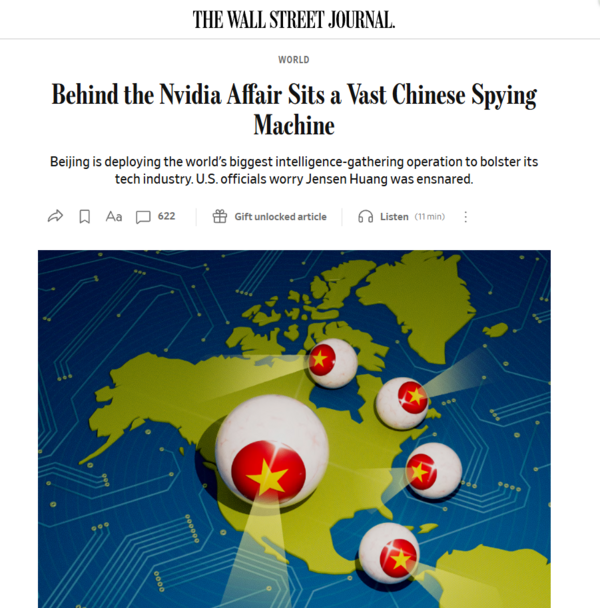
In an in-depth report on the 14th, The Wall Street Journal (WSJ) reported that "China has mobilized government agencies and private enterprises to acquire Western cutting-edge technology," adding that "it is utilizing not only human contact by intelligence agents and hacking, but also strategic corporate investments and research funding in sensitive fields." A European intelligence agency cited by the WSJ estimated the number of personnel working in China’s intelligence and security sectors at up to 600,000. This is a scale difficult to match even if the personnel of major U.S. and European intelligence agencies were all combined.
The gap in the cyber domain is even wider. The U.S. Federal Bureau of Investigation (FBI) assesses that "the number of hackers backed by the Chinese government is at least 50 times the FBI's entire cyber workforce." Former FBI Director Christopher Wray warned during his tenure that "China’s hacking program is larger than that of every other major nation combined."
More threatening than the sheer scale is the structure. China’s intelligence activities are not the sole purview of the Ministry of State Security. The military, public security, state-owned enterprises, private cybersecurity firms, universities, and research institutes operate in a decentralized structure where each acts as an intelligence collection window. China’s National Intelligence Law, enacted in 2017, obligates all organizations and citizens to cooperate with national intelligence work. Because investment, joint research, talent recruitment, and hacking are bound together under a single national objective, the traditional Western counterintelligence approach of tracking a single organization struggles to keep up with the entirety of the operation.
[The 'Intelligence Asset' Beside Nvidia’s CEO]
What triggered the WSJ report was the Nvidia incident. On the 8th, Nvidia’s board of directors launched an independent investigation following reports that CEO Huang had been the target of a foreign intelligence operation. CEO Jensen Huang admitted to employees that he had an extramarital affair. The other party was Alice Huang (Chinese name Huang Le), an executive at the Singaporean data center company Megaspeed, who is not related to CEO Huang. According to The New York Times (NYT), U.S. intelligence authorities concluded that she was recruited with the mission of gathering intelligence on U.S. AI chips and influencing CEO Jensen Huang to push for the sale of advanced chips to China. Megaspeed is currently under U.S. government investigation on suspicion of supplying Nvidia chips to China in circumvention of export controls, a charge the company denies. Although President Trump was briefed on this intelligence about a year ago, CEO Jensen Huang—who had been leading lobbying efforts to ease export restrictions to China—did not receive a government "defensive briefing." The chairs of the U.S. House Select Committee on the Chinese Communist Party, the Foreign Affairs Committee, and the Intelligence Committee have demanded that CEO Huang appear for a closed-door briefing on the 18th.
[Cloning ‘AI Brains’ with Tens of Thousands of Disguised Accounts]
The newest tactic is the "distillation attack" aimed directly at AI models themselves. On February 23, Anthropic announced that "Chinese AI companies DeepSeek, Moonshot AI, and MiniMax exchanged over 16 million conversations with its model Claude using approximately 24,000 disguised accounts, and used the results to train their own models." MiniMax accounted for about 13 million interactions, Moonshot AI for about 3.4 million, and DeepSeek for about 150,000. The attacks focused on Claude’s core strengths, such as coding, agentic reasoning, and tool use, while access restrictions inside China were bypassed using commercial proxy services.
The U.S. government has also defined this as a state-level operation. On April 23, White House Office of Science and Technology Policy (OSTP) Director Michael Kratsios sent a memorandum titled "Adversarial Distillation of American AI Models" to federal agencies. In the memo, he specified that foreign actors, primarily based in China, are extracting the capabilities of cutting-edge U.S. AI at an industrial scale using tens of thousands of proxy accounts and jailbreak techniques. He criticized the practice, stating, "There is zero innovation in systematically extracting and replicating the innovation of American industry." The memo warned that models cloned in this manner could enter the market at far lower prices, with safety guardrails stripped away in the process. On April 15, the "Deterring Theft of American AI Models Act (H.R. 8283)" was introduced in the U.S. Congress to identify and sanction entities responsible for such theft.
[Frontlines Breached All the Way to University Servers and Research Labs]
Cyberattacks remain a core instrument. On October 8, the U.S. Department of Justice and the FBI announced they had seized and neutralized the scanning tool "Microscan" and the phishing tool "FishHub" used by a Chinese hacking group. The operator was Integrity Technology Group, a cybersecurity firm contracted by the Chinese government, which the FBI identifies as the entity behind the hacking group "Flax Typhoon." Microscan scanned a power utility in South Carolina, airports in Japan and Poland, and gas and power companies as well as two universities in Taiwan. Roughly 20 Taiwanese universities were actually breached via FishHub. Jason Bilnoski, Deputy Assistant Director of the FBI’s Cyber Division, described the operation as "indiscriminate and reckless."
Academia has been targeted through quieter means. On September 30, the United Kingdom’s domestic intelligence agency (MI5) issued a rare public "espionage alert." MI5 stated that the China General Technology Research Institute (CGTRI) is strongly linked to China’s Ministry of State Security and that its primary purpose is to fund research that enhances China’s espionage capabilities. More than 100 UK-affiliated academics participated in projects funded by this institute covering AI, cybersecurity, covert communications, and steganography (the technique of hiding messages within other files).
MI5 warned that while many may have been unaware of the funding’s true source, continuing to cooperate after the alert could constitute a violation of the National Security Act. UK Security Minister Dan Jarvis said the alert exposed attempts by Chinese intelligence agencies to covertly exploit the expertise of British academics.
[Chip Bypass Routes Exploiting Loopholes in Export Controls]
Attempts to physically acquire chips also continue unabated. In May of this year, the Keelung District Prosecutors Office in Taiwan announced it was pursuing three individuals. They are suspected of forging shipping documents to divert roughly $2.5 billion worth of Super Micro servers equipped with Nvidia chips to destinations including China via shell companies in Southeast Asia. Previously, the WSJ reported a case in which Chinese engineers rented about 300 Nvidia-powered servers at a data center in Malaysia to train AI models, returning home with hundreds of gigabytes of data including model parameters. If chips cannot be imported directly, they rent overseas data centers; if that is blocked, they put forward intermediary distributors. Megaspeed is likewise suspected of being one such bypass route.
[Why AI and Semiconductors?]
The reason China is pouring all-out efforts into this sector can be glimpsed in the perceptions of its leadership. In an article contributed to the state-run journal Cyberspace Administration of China (Zhongguo Wangxin) on September 13, Minister of State Security Chen Yixin wrote that "if hostile forces abuse AI, it can directly threaten China’s political, institutional, and ideological security." He also explicitly cited U.S. models such as Anthropic’s "Claude Mythos" and OpenAI’s "GPT-5.5-Cyber" as threats to China’s critical infrastructure. The WSJ analyzed that "as President Xi Jinping seeks to catch up with the United States in technological and military power, AI and semiconductors have become strategic sectors."
[Beijing Denies Allegations, Unresolved Issues Remain]
China flatly denies the allegations. Chinese Foreign Ministry spokesperson Guo Jiakun dismissed the suspicions surrounding Jensen Huang as "purely groundless and an attempt to smear China." Nvidia’s board of directors stated that "there is no reason to believe national security or Nvidia’s confidential information was compromised," while adding that it will review all information. CEO Huang pledged full cooperation with the investigation, saying, "I love my country and I love my company." Whether Alice Huang actually handed over any intelligence and whether advanced chips entered China through this channel have not yet been publicly confirmed. The closed-door briefing demanded by the House on the 18th and the results of the board’s investigation are expected to be the next watershed moment.
[Why Times Insight]
First, this incident marks the first time China’s "four-tier collection network" has been exposed all at once. Operations across four layers—chips (Megaspeed and smuggling), models (distillation attacks), research (CGTRI grants), and people (access to a CEO)—came to light sequentially within a single year. Connected together, they read as a blueprint targeting every element necessary for AI hegemony simultaneously. The figure of 600,000 demonstrates the sheer manpower making such multi-front offensives possible.
Second, vulnerabilities in the U.S. policymaking structure have been laid bare. A business leader who had been at the forefront of advocating for looser chip export controls to China was in fact the target of an intelligence operation, yet the government failed to warn him for nearly a year. Moving forward, the question of "who wanted that policy" will carry far greater weight in Washington’s export control debates.
Third, South Korea is by no means an exception. Samsung Electronics and SK Hynix, which manufacture HBM memory, along with domestic universities and research institutes studying AI, are high-value targets that this very same collection network could pursue. The breaches of roughly 20 Taiwanese universities via phishing and the entanglement of over 100 British academics with funding of opaque origin must be read as a warning to re-examine the security standards of industry-academia cooperation in South Korea.

-중국 푸단대학교 한국연구원 객좌교수
-전 EDUIN News 대표
-전 OUR NEWS 대표
-제17대 대통령직인수위원회 정책기획팀장
-전 대통령실 홍보기획비서관
-사단법인 한국가정상담연구소 이사장
-저서: 북한급변사태와 한반도통일, 2012 다시우파다, 선거마케팅, 한국의 정치광고, 국회의원 선거매뉴얼 등 50여권