Update2026.11.14 (토)

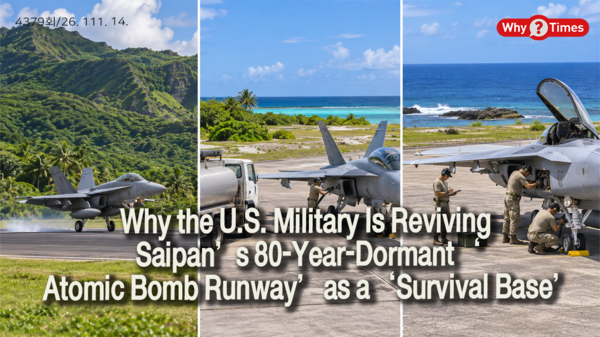
[Tinian, Left Behind by the B-29s… Now Preparing for When Guam Is Blocked]
If Chinese missiles strike the runways of Andersen Air Force Base in Guam, where will surviving U.S. fighter jets land to prepare for their next sortie? To find the answer, the U.S. Air Force is reviving an old airfield on Tinian near Saipan and pushing forward with dispersal exercises utilizing civilian airports on neighboring islands. More than 80 years after the B-29 bombers bound for Hiroshima and Nagasaki took off from Tinian in 1945, the island is drawing renewed attention as an emergency hub for U.S. forces in the Western Pacific. Given that the U.S. military already operates air bases in South Korea and Japan, why is Washington going so far as to restore aging runways near Guam?
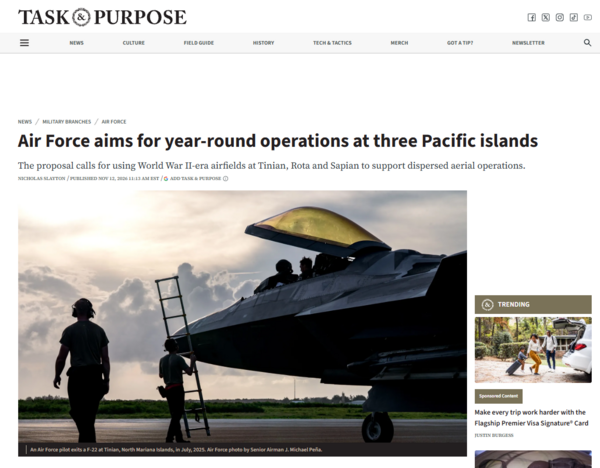
U.S. military outlet Task & Purpose reported on the 12th (local time) that "the U.S. Air Force is pursuing plans to conduct year-round dispersal exercises across four locations in the Northern Mariana Islands: Saipan, Tinian, and Rota international airports, as well as Tinian North Field." The report noted that "the baseline proposal published by the Air Force in the Federal Register on October 28 outlines up to 1,200 fixed-wing operations and up to 320 rotary-wing (such as helicopter) operations per airfield annually—totaling up to 6,080 operations per year across the four sites. These figures count takeoffs and landings separately and represent the upper limit of training scale the Air Force will evaluate in its environmental impact assessment."
According to Stars and Stripes, restoration of Tinian North Field began prior to this announcement. Since January 2024, U.S. Air Force engineers have been clearing overgrown runways and taxiways at the very site from which B-29 bombers departed in 1945 to drop atomic bombs on Hiroshima and Nagasaki. In July 2025, F-22 fighter jets participating in a large-scale Pacific exercise deployed to Tinian. Building on the ongoing restoration of the northern airfield, the United States is now examining how far it can expand exercises that shuttle forces across airfields on the three islands.
What the U.S. Air Force wants to verify is whether fighter jets can land on another island and immediately launch back into missions from there. Even if an emergency landing succeeds, a fighter jet remains grounded if refueling equipment is unavailable or maintenance crews fail to arrive on time. If communications with command are severed, it also becomes difficult to track which airfields remain open and which aircraft can be committed to the next mission. This is why the Air Force has included not only aircraft movement, but also fuel storage and supply, maintenance support, and command and control within the scope of its exercises—a concept the service calls "Agile Combat Employment" (ACE).
[Guam Within Chinese Missile Range… Preventing the First Strike from Halting Sorties]
According to Stars and Stripes, Andersen Air Force Base in Guam is the core hub from which the U.S. military projects air power across the Western Pacific. Concentrating large runways alongside fuel and maintenance facilities allows for efficient peacetime operations, but in wartime, that concentration becomes a vulnerability. Even if fighters and bombers survive an initial attack, follow-on sorties are delayed if key sections of the runway are destroyed or fuel supplies are cut off. The U.S. Department of Defense assesses the range of China’s Dongfeng (DF)-26 intermediate-range ballistic missile at 3,000 to 4,000 kilometers, placing Guam squarely under the threat of missiles launched from the Chinese mainland.
Saipan, Tinian, and Rota near Guam are also part of the Mariana Islands and can similarly be exposed to China’s long-range strike threats. Nevertheless, dispersing runways and support personnel across multiple locations increases the number of destinations available to aircraft if Guam is hit. An attacker is forced to track which airfields actually house forces, strike multiple sites simultaneously, or conduct follow-up attacks depending on repair progress. The so-called "Second Guam" should be understood as a concept in which multiple islands share portions of Guam’s functions.
Recent movements by the Chinese military illustrate why the United States is scrutinizing the survivability of its rear bases. Citing Taiwanese security officials on the 13th, Reuters reported that "the Chinese military and coast guard conducted unannounced drills around Taiwan and in the Western Pacific in early November, with the number of naval and coast guard vessels gathered in the area exceeding 100 at one point." Taiwanese authorities stated that "forces from multiple Chinese theater commands and the Liaoning aircraft carrier strike group also operated in waters east of the Philippines." While the U.S. Air Force’s notice preceded these drills, China’s coordinated deployment of multiple fleets beyond Taiwan into the Western Pacific adds weight to Washington’s decision to secure backup hubs near Guam.
[First Reason: Allied Bases Come with a 'Political Switch']
This raises an important question: why not simply expand bases in South Korea or Japan? The answer lies first in the legal and political realities of allied nations. Under the 1960 Exchange of Notes accompanying the U.S.-Japan Security Treaty, U.S. Forces Japan must hold prior consultations with the Japanese government before launching combat operations from bases in Japan for purposes other than the defense of Japan. In the event of a Taiwan contingency, fighter jets taking off from Kadena Air Base would first require a political decision from Tokyo.
The Philippines is even more explicit. Following pushback from China after expanding U.S. military access sites, President Ferdinand Marcos Jr. stated that "the Philippines will not allow those bases to be used for any offensive action." During a 2023 visit to Washington, he also emphasized that using the bases for "offensive operations" goes beyond what Manila had discussed with the United States.
South Korea is no exception. When Seoul and Washington agreed on strategic flexibility in 2006, they included a clause stating that "the United States respects the Korean position that it shall not be involved in a regional conflict in Northeast Asia against the will of the Korean people." Ahead of the first South Korea-U.S. summit in August 2025, the Lee Jae-myung administration stated that U.S. demands regarding the "strategic flexibility" of U.S. Forces Korea were "difficult to agree to." While access to allied bases is guaranteed in peacetime, whether they can be used in wartime remains a separate question subject to each country’s cabinet meetings and public opinion.
The Northern Mariana Islands, however, are different. As an unincorporated U.S. territory like Guam, the U.S. military requires no foreign government’s consent to launch sorties from there. Structurally eliminating the risk that sortie orders—which must be decided within hours in a crisis—get tied up in an ally’s parliamentary schedule is the first answer to why Washington chose an old airfield next to Saipan.
[Second Reason: The Difference Between Thousands of Missiles and Hundreds]
The second answer is geography. Okinawa and the Korean Peninsula lie only a few hundred to roughly a thousand kilometers from the Chinese coast, placing them within reach of China’s largest stockpiles of short- and medium-range missiles. Researchers point out as a core problem that bases inside the First Island Chain fall within the range of thousands of Chinese missiles—and U.S. bases in South Korea face the added threat of North Korean missiles. Building more bases inside this ring simply adds more targets within the densest threat radius.
The Marianas are no sanctuary either. According to the RAND Corporation, China’s inventory of intermediate-range ballistic missiles surged 2,400 percent, from 20 in 2012 to 500 in 2023. Thomas Shugart and Timothy Walton of the Hudson Institute have pointed out that "the Chinese Rocket Force possesses hundreds of intermediate-range ballistic missiles capable of reaching Guam and the Northern Mariana Islands, and most bases in this region are exposed without hardened shelters." According to Stacie Pettyjohn, who has led Pentagon wargames, the Chinese side in Taiwan scenarios typically fires massive salvos of ballistic and cruise missiles carrying submunitions to neutralize Andersen Air Force Base and often targets Tinian’s airfield as well.
Ultimately, distance does not eliminate the threat, but it does reduce it. Expanding runways to four locations in an area where threats drop from the thousands to the hundreds forces China to divide its limited long-range missiles across more targets. Still, dispersed ACE hubs cannot remain invisible to China’s space-based targeting systems. That is why reports released over the past year by the Mitchell Institute for Aerospace Studies, the Hudson Institute, and RAND have consecutively urged the Air Force to bolster passive and active defenses—such as rapid runway repair, blast-resistant hangars, counter-drone directed-energy weapons, and new air defense systems. Simply increasing runways to four is not enough; dispersal becomes true combat power only when each hub is equipped with fuel, munitions, maintenance capabilities, and protection.
[China Has Already Moved Toward 'Normalization']
The asymmetry in timelines also warrants close attention. Reuters reported in December 2025 that "China deployed a massive number of naval and coast guard vessels across East Asian waters, exceeding 100 ships at one point." Immediately following the May 2026 Beijing summit between Trump and Xi Jinping, Taiwan’s National Security Council Secretary-General Joseph Wu stated that "China deployed over 100 vessels across the First Island Chain right after the Beijing summit," later calling "more than 110 ships an unprecedented scale." While China has made military pressure a daily routine, America’s dispersed bases are still awaiting final evaluation in 2028.
[Why Times Insight | What Beijing Must Calculate Is the Aftermath of a Strike on Guam]
The message the Tinian plan sends to Seoul and Tokyo is subtle yet unmistakable: U.S. operational planning now formally factors in the assumption that "allies may not permit sorties." In 1945, Tinian was an offensive springboard for striking the Japanese mainland; in 2026, Tinian is a survival base designed to endure a first strike. The very fact that the same runway has shifted in character from offense to survival demonstrates how profoundly the balance of power in the Western Pacific has changed.
The implications for South Korea are two-sided. If the United States can conduct more air operations in a Taiwan contingency from its own territory, direct pressure surrounding the strategic flexibility of U.S. Forces Korea may ease relatively. At the same time, however, South Korea’s "base leverage" diminishes alongside it. As the era of measuring alliance contributions by whether runways are granted fades, the roles Washington expects from Seoul are likely to shift toward maintenance, repair, and overhaul (MRO) for ships and aircraft, munitions production, and logistics and shipbuilding capabilities that backstop a dispersed base network. Unless South Korea moves beyond defensive replies like "difficult to agree to" and proactively defines what it can offer, it risks remaining a "bypass target" rather than a "consultation partner" on America’s new basing map.

-중국 푸단대학교 한국연구원 객좌교수
-전 EDUIN News 대표
-전 OUR NEWS 대표
-제17대 대통령직인수위원회 정책기획팀장
-전 대통령실 홍보기획비서관
-사단법인 한국가정상담연구소 이사장
-저서: 북한급변사태와 한반도통일, 2012 다시우파다, 선거마케팅, 한국의 정치광고, 국회의원 선거매뉴얼 등 50여권