Update2026.11.14 (토)

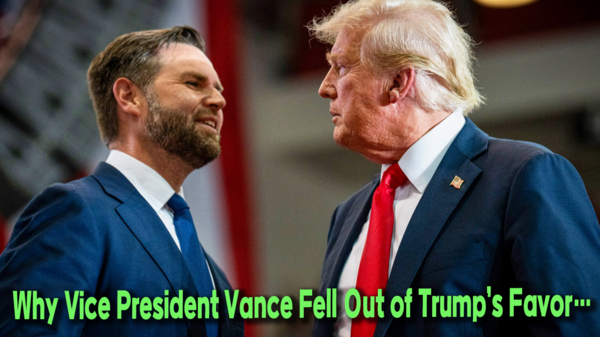
[“We Lost Because of the War”… Vance Distanced Himself from Trump, But…]
Vice President JD Vance, who began distancing himself from President Donald Trump to chart an independent course immediately following a crushing midterm election defeat, has run head-on into a counterattack from the president. On the 12th (local time), President Trump declared that "there is no need for a deal with Iran," effectively sidelining Vance from the Iran peace negotiations the vice president had been cultivating and instead assigning him to handle corruption issues in Democratic-led areas. While Vance sought to prepare for a "post-Trump" era by building an independent legacy as the figure who ended the Iran war, Trump dismantled that stage entirely and sent him back to the front lines of partisan battles. The move is widely interpreted as the president signaling a political break with a vice president who raised the issue of war accountability, pushing the "Vance inevitability" narrative in the 2028 Republican succession race into a phase of complete collapse.
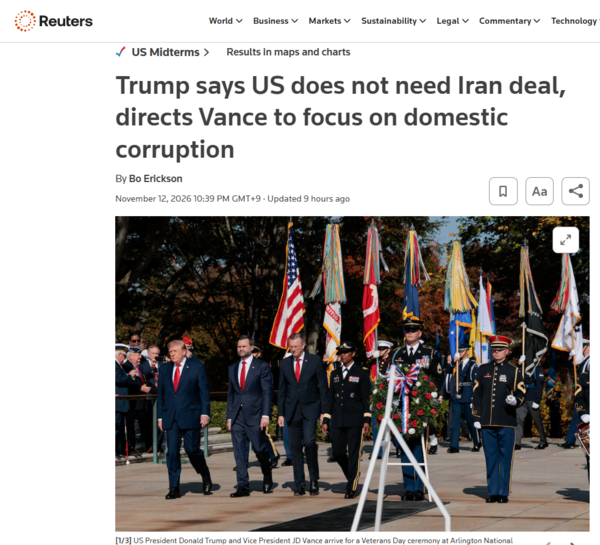
Reuters reported on the 12th (local time) that "President Trump stated via Truth Social that the United States does not need a deal with Iran," adding that he "instructed Vice President Vance to focus entirely on corruption and crime allegations in areas led by Democrats." Trump wrote, "We do not need a Deal with Iran. Those days are long gone." Just one day earlier, The Wall Street Journal (WSJ) had reported that "President Trump granted negotiating authority to Vice President Vance, who was considering a face-to-face meeting with Mohsen Rezaei, Secretary of Iran's Supreme National Security Council (SNSC)." Yet before a face-to-face schedule could even be set, the president publicly denied the need for negotiations and reassigned the vice president leading them to another task.
The catalyst that exposed the political distance between the two men was the November 3 midterm election. When the Republican Party lost control of both the Senate and the House, Vance posted on X the next day, "The reason we lost is the war," pointing to the conflict with Iran as the cause of the defeat. In explaining the voters' verdict, a sitting vice president directly cited a core foreign policy and national security decision made by the president. Amid rising fuel costs driven by the Iran war, his remarks were read as a message that his judgment differed from that of a White House determined to prolong the conflict. CNN reported that "the post was widely interpreted in Washington as a move by Vance to establish his own profile ahead of a potential presidential run." Because it came just as the Republican Party began debating what direction to take to win back voters in the 2028 presidential election, the fallout was substantial.
In a CBS ‘60 Minutes’ interview aired on the 8th, President Trump stated that "Vice President Vance asked for my opinion before posting, and I told him to write whatever he wanted," though implying the two had not discussed the lengthy post in detail. While partially acknowledging Vance's analysis of the election loss, Trump said, "If I had to make the same decision again, I would choose military action to prevent Iran from acquiring nuclear weapons—100 percent." When reporters later asked if the incident had affected their relationship, Trump replied, "Not at all," while adding, "A lot of people didn't like what he said. I wasn't one of them." Whereas Vance highlighted the electoral price paid for the war, Trump emphasized the legitimacy of his decision to launch it. Had Vance publicly vocalized the costs of the war and personally opened a path to ending it, this divergence in stance could have evolved into an independent political platform ahead of the next presidential election.
[The Political Opportunity Vance Aimed For: ‘The Vice President Who Ended the War’]
Vice President Vance’s diplomatic outreach had been underway even before the election. According to Axios, he sent a letter to Secretary Rezaei in October proposing the resumption of direct negotiations, and maintained near-daily contact with Qatari and Pakistani mediators to sound out working-level talks for a new ceasefire and renewed nuclear negotiations. The consideration of a face-to-face meeting reported by the WSJ on the 11th was an effort to elevate those behind-the-scenes contacts to the next level. Had Vance met directly with Iranian hardliners, both the responsibility for the outcome and the credit for any success would inevitably have centered on the vice president.
Following the midterm defeat, those same negotiations took on a different political meaning for Vance. If the man who declared that the war cost the Republicans the election personally brokered a ceasefire, he could add a signature diplomatic achievement to his resume as the Trump administration's number two. It would have created a dynamic positioning Trump as the president who decided on military action, and Vance as the vice president who paved the way to end that war. Diplomatic efforts initiated before the election thus became the most concrete opportunity to underpin his political independence afterward.
Of course, Vance has never stated that he intended to use a ceasefire achievement for a presidential bid. Discussions of a face-to-face meeting were still in the early stages, and some U.S. officials pointed out that if the talks failed, he would bear the blame. Even so, the political calculation was clear: merely saying "we lost because of the war" left Vance tied to the administration that waged it. Only by personally creating an opening for a ceasefire or an end to the war could the narrative of war accountability be transformed into a showcase of his own leadership.
[Trump’s Counterattack… Withholding Support for Vance and the ‘Rubio Alternative’]
The counterattack unfolded simultaneously in the succession arena. When asked during the ‘60 Minutes’ interview whether he would endorse Vance as the 2028 Republican nominee, President Trump answered, "Maybe. Not necessarily." He immediately followed up by praising Secretary of State Marco Rubio, saying, "Marco is great." Departing from his previous habit of mentioning Vance and Rubio side by side as potential successors, Trump withheld explicit support immediately after Vance raised the war accountability issue. Rubio, by contrast, stood firmly with the president, arguing that while the war was unpopular, it was necessary to stop Iran's nuclear threat.
Sentiment within the party has been moving in the same direction. Politico reported on the 12th that "interviews with roughly two dozen Republican lawmakers show a growing view that the 2028 field is wide open, with an increasing number looking to Rubio as an alternative." Representative Marlin Stutzman (R-Ind.) said of Rubio, "I hope he runs," adding, "We're going to have to keep rebranding and bringing forward fresh faces." One House Republican called Rubio "our best hope to pull us out of this dark period." Even among core MAGA allies, reluctance to publicly back Vance has been detected. Fundraising is also faltering: according to the WSJ, voices among major donors are saying they "cannot support Vance in 2028," with some floating Florida Governor Ron DeSantis as an alternative.
To be sure, Vance’s base of support has not collapsed. Senator Jim Banks (R-Ind.) emphasized that "if Vance runs, he will have my full support," noting that "he continues to lead in Republican primary polling." Representative Brandon Gill (R-Texas) also described him as "obviously the frontrunner." Rubio himself has distanced himself from talk of running, stating he will "no longer talk about 2028," and has maintained that he would support Vance if the vice president enters the race. Nevertheless, simply having to navigate a Republican primary without the president's endorsement turns the contest into an entirely different game for Vance.
[The Remaining Iran Negotiations… Back to ‘Blockade vs. Endurance’]
With Vance sidelined, the Iran negotiations have also lost momentum. Secretary Rezaei had confirmed receiving Vance's letter in late October, remarking that the U.S. tone had "completely changed." By the 9th, however, he took to X to say, "Stop fabricating 'fake news' about imaginary negotiations," and in separate remarks claimed it was "time for the U.S. to surrender." Demanding the lifting of blockades and the release of frozen assets, Tehran views the Republican election defeat as an opportunity to increase its leverage. Middle Eastern sources express concern that "Islamic Revolutionary Guard Corps (IRGC) Commander-in-Chief Ahmad Vahidi wields greater influence than Rezaei and could derail the negotiations altogether." Some analysts interpret Trump’s dismissal of negotiations as a strategic move to maintain economic pressure via blockade while keeping the option of renewed military strikes on the table.
[Why Times Insight]
The essence of this episode is not a shift in Iran policy, but a question of power. Vice President Vance treated the midterm defeat as an opening to stand on his own. He envisioned shifting responsibility for the war onto the president while positioning himself as the one who brought it to a close—an intricate design aimed at securing both political distance and credit for ending the conflict in a single stroke. President Trump read that blueprint accurately. Publicly revoking negotiating authority just one day after its delegation was reported can only be seen as a signal that the president saw straight through the vice president's ambitions. The president's actions speak far louder than his words claiming their relationship was "not at all" affected.
Trump’s response achieved a dual effect. First, it blocked any path for Vance to claim credit for ending the war. Second, by assigning him to attack Democratic corruption—the quintessential Trumpian mission—it tethered him back as "Trump’s man," giving a vice president seeking differentiation a role in which differentiation is impossible. Combined with withholding a 2028 endorsement and elevating Secretary Rubio, Trump has effectively put complete distance between himself and Vance.
As a result, Vance finds himself trapped in a political checkmate of his own making. If he criticizes the war, he becomes a traitor defying the president; if he stays silent, he is left with an eight-month record of defending it. Trump loyalists now view him with suspicion, while disaffected voters still see him as Trump’s heir. Conversely, Secretary Rubio, who stood by the president to the end, has gained the dual assets of "loyalty" and being a "fresh face." In the second half of Trump’s second term, the vice president's prominence is likely to shrink sharply, and enjoying an "incumbent vice president premium" in the 2028 primary has become far more difficult. The price of rushing to stand alone was isolation.

-중국 푸단대학교 한국연구원 객좌교수
-전 EDUIN News 대표
-전 OUR NEWS 대표
-제17대 대통령직인수위원회 정책기획팀장
-전 대통령실 홍보기획비서관
-사단법인 한국가정상담연구소 이사장
-저서: 북한급변사태와 한반도통일, 2012 다시우파다, 선거마케팅, 한국의 정치광고, 국회의원 선거매뉴얼 등 50여권