
Update2026.11.11 (수)

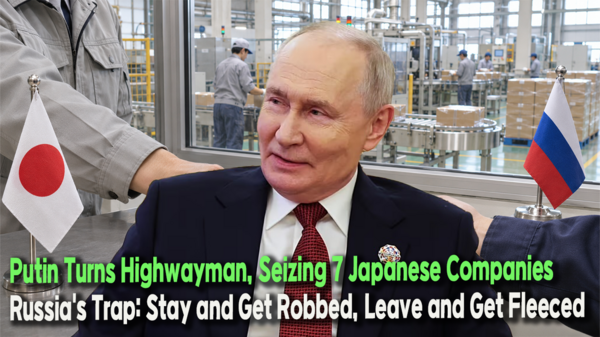
[Putin Issues Decrees Two Days in a Row… Management Control of All 7 JT Russian Entities Transferred]
Russian President Vladimir Putin placed all seven Russian subsidiaries of Japan Tobacco (JT) under the "temporary management" of a Russian company through two separate presidential decrees. While local operations continue to function, JT has effectively lost managerial control of its Russian business, which accounts for approximately a quarter of the group's adjusted operating profit. Japanese companies, including Ajinomoto, find themselves trapped: remaining means risking the seizure of their management rights, while leaving requires accepting fire-sale divestment prices and paying exorbitant exit levies to the Russian government. Russia, which will need to attract foreign capital again after the war in Ukraine ends, is dismantling investment trust with its own hands.
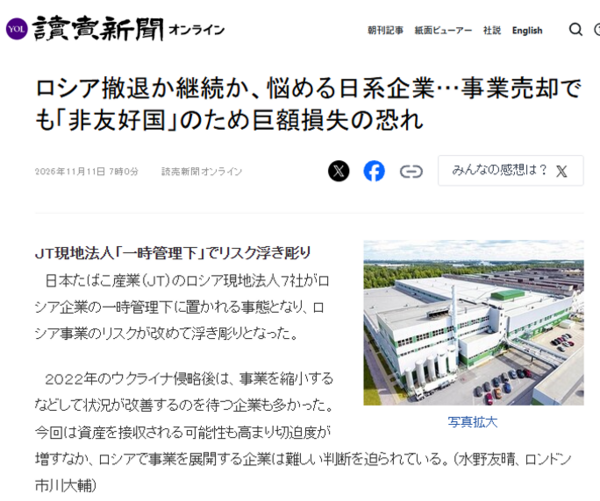
Japan's Yomiuri Shimbun reported on the 11th that "as all seven local Russian entities of Japan Tobacco (JT) were placed under the temporary management of a Russian firm, remaining Japanese companies are forced to re-evaluate whether to withdraw," adding that "the risk of losing management rights has turned into a reality even for firms that scaled back operations after the 2022 full-scale invasion of Ukraine and waited for conditions to improve."
According to the Japan External Trade Organization (JETRO), Putin designated four of JT Group's Russian manufacturing entities for temporary management by local company "Industrial Assets" on the 5th. The following day, three additional entities handling wholesale and asset management were added. Both decrees hand over 100% of the voting and management rights of the designated subsidiaries to the local company. Russia used a presidential decree enacted in April 2023 as the legal pretext for these actions.
JT stated that "as of the 9th, local operations continue." However, even if factories and distribution networks remain operational, the extent to which the Japanese headquarters can make core decisions regarding investments, personnel, and dividends is an entirely different issue. According to Reuters, JT's share price plunged to its daily lower limit for two consecutive trading sessions on the Tokyo Stock Exchange on the 9th. The Japanese government lodged a formal protest with Russia and demanded an immediate reversal of the measures.
According to JT's disclosures, assets linked to its Russian business stood at approximately 1.5 trillion yen (around 13 trillion won) including goodwill as of the end of September, with related liabilities of around 200 billion yen (around 1.7 trillion won). Subtracting the liabilities leaves a book net asset value of roughly 1.3 trillion yen (around 11 trillion won). Under this year's revised forecast, Russia accounts for about 10% of the group's consolidated revenue and approximately 25% of its adjusted operating profit. If a loss of accounting control over the local entities is established and they are deconsolidated, asset valuations and future profit projections will suffer significant hits.
[Risky to Stay, Sold for Scraps to Leave… Why Ajinomoto Hesitates to Decide]
Shigeo Nakamura, President of Japanese food giant Ajinomoto, stated at an earnings press conference on the 9th that "it is still difficult to determine whether to completely abandon our Russian operations, which we have cultivated for a long time." Even after halting local consumer food sales in 2022, Ajinomoto maintained sales of agricultural inputs and continued research and development in fermentation technology. Russia, a major consumer of mayonnaise, remains an attractive market should food operations resume down the road. A complete withdrawal could mean forfeiting both remaining operations and the springboard for re-entry.
According to a Yale University study cited by Yomiuri, 65 Japanese enterprises—including trading houses, manufacturers, and financial institutions—continue their operations in Russia. Russia has designated Japan as an "unfriendly nation" following Tokyo's participation in international sanctions. Professor Michitaka Hattori of Hokkaido University pointed out that "Japanese firms may need to make the hard choice to exit at a loss while they still hold the reins of their business." He explained that "after the JT precedent, hesitating to leave means they could lose even the authority to decide the timing and terms of their own divestment."
The exit terms imposed by Moscow are punitive. Under approval criteria established by a subcommittee of the Russian government's Commission on Monitoring Foreign Investment, investors affiliated with unfriendly nations must apply a discount of at least 60% relative to independent appraisals when selling local assets. This means the sale price cannot exceed 40% of the appraised value. On top of that, sellers face a mandatory federal budget contribution of at least 35% calculated against the appraised value, not the discounted sale price. Factoring in the heavy discount and the mandatory state levy, recovering invested capital upon exit becomes virtually impossible.
[Carlsberg and Danone Suffered First… Losses Left Behind 'Temporary Management']
According to Reuters, the Putin administration placed the stake in Russian brewer Baltika held by Denmark's Carlsberg and the Russian operations of France's Danone under temporary management in July 2023. Carlsberg completed the sale of Baltika in December of the following year after the management order was lifted. Danone excluded its local business from its consolidated balance sheets once it lost operational control in 2023, subsequently reporting in March 2024 that accumulated accounting impairments had reached 1.2 billion euros (around 1.8 trillion won). The formal divestment was completed in May of that year. These cases demonstrated that the loss of control inflicts direct damage on corporate balance sheets long before a final sale agreement is executed.
The blueprint applied to JT mirrors the previous European precedents: keep local production and sales running while swapping out who controls the enterprise. While the Russian government keeps factories humming and workers employed, the foreign corporate parent loses all certainty over governance and capital recovery. For investors, the better the local business performs, the more acute the problem becomes over who ultimately pockets the profit.
[Yuan 'De-Dollarization' Experiment Hits the Rocks]
The external financial environment squeezing foreign enterprises in Russia is growing bleaker. Bloomberg News reported on the 11th that "Russia has effectively abandoned its effort to replace the US dollar with the Chinese yuan under mounting pressure from US secondary sanctions." According to data from the Central Bank of Russia, the share of the yuan in Russian export settlements dropped to 22% this year—half of the roughly 44% peak reached in mid-2024 when Washington expanded secondary sanctions. The ruble filled that void. In trade with Asia, Russia is currently receiving 69% of its export payments in rubles.
Behind this trend is the risk aversion of Chinese banks desperate to steer clear of US sanctions. Alex Isakov, Russia economist at Bloomberg Economics, previously analyzed that "Moscow's appetite to adopt the yuan may outstrip Chinese banks' willingness to accept the currency," noting that "the threat of US secondary sanctions frightens the banks." Consequently, Russian firms are forced to process payments through intermediary networks; transactions take longer, costs have surged, and predictability has plummeted. According to The Moscow Times, the squeeze on yuan liquidity became so acute in March of this year that overnight yuan lending rates on the Moscow Exchange spiked to 44%. Because a wartime economy starved of foreign exchange liquidity is desperate to lock down foreign assets remaining inside its borders, this seizure of management rights reads fundamentally as an extension of capital controls.
[Why Times Insight | Management Rights Seized by Putin: Russia's Postwar Bill]
First, "temporary management" is state-sanctioned plunder. Russia packages this apparatus as a "countermeasure" against overseas asset freezes. Yet the target, JT, is a company that stayed in Russia after 2022, continued paying taxes as the market leader, and maintained local employment. The pattern seen since Danone and Carlsberg is unmistakable: seize management control, run down the clock, and hand the business over to Kremlin-connected insiders for pennies. It is called "temporary" in name only; in practice, it is the initial phase of permanent expropriation.
Second, this represents economic self-harm by Russia. The signal JT's ordeal sends to businesses across the globe is singular: remaining in Russia and showing loyalty guarantees zero protection. If departing means surrendering 95% of value and staying means losing everything outright, no rational corporation will invest fresh capital in Russia once the war concludes. Once trust in property rights is destroyed, rebuilding it takes decades. The foreign assets Putin is pocketing today represent the down payment on driving away the very capital and technological expertise Russia will desperately need after the war. The Russian state is choking off its own economic future.
Third, the unraveling of the yuan experiment exposes the strict limits of the "no-limits partnership" between Beijing and Moscow. When push came to shove, Chinese banks prioritized access to the US dollar over Moscow. Yet this does not mean Russia can simply revert to the dollar ecosystem. Instead, Russia finds itself trapped inside an isolated circular flow of rubles, a currency with negligible international utility. The reality that the dollar has no viable substitute has been laid bare, while settling trades in rubles only multiplies costs and volatility. Grabbing the assets of foreign firms amid a parched foreign currency reserve is unmistakable proof of desperation. Russia will eventually face a staggering bill for the piracy it commits today.

-중국 푸단대학교 한국연구원 객좌교수
-전 EDUIN News 대표
-전 OUR NEWS 대표
-제17대 대통령직인수위원회 정책기획팀장
-전 대통령실 홍보기획비서관
-사단법인 한국가정상담연구소 이사장
-저서: 북한급변사태와 한반도통일, 2012 다시우파다, 선거마케팅, 한국의 정치광고, 국회의원 선거매뉴얼 등 50여권