Update2026.11.11 (수)

[From Speeches to Conclusions: Beijing’s Non-Negotiable Summit Preconditions]
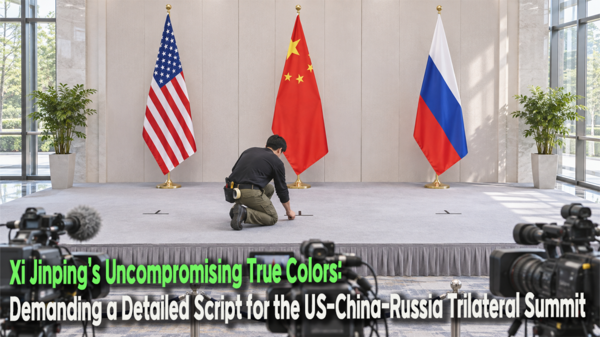
The first-ever proposed trilateral summit among the leaders of the United States, China, and Russia is faltering over procedural format disputes. Beijing is insisting on a heavily scripted format where the three heads of state take turns reading pre-negotiated statements, whereas Washington is pushing back with a demand for an open, unscripted setting permitting spontaneous debate. While superficially a battle over protocol, the substantive issue is nuclear armaments. US President Donald Trump has publicly vowed to put nuclear arms control on the table. For President Xi Jinping, who is rapidly expanding China's nuclear arsenal, trilateral arms reduction talks represent a strategic trap that could formally lock China into a position of nuclear inferiority through an international pact. Focused heavily on internal power realignments ahead of the 21st National Congress of the Chinese Communist Party (CCP) in 2027, Xi seeks the optics of a historic summit while rigorously avoiding any unscripted dialogue. This procedural standoff represents a struggle over who sets the strategic architecture among the three nuclear superpowers, and depending on the outcome, the trilateral summit itself could fall through entirely.
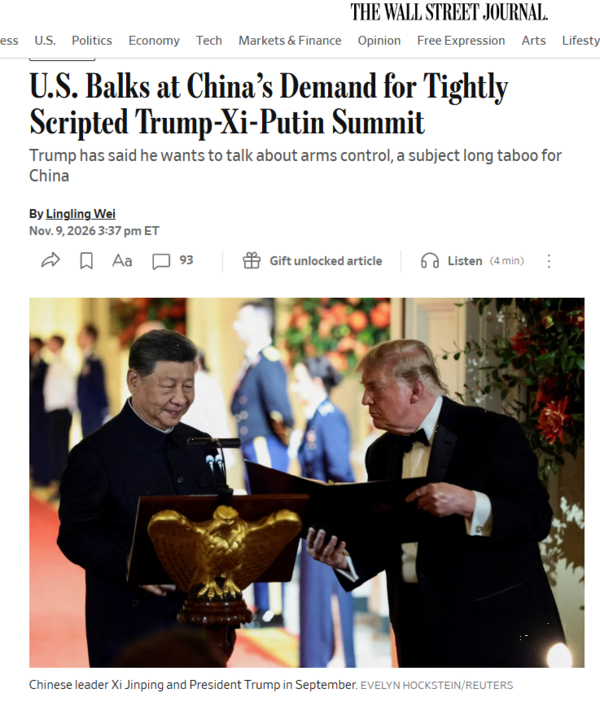
On November 11, the Wall Street Journal (WSJ) reported, citing sources involved in summit preparations, that China is demanding a tightly choreographed summit format where each leader delivers prepared remarks in sequence with minimal room for spontaneous debate. According to WSJ, the meeting has been pursued on the sidelines of the Asia-Pacific Economic Cooperation (APEC) summit scheduled for November 18–19 in Shenzhen, Guangdong Province. The Trump administration has objected to Beijing's demands, insisting on a looser framework of free-flowing dialogue and genuine back-and-forth exchanges rather than prearranged monologues. While the US, China, and Russia initially showed receptiveness to the summit concept, WSJ reported that unresolved disagreements over format and agenda have cast serious doubt over whether the meeting will take place at all.
China’s stance remains firm. A Chinese official who spoke with WSJ made Beijing’s position conditional: Beijing is open to hosting the trilateral meeting, but only after exhaustive preparations that lock down both the agenda and the final outcomes beforehand. Under such an orchestrated framework, pressing matters such as the war in Ukraine could be addressed; however, if pre-summit consensus is not reached, China prefers to substitute the trilateral summit with separate bilateral meetings. In effect, it serves as an ultimatum: no script, no summit. A senior US administration official noted that President Xi appears unwilling to engage in unscripted discussions with his counterparts, adding that such rigid format requirements raise questions about whether Beijing is truly prepared for a direct face-to-face encounter.
The idea for the summit was first floated in September by the Kremlin. Yuri Ushakov, foreign policy aide to the Russian presidency, remarked that the realization of the trilateral summit hinges on China as the APEC host nation. The Financial Times (FT) likewise reported that reaching an agreement on the agenda constitutes the primary stumbling block. Recently, Chinese Foreign Ministry spokesperson Mao Ning confirmed that Beijing has been in communication with the United States and Russia regarding the feasibility of holding a trilateral meeting. The challenge of coordinating the agenda has ultimately manifested as China's demand for total structural control.
[The Core Dispute Lies in 'Nuclear Arms': The Post-New START Vacuum]
At the very core of this format standoff lies nuclear disarmament. President Trump remarked on November 8 that when meeting Xi Jinping and Vladimir Putin, "We’ll talk a lot of things, including denuclearization." US Secretary of State Marco Rubio had previously noted that this summit would provide an opportunity for the leaders of the world's top three nuclear powers to address arms control at the head-of-state level. This is precisely what Beijing dreads: the prospect of President Trump proposing spontaneous nuclear arms negotiations directly before the cameras, or unilaterally declaring an unverified "agreement" following the meeting on points China never conceded. Without pre-cleared transcripts and tight procedural control, Beijing has no way to prevent such developments.
This impasse unfolds against the backdrop of a disintegrating global nuclear arms control architecture. Following the expiration of the New Strategic Arms Reduction Treaty (New START)—the final bilateral nuclear pact between Washington and Moscow—last February without a successor agreement, the arsenals of the two largest nuclear powers have been left completely unconstrained by treaties for the first time in decades. The Trump administration maintains that arms control frameworks excluding Beijing merely favor China as it expands its stockpile, upholding the firm principle that any future agreement must include China.
Concrete data illustrates the basis for Washington's concerns. According to a report released in June by the Stockholm International Peace Research Institute (SIPRI), the United States and Russia each possess approximately 5,000 nuclear warheads. While China possesses roughly 620 warheads—a substantially smaller stockpile—its rate of expansion significantly outpaces both Washington and Moscow. Alongside warhead growth, China is rapidly modernizing its delivery systems, including intercontinental ballistic missiles (ICBMs). WSJ analyzed that from Beijing's perspective, entering trilateral arms reduction talks carries the risk of codifying permanent nuclear inferiority—an outcome unacceptable to Xi Jinping, who has overseen the largest nuclear buildup in Chinese history. The aforementioned Chinese official similarly underscored that Beijing will not take part in trilateral nuclear arms control negotiations.
[Putin’s Calculation, Xi Jinping’s Arithmetic]
It was Russia that initially spearheaded the trilateral summit initiative. WSJ assessed that President Vladimir Putin’s proposal appears designed to exploit a more favorable disposition toward the Kremlin from President Trump, utilizing Chinese leverage to bring the war in Ukraine to an end on terms favorable to Russia. Crucially, Ukrainian President Volodymyr Zelenskyy is excluded from this equation. With the aggressor nation attempting to dictate the war’s resolution through great-power bargaining while sidelining the victim state, the trilateral summit represents another grave source of apprehension for Ukraine and its European allies.
For Xi Jinping, however, the trilateral architecture itself presents distinct liabilities. Kurt Campbell, chairman of The Asia Group and former US Deputy Secretary of State under the Biden administration, observed: "I think it’s very risky and deeply unpredictable for Xi." Campbell added that Beijing would prefer to manage its ties with Washington and Moscow separately, extracting benefits from each side independently. In a bilateral format, China can maximize its strategic leverage by playing the role of mediator or balancer between the US and Russia. Sitting at a three-way table, however, relegates China to the vulnerable status of a "third nuclear power" facing concerted disarmament pressure from both dominant nuclear states.
[The Politics of 'Infallibility' Ahead of the 2027 Party Congress]
Chinese diplomacy is inherently conditioned on scripted, sequential delivery. Bilateral meetings between Xi Jinping and foreign leaders are routinely scheduled down to the minute, with talking points vetted in advance to eliminate any opportunity for improvisation. Insiders familiar with Beijing's decision-making apparatus indicate that while Xi covets the symbolic prestige, photo opportunities, and domestic propaganda value of a historic trilateral summit, he refuses to assume the political risks of unpredictable, unscripted discourse.
Domestic political timelines further heighten this caution. At the 21st CCP National Congress scheduled for late 2027, Xi is expected to oversee a major reshuffle of the senior leadership, consolidating power by appointing a younger generation of loyalists to pivotal positions. According to sources cited by WSJ, an unscripted engagement with Trump and Putin amid sensitive internal deliberations over purges, personnel assignments, and succession dynamics constitutes a classic "uncontrollable variable" that the Xi apparatus is structurally designed to avoid. Any display of hesitation, vulnerability, or compromise by the paramount leader on the world stage could diminish the absolute authority of the leadership during a critical internal transition.
[Why Times Insight]
This diplomatic standoff serves as an outward reflection of Xi Jinping’s domestic governing style. The Xi administration operates on the principles of total centralized oversight, where the top leader personally directs all affairs, coupled with the political doctrine of absolute institutional infallibility. Decisions are reviewed in advance, and once promulgated, they are rarely reversed. Beijing’s insistence on a rigid script in discussions with American and Russian leadership appears to be an attempt to project these domestic controls onto the global stage. However, assuming that methods of internal party discipline can be applied to bilateral or multilateral diplomacy among equal nuclear powers is a profound miscalculation—particularly when facing President Trump, whose negotiating strategy relies heavily on impromptu maneuvers and situational instinct.
The more fundamental reality is that demanding a prearranged script functions as a diplomatic shield designed to block substantive nuclear disarmament discussions entirely. Even as it rapidly builds out its nuclear inventory, China has consistently rebuffed calls for verification mechanisms and strategic transparency. Demanding that the trilateral summit be reduced to formal photo-ops and prepared remarks reflects an intention to project the image of a responsible major power while concealing ongoing nuclear expansion. This explains why the United States refuses to yield on the question of format. Devoid of nuclear arms control, a trilateral summit risks degenerating into a state-run propaganda platform for China and strategic leverage for Russia in its negotiations over Ukraine.
Should Beijing maintain its preconditions, the likelihood remains high that the trilateral summit will be scrapped or downgraded to separate bilateral meetings. Even if that occurs, the breakdown will signal clearly to the international community that China chose to evade direct dialogue on nuclear arms control. While Beijing's procedural obstinacy might protect the format it desires, avoiding the mounting global pressure to address its nuclear buildup will prove increasingly difficult.

-중국 푸단대학교 한국연구원 객좌교수
-전 EDUIN News 대표
-전 OUR NEWS 대표
-제17대 대통령직인수위원회 정책기획팀장
-전 대통령실 홍보기획비서관
-사단법인 한국가정상담연구소 이사장
-저서: 북한급변사태와 한반도통일, 2012 다시우파다, 선거마케팅, 한국의 정치광고, 국회의원 선거매뉴얼 등 50여권