


Update2026.11.07 (토)

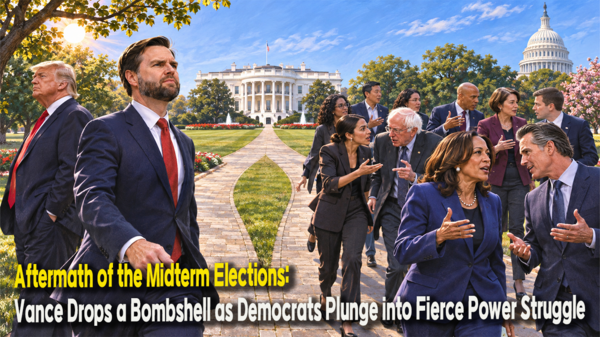
[Vance's Bombshell Remark Takes Direct Aim at Trump's War with Iran]
Following the crushing defeat in the November 3, 2026 midterm elections, both pillars of American politics are shaking simultaneously. In the Republican Party, Vice President JD Vance issued a public statement declaring that "the reason we lost is the war," calling for an end to the war with Iran and a reset of relations with Israel, effectively creating distance from the signature foreign policy of his own administration. While exit polls identified the cost of living and corruption as the primary causes of defeat, Vance chose to place the blame squarely on the war—a move widely interpreted as an early maneuver ahead of the 2028 presidential primaries. Meanwhile, although the Democratic Party regained control of both the Senate and the House of Representatives and secured an overwhelming majority projected at over 250 House seats, progressives and moderates immediately clashed over how to wield that power. Both the victorious and defeated parties have plunged into internal power struggles over who gets to interpret the election outcome.
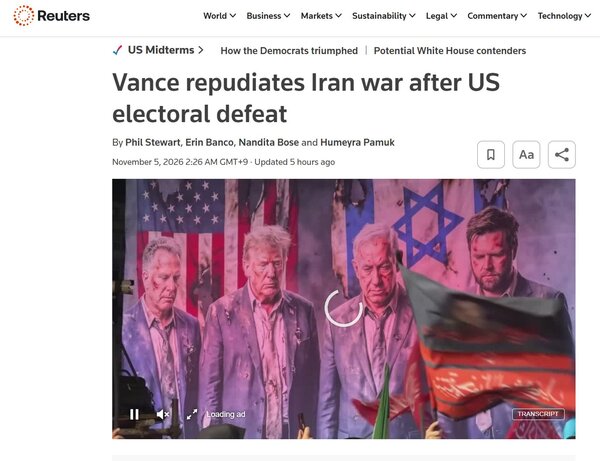
On November 5 (local time), Reuters reported in an article titled "Vance Distances Himself from Iran War Following US Election Defeat" that "Vice President JD Vance has openly challenged President Trump's war in Iran." Reuters analyzed that "Vance's questioning of the war's political value and his focus on assigning blame for the Republican midterm rout to the Iran war could impact not only the Trump administration's future Iran policy but also the internal power dynamics of the Republican Party."
On November 4, Vance posted an extensive statement on his social media platform X, arguing that "the reason Republicans lost was the war." He pointed out, "We must question whether losing our Senate majority for the next six years was truly worth the war in Iran." He added, "We need to understand clearly why voters who supported Trump in 2024 turned to the Democrats in this election."
Vance outlined four core voter demands: end the war in Iran, focus on the cost of living and inflation, put America First into practice, and change the relationship with Israel. This illustrates that voter dissatisfaction had mounted not only against the Trump administration's foreign policy but also against its economic management.
The issue was Trump's reaction. While Trump acknowledged that the war with Iran had an impact on the Republican defeat, he insisted the war itself was justified. Speaking to reporters on November 4, Trump emphasized, "The war was necessary to prevent Iran from acquiring nuclear weapons," adding, "I would make the exact same decision if given the choice again." He also showed an unbothered reaction regarding Vance's remarks.
This signifies that while Vance and Trump partially agree on the causes of the electoral defeat, they hold fundamentally divergent views on the legitimacy of the war in Iran. To Trump, the war with Iran is an acceptable cost incurred for American security, but to Vance, it is a decisive disaster that dismantled the Republican political coalition.
Even more significant is that Vance raised this critique publicly right after the election rout. Given that Vance is widely regarded as a potential 2028 Republican presidential contender, his move to distance himself from Trump's core policy can be seen as more than a post-election review—it marks the opening salvo in the battle for future power.
[Is War the Sole Culprit? The Economic and Corruption Issues Overlooked by Vance]
However, Vance's diagnosis does not account for all factors behind the Republican defeat. Voters turned away from the party due to a complex combination of issues, including rising prices, overall economic management, and growing distrust toward the administration, in addition to the war in Iran.
Reuters reported on November 4 that "as Democrats claimed victory in both the Senate and the House, President Trump will face a Democratic-controlled Congress for the remainder of his term." The outlet particularly highlighted the rising cost of living exacerbated by the war in Iran. The pro-Trump New York Post also criticized Vance's stance in an opinion column on November 4, stating that "Vance's war-centric blame argument oversimplifies the causes of the defeat." The column noted that "while it is true that the war in Iran dealt a blow to Republicans by driving up gasoline prices, the Trump administration had already been losing voter confidence due to its tariff policies and overall economic stewardship."
Trump won the 2024 presidential election on promises to rein in inflation and revitalize the American economy. However, widespread tariff implementations combined with soaring energy prices triggered by the war in Iran only heightened the financial burden on consumers. The Democratic Party effectively leveraged these economic grievances as the central attack line of its campaign.
[Victorious Democrats Also Engulfed in Power Struggle: Direct Clash Between Progressives and Moderates]
While Republicans are divided over assigning blame for the defeat, Democrats have entered an internal battle over the meaning of their victory and the direction of governing moving forward. On November 5, the American political outlet Axios reported in an article titled "House Democrats, Armed with Huge Majority, Face Massive Power Struggle" that "progressives and moderates within the Democratic Party are clashing over the direction of congressional operations for the next two years." The report was based on interviews with more than a dozen current and newly elected Democratic House members.
According to Axios, Democrats are projected to secure more than 250 seats in the House. Well above the 218-seat threshold needed for a majority, this gives Democratic leadership significant legislative momentum.
Yet, this very landslide victory is emerging as a fresh catalyst for internal strife. Progressives view the election outcome as a mandate from American voters demanding fundamental shifts in the existing political and economic order. Moderates, by contrast, interpret it as a referendum on the Trump administration's economic record and corruption issues.
[The Democrats' True War: Who Will Seize the Party's Future?]
A key faction to watch in the internal Democratic power struggle is the Congressional Progressive Caucus (CPC). Comprising roughly 100 lawmakers, this group represents the core force of the Democratic Party's progressive wing. Newly elected progressives initially sought to pressure party leadership to extract concessions, such as changes to House rules, prime committee assignments, and the advancement of progressive policy agendas.
However, because Democrats secured far more seats than anticipated, small blocs of lawmakers hold less leverage to unilaterally dictate terms to leadership. Consequently, progressives are shifting strategy toward expanding the CPC's institutional and organizational clout.
Representative Greg Casar, the CPC Chair, asserted that "the American people have demanded bold change," emphasizing that "the party must aggressively champion a progressive policy agenda." Former CPC Chair Pramila Jayapal similarly stated that while progressives should work alongside Democratic House Minority Leader Hakeem Jeffries, they must pursue more ambitious initiatives in areas such as healthcare, a living wage, and childcare.
Democratic leadership, however, is maintaining a cautious posture. Representative Hakeem Jeffries indicated that the policy agenda will be deliberated through the full caucus once the new Congress convenes. On healthcare, the leadership favors practical steps first, such as expanding existing Affordable Care Act subsidies and reversing Medicaid cuts.
Furthermore, even with Democrats controlling both chambers of Congress, President Trump remains in the White House. Any legislation passed by Congress still must clear the hurdle of a presidential veto. Therefore, it remains uncertain whether progressive demands for massive welfare expansions and sweeping overhauls of immigration policy can translate into actual statutory achievements.
[Why Times Insight | America After Trump: The War for Power Has Just Begun]
The most crucial signal this midterm election sends to American politics is not simply the scale of the Republican defeat or the Democratic triumph. It is the reality that both parties are now compelled to make new political choices as American voters voice deep frustration with the Trump administration's conduct of the war and its management of the economy.
First, within the Republican Party, the competition over the post-Trump power structure is poised to accelerate. Vance's frontal critique of the war in Iran signals an unwillingness to bind his political future entirely to every decision made by Trump. Still, charting a course that differentiates himself from the administration's policy missteps while preserving Trump's core base will be no simple task.
Second, the sweeping Democratic victory is paradoxically widening the party's ideological divide. While progressives frame the result as a public mandate for systemic transformation in American politics, moderates argue that a pragmatic focus on the cost of living and corruption was the real key to victory. This divergence in interpretation extends beyond immediate policy debates; it will directly shape which political lane the 2028 Democratic presidential nominee chooses to navigate.
Third, American foreign policy faces renewed uncertainty. With Democrats taking control of Capitol Hill, congressional scrutiny over the war in Iran, tariff policies, defense spending, and foreign military aid is bound to intensify. Yet divisions also persist within Democratic ranks regarding military aid to Israel and overseas interventions. Rather than pivoting smoothly in a single, coherent direction, U.S. foreign and national security policy is likely to navigate a contentious web of friction and negotiation among the White House, Congress, and rival factions within both parties.
Ultimately, this midterm election may mark the end of one era in American politics and the opening of an intense new struggle for dominance. Republicans have begun competing over who will inherit Trump's political mantle, while Democrats are clashing over who gets to define the meaning of their victory and set the next political course.
A defeated Republican Party is fighting over who is to blame, while a victorious Democratic Party is fighting over how to use its power. This is where the true fallout of the election lies. The midterm elections are over, but the political war for the White House in 2028 has already begun.

-중국 푸단대학교 한국연구원 객좌교수
-전 EDUIN News 대표
-전 OUR NEWS 대표
-제17대 대통령직인수위원회 정책기획팀장
-전 대통령실 홍보기획비서관
-사단법인 한국가정상담연구소 이사장
-저서: 북한급변사태와 한반도통일, 2012 다시우파다, 선거마케팅, 한국의 정치광고, 국회의원 선거매뉴얼 등 50여권



