


Update2026.11.05 (목)


[Refinery Strikes Drive Up War Costs Far Beyond the Front Lines]
Ukraine has resumed strikes on Russian oil refining facilities after a roughly two-week pause under U.S. pressure. Over three consecutive nights, three refineries accounting for about 10% of Russia’s refining capacity were struck one after another, and on November 3, the day of the U.S. midterm elections, a major fire erupted at the Yaroslavl refinery, one of Russia’s top five refining complexes. On the front lines, Russian casualties in October alone reached 54,400 (according to Ukrainian estimates)—the highest monthly total since the start of the war—yet occupied territory actually shrank. In Moscow, the Ministry of Defense is reviewing a proposal to postpone December military pay to the following year for the first time in at least 18 years. With the three pillars of the war effort—refineries, manpower, and the state treasury—under simultaneous strain, assessments are emerging that Russia is facing its worst combat situation yet.
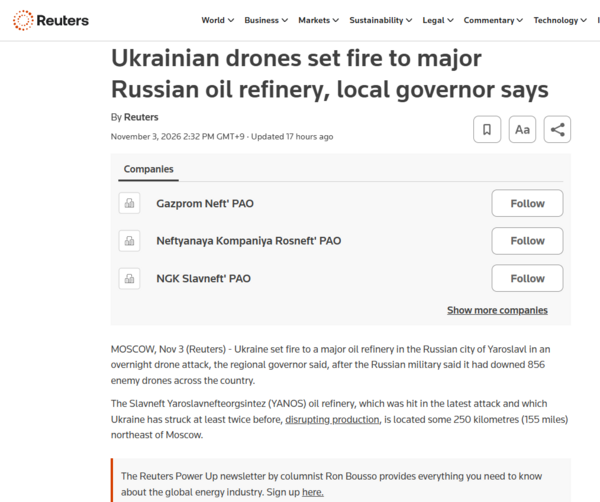
Reuters reported on the 3rd (local time) that "Russia's YANOS refinery in Yaroslavl was set on fire in an overnight drone attack," adding that "the local governor confirmed damage to facilities and injuries to two workers, and this refinery northeast of Moscow has an annual crude processing capacity of around 15 million tons."
According to Reuters, the first target was the Novokuibyshevsk refinery, an affiliate of Rosneft in the Samara region. This facility has an annual primary refining capacity of about 7 million tons and also produces jet fuel supplied to the Russian aviation sector. The following night, the Bashneft-Novoil refinery in Ufa, Republic of Bashkortostan, came under attack, followed by strikes on the Lukoil refinery in Kstovo, Nizhny Novgorod region. Kstovo is the largest among the three, with an estimated annual crude processing capacity of 15 to 17 million tons, supplying roughly 30% of the gasoline in the Moscow area. This facility is located approximately 780 kilometers from the Ukrainian border. Ukrainian drone manufacturer Fire Point stated that "it was involved in the attacks on Novokuibyshevsk and Kstovo, and also hit hydrotreating units for diesel." The offensive continued thereafter. In the early morning hours of that day, flames broke out at multiple sites at the Yaroslavl refinery, one of Russia's five largest refining hubs. Russian authorities claimed that 124 drones were deployed in the attack.
These strikes directly feed into Russian domestic inflation. When the Central Bank of Russia froze its benchmark interest rate at 14% on October 23, it explained that "inflation dynamics remain influenced by highly volatile items, particularly motor fuels." As of October 19, the annual inflation rate stood at 6.8%, and the central bank raised its annual forecast to 7.1–7.6%. Although the benchmark rate came down from its late-2024 peak of 21%, if oil price shocks persist, rate cuts could stall or rates could even climb again. In fact, within Russian financial markets, a risk scenario is being actively discussed where the central bank might prepare to raise rates if inflation remains entrenched at high levels and fuel market disruptions persist.
[Troops Consumed, Yet Occupied Territory Shrinks]
The battlefield balance is tilting further against Russia. President Volodymyr Zelenskyy stated on the 1st (local time) that "Russian forces suffered 54,400 killed or severely wounded in October alone, marking the highest monthly casualty count since the start of the war." The previous high was 48,670 in December 2024. The peak single-day loss was 2,250 on October 21, with a daily average of 1,755 casualties throughout the month. September casualties were also substantial. Citing a senior NATO military official, Bloomberg reported that "Russia suffered over 50,000 casualties in September, including up to 28,000 killed in action."
Replenishing this manpower demands massive cash outlays. According to a September report by Reuters, the federal sign-up bonus for Russian contract soldiers stands at a minimum of 400,000 rubles (roughly 6.58 million won), and when combined with regional supplements, the total can reach several million rubles. Monthly wages are paid separately. As personnel losses climb, not only sign-up bonuses but also recurring training and re-equipment costs escalate continuously.
Despite suffering such catastrophic losses, Russia failed to expand its territorial control. President Zelenskyy announced that "Ukrainian forces reclaimed 96.2 square kilometers in October, surpassing Russian territorial gains by 10.4 square kilometers." The Institute for the Study of War (ISW) estimated Russia's net territorial loss to be even larger, at around 28 square kilometers. According to ISW, Russian troops made marginal advances only in Sumy and Zaporizhzhia, while losing ground on all other fronts, including the critical Donetsk operational axis. The Center for Strategic and International Studies (CSIS) analyzed that "Russia's monthly casualties likely exceeded 30,000 in 2026, surpassing its monthly recruitment rate of roughly 27,000." This indicates that Russia is losing soldiers faster than it can replace them.
[The Bill for Hired Troops: Moscow Scrambles to Plug Deficits]
Mounting manpower losses ultimately burden the state budget. Russian-language independent outlet Meduza pointed out that "the Ministry of Defense has drafted an order to postpone December military pay to January for the first time in at least 18 years," noting that "plans are under review to push back December wages—normally disbursed by December 25—to January 11–21 of the following year." Service members in joint operational units deployed directly in Ukraine are an exception and will be paid according to the original schedule. The Stavropol regional government also decided to delay compensation payouts to families of deceased and wounded soldiers until 2027.
The national fiscal outlook is deteriorating rapidly. According to Bloomberg, Russian government spending this year is expected to reach 48.5 trillion rubles (roughly 798 trillion won)—about 10% higher than initially budgeted—with the annual fiscal deficit projected at 7.3 trillion rubles (roughly 120 trillion won), or 3.2% of GDP. The September estimate had stood at 2.2%. Given that the original budget targeted a deficit of 3.786 trillion rubles (roughly 62 trillion won), or 1.6% of GDP, the deficit has nearly doubled in less than a year. Nevertheless, military spending for 2027 is projected at a historic high of 17.1 trillion rubles (roughly 281 trillion won). Delaying December paychecks allows the government to roll a portion of its expenditures into the next fiscal year without officially slashing headline military payroll totals.
Regional finances have already approached their breaking point. While regions competed aggressively to raise contract-soldier sign-up bonuses in 2024, they are now reversing course and slashing them. Russia's second-largest city, Saint Petersburg, cut its sign-up bonus for new recruits from 3.5 million rubles (57.57 million won) to 400,000 rubles (roughly 6.58 million won)—its second cut within two weeks. The Samara region also slashed its sign-up bonus from 3.6 million rubles (59.22 million won) to 400,000 rubles (6.58 million won) starting in October. The governor of Irkutsk admitted when reducing bonuses that regional budget execution in 2026 was proving difficult. The Kremlin has relied on financial incentives to buy troops in order to avoid the intense social backlash of forced mobilization, but the funds required to sustain that mechanism are depleting swiftly.
[Why Times Insight]
Russia's war economy is currently cracking across three pillars simultaneously: refined fuel revenues, contract military recruitment, and fiscal capacity. These three vulnerabilities are deeply intertwined. When refineries are knocked offline, fuel prices rise; when fuel prices rise, high interest rates must remain in place longer to curb inflation. High rates stifle economic growth and shrink tax revenues, and diminished tax revenues in turn force cuts to enlistment bonuses and casualty compensation. While deferring December military pay is relatively modest in nominal terms, it serves as a clear signal that the Kremlin has begun managing cash flows on a month-to-month basis. If casualties continue to outstrip recruitment rates, President Putin could find himself forced to choose between another politically perilous round of mobilization and front-line stalemate.
There is also an underlying paradox in this dynamic. Washington opened channels for Russian diesel trade and requested Ukraine pause air strikes in an effort to stabilize domestic U.S. gasoline prices. Yet from Kyiv's vantage point, striking refineries is virtually its only asymmetric tool capable of directly strangling Russia's war revenue. Relinquishing this card while the adversary continues its aggression would amount to Ukraine throwing away its own bargaining leverage ahead of trilateral negotiations slated for later this month.
Taken together, these data points show that Russia's core vulnerability is not an immediate, complete exhaustion of war funds. Rather, it is that the cost of replenishing troops, repairing refineries, and plugging budget deficits is growing vastly disproportionate to any tangible gains achieved on the battlefield. Should Ukraine sustain this pressure, Russia's presumed long-term endurance advantage could rapidly erode. Ultimately, the longer this conflict drags on, the more Putin's reckless war drains Russia's national power, putting the nation on a direct trajectory toward structural decline.


-중국 푸단대학교 한국연구원 객좌교수
-전 EDUIN News 대표
-전 OUR NEWS 대표
-제17대 대통령직인수위원회 정책기획팀장
-전 대통령실 홍보기획비서관
-사단법인 한국가정상담연구소 이사장
-저서: 북한급변사태와 한반도통일, 2012 다시우파다, 선거마케팅, 한국의 정치광고, 국회의원 선거매뉴얼 등 50여권



