
Update2026.11.05 (목)


[Broadcasts Still Cut Despite Apologies… AFP Confirms China's Pressure]
Following French soccer superstar Kylian Mbappé's internet meme comment referring to China's historical leader Mao Zedong as a "dictator," the Chinese Communist Party launched an unprecedented backlash. Although Mbappé, his club Real Madrid, and even La Liga offered apologies, intense pressure and public shaming continue unabated. The Chinese Communist Party immediately terminated Mbappé's commercial endorsement contracts in China, and China's state broadcaster CCTV refused to air the La Liga match between Real Madrid and Racing Santander on November 1.
However, Beijing's rationale—that calling Mao Zedong a dictator "hurt the feelings of the Chinese people"—loses all credibility before the sacrifices of the Great Leap Forward and the Cultural Revolution. Continuing to impose punishments even after extracting apologies once again reveals Beijing’s playbook of leveraging its market to discipline foreign corporations and celebrities. This incident merely exposed the stark reality of how Beijing exercises market leverage under the guise of the "feelings of the Chinese people," and precisely whose authority it seeks to shield in the process.
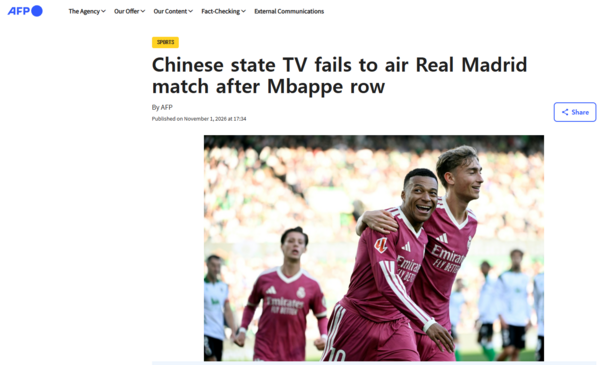
AFP reported on the 1st (local time) that "China's state broadcaster CCTV did not broadcast Real Madrid's La Liga match," noting that "the match kicked off at 15:15 GMT at Racing Santander’s home ground, El Sardinero." AFP stated, "We verified firsthand that this match was not scheduled on either of CCTV’s two sports channels," pointing out that "CCTV did not broadcast any Round 11 matches of La Liga, including Real Madrid's fixture." According to AFP, Mbappé scored a goal in the match, but no viewers in Chinese households could watch the scene. Until now, CCTV had been broadcasting all La Liga matches live.
The blackout was not confined to state terrestrial television. AFP revealed that while "live broadcasts of other La Liga matches were confirmed on Migu, a streaming platform under the state-owned telecom operator China Mobile," "the Racing Santander vs. Real Madrid match was unavailable." Unlike CCTV, which severed coverage of the entire league, Migu selectively targeted and excluded the specific club.
China Media Group had already decided to halt La Liga broadcasts on October 26, laying down apologies from La Liga, Mbappé, and Real Madrid as an "absolute prerequisite" for resolving the controversy. Yet even after all three entities apologized, the screens remained black, signaling Beijing’s message that an apology does not conclude the matter, but merely marks the beginning of "behavioral scrutiny."
[Three Apology Letters, and "We Will Watch Actions"]
On October 27, Mbappé issued statements in French, Simplified Chinese, and English, expressing: "My remarks were rash, and I now understand that they hurt many people in China and among the Chinese community worldwide." Javier Tebas, president of La Liga, also posted an apology on X the same day. Following search queries on Baidu topping the charts with "How long will arrogant Real keep acting like an ostrich?", Real Madrid released a statement on the 28th stating, "We apologize to the Chinese people." Chinese Foreign Ministry spokesperson Guo Jiakun remarked, "We take the parties' apologies seriously." CCTV stated, "Rather than listening to words, we will watch actions." The next test will be Real Madrid's UEFA Champions League away fixture against AEK Athens on November 4.
[How a Single Joke Became a 'National Crisis']
The controversy originated from an interview clip filmed in April on the French program The Bridge. The clip circulated online shortly after October 26, when Mbappé finished second in the Ballon d'Or voting. The host asked him to name the funniest meme depicting him as a dictator. Mbappé chuckled and replied: "Someone made a video... it looks like a Chinese dictator." He did not directly utter Mao Zedong’s name. However, the controversy erupted when an image superimposing his face onto Mao's body appeared on screen.
The "dictator" nickname itself has nothing to do with China. Soccer fans had jokingly dubbed Mbappé a "dictator" since his Paris Saint-Germain days due to his outsized influence over team tactics and transfer negotiations. Memes circulating during that period superimposed his face onto various authoritarian figures, including Stalin and Mao. It was purely self-deprecating humor unrelated to politics. In fact, Mbappé had expressed discomfort during an interview with L'Équipe in September, noting that some of these memes featured figures who caused immense historical harm.
Nonetheless, China's reaction triggered a chain reaction. Energy drink brand Eastroc Beverage, major dairy corporation Mengniu, and cheese maker Milkground simultaneously announced the termination of their contracts on October 27. They issued statements declaring "zero tolerance for any words or actions that hurt the feelings of the Chinese people." According to AFP, the hashtag 'Eastroc Terminates Collaboration with Mbappé' racked up 430 million views on Weibo. Mbappé’s Xiaohongshu account, with over 1 million followers, was frozen. Mbappé-related promotional materials also disappeared from the Weibo accounts of Dior and Hublot. China Media Group (CMG) set an apology as the "absolute prerequisite" for dialogue. Even after the apologies were issued, CMG maintained that "rather than listening to words, we will watch actions," adding, "We hope La Liga, Real Madrid, and Mbappé himself truly learn the lesson, apologize sincerely, and thoroughly correct their wrongdoing."
[An 'Insult' Banned Even from Translation]
The greatest paradox of this incident is that the vast majority of people in China do not know what Mbappé actually said. The original video was either withheld or scrubbed from Chinese social media. Football news app Dongqiudi posted a notice explaining that "the statement cannot be translated because its contents harm China and the Chinese people." The Australian current affairs magazine The Spectator reported that "Chinese AI models Doubao and DeepSeek also refuse to answer queries regarding the contents of Mbappé’s remarks."
The reason it cannot be translated is self-evident: publishing the exact phrasing would force Chinese media outlets to print the sentence "Mao Zedong is a dictator." The Communist Party partially acknowledged Mao's errors in its 1981 'Historical Resolution.' Academic estimates place the death toll of the Great Famine triggered by the Great Leap Forward at 30 million to 45 million. During the Cultural Revolution, teachers were denounced by students, intellectuals were persecuted, and temples and historical relics were obliterated. Yet Mao's portrait still hangs over Tiananmen Gate. Mao represents the foundational legitimacy of Communist Party rule. Whether or not he can be labeled a "dictator" serves as a direct barometer of the regime's core nature.
['The Feelings of the People': A 70-Year-Old Political Tool]
Miles Yu, Director of the China Center at the Hudson Institute and former principal China policy adviser to the Secretary of State during the first Trump administration, criticized the hypocrisy of this rhetoric in a post on X on October 31. He questioned: "Does mentioning these historical facts hurt the feelings of the Chinese people more than the fact that Mao Zedong caused the deaths of tens of millions of Chinese people?"
The expression "hurting the feelings of the Chinese people" is a long-standing diplomatic trope. According to an analysis by the China Media Project, the People's Daily first deployed this phrase in 1959 to criticize India during the Sino-Indian border dispute. Between 1959 and 2015, the phrase appeared in 143 articles in the People's Daily. Japan was targeted most frequently, followed by the United States, with issues surrounding Taiwan and Tibet appearing regularly as well. Miles Yu cited the 1989 Tiananmen Square crackdown as a prime example. When the U.S. Congress condemned the crackdown, Beijing accused the United States of hurting the feelings of the Chinese people. He pointed out: "Does killing Chinese people not hurt feelings, while condemning the atrocity constitutes a crime of hurting feelings?"
Yu asserted that these rules of "feelings" are applied strictly to foreigners. Whenever domestic discontent mounts over economic stagnation, youth unemployment, corruption, and inequality, the Party redirects popular anger abroad, packaging itself as the sole defender of national dignity. He stated: "Domestically, grievances are deflected onto foreigners; internationally, the vast market is leveraged to compel foreign governments, corporations, athletes, and celebrities to conform to the Communist Party's political rules." He added: "What truly undermines the dignity of the Chinese people is not foreign criticism of the Communist Party, but the Communist Party itself."
[Washington's Counterattack: "Mao Was a Dictator"]
Western reactions diverged completely from Beijing's expectations. Representative John Moolenaar (R-MI), Chairman of the U.S. House Select Committee on the Chinese Communist Party, issued a statement defending Mbappé. He stated: "Global soccer star Kylian Mbappé should not apologize for calling Mao Zedong a dictator." He continued: "Mao was a dictator and caused far more harm to the Chinese people than any soccer player ever could." He pointed out that "for decades, the CCP has denied basic rights to the Chinese people, including freedoms of speech and religion," and urged Mbappé to seize this opportunity to "expose the grim reality of Mao’s dictatorship."
The American conservative outlet National Review also criticized the move, calling Mbappé's apology "an own goal" and warning that "such apologies only embolden the regime to continue persecuting those who point out its bloody history." It serves as a stark warning that apologies, far from ending conflicts, establish dangerous precedents for subsequent coercion.
[Why Times Insight]
The core takeaway of this incident is the utter futility of apologizing. Mbappé, Real Madrid, and La Liga bowed their heads one after another. Yet Beijing refused to lift its penalties, insisting it would "watch actions." This demonstrates that an apology is never an instrument for resolving disputes; it is a ritual confirming subjugation and a starting point for further coercion. The withdrawal of Citroën’s Mao parody advertisement in 2007, the censorship of Mesut Özil over his Uyghur remarks in 2019, and the current Mbappé controversy all adhere to the identical script: mobilize public opinion, force brands to distance themselves, and when the target apologizes, use that capitulation to reinforce the legitimacy of the narrative.
This time, however, fissures are appearing in the script. First, it exposed the regime's extreme fragility, showing that the single word "dictator" is so threatening that it must be barred even from translation—an omission that indirectly answers the historical question of Mao’s character. Second, the U.S. Congress and Western media openly pushed back, asserting that "no apology should have been made." For the first time, a dynamic emerged where apologizing clearly incurs heavy costs in international public opinion. Third, the sluggish Chinese consumer market raises doubts about the actual weight of the "1.4-billion-consumer market" threat. While corporations will not cease capitulating overnight, the political risks inherent in engaging with the Chinese market have officially entered boardroom cost-benefit calculations. In that sense, this episode reads less like a triumph for Beijing and more like a prelude to a significant backlash.
-중국 푸단대학교 한국연구원 객좌교수
-전 EDUIN News 대표
-전 OUR NEWS 대표
-제17대 대통령직인수위원회 정책기획팀장
-전 대통령실 홍보기획비서관
-사단법인 한국가정상담연구소 이사장
-저서: 북한급변사태와 한반도통일, 2012 다시우파다, 선거마케팅, 한국의 정치광고, 국회의원 선거매뉴얼 등 50여권