
Update2026.11.09 (월)


[Backlash Erupts from Within First: "The Spending-Cut Pledges Lost the Election"]
Brazilian President Luiz Inácio Lula da Silva, who secured a fourth presidential term, stands on the brink of a severe crisis before his new term has even begun. On October 26, the day after the runoff election, the Ibovespa index plunged 13.88%, triggering a circuit breaker. The real fell by more than 8% in a single day, and the 10-year sovereign bond yield soared to 15%. At the root of the market's "vote of no confidence" lies the country's fiscal situation. With the nominal fiscal deficit approaching nearly 10% of GDP—the vast majority of which stems from interest expenses—an inability to lower interest rates solidifies a vicious cycle where debt simply generates more debt. Lula is being squeezed from the outside by a conservative-led Congress demanding austerity, and from the inside by his political base establishing strict boundaries against spending cuts. While the likelihood of national default remains low, what is teetering on the edge of a cliff is the fiscal credibility of Lula's administration.
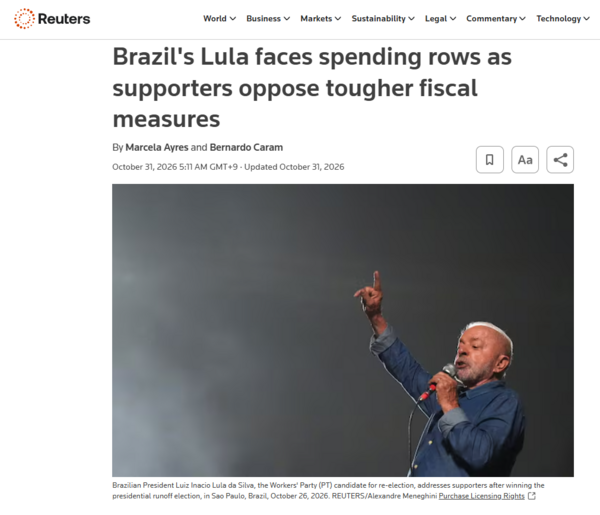
Reuters reported on October 31 that "less than a week after Lula's reelection, voices from within the government and the ruling Workers' Party (PT) are drawing 'red lines' against spending austerity." The report noted that José Guimarães, Minister of Institutional Relations, told reporters two days after the election: "That issue (fiscal adjustment) has never been discussed, is not being discussed now, and is certainly not being discussed within our legislative caucus."
Furthermore, Guilherme Boulos, General Secretary of the Presidency, wrote on social media on October 29 that "the spending-cut pledges lost the election," arguing that "even if fiscal adjustment is necessary, it should be limited to reducing congressional budget earmarks and tax exemptions." On the same day, the National Executive Committee of the ruling Workers' Party (PT) issued a statement asserting that "spending control must not be achieved at the expense of the poor."
Such rhetoric heightened investor anxiety. According to Reuters, Brazil's gross public debt grew by more than 11 percentage points during Lula's tenure alone, reaching 82.9% of GDP. Fiscal uncertainty continues to push up the government's borrowing costs. The alternative proposal put forward by the economic team remains moderate: targeting a primary surplus of 0.5% of GDP for next year—the midpoint rather than the lower bound of the tolerance band. The allowed margin is 0.25 percentage points above or below the target. Government sources conveyed that while strengthening fiscal rules is under consideration, it hinges on Lula's approval. Jeferson Bittencourt, former Treasury Secretary and Head of Macroeconomics at ASA, criticized the administration by stating: "The reason for the market's reaction is that the government shows no urgency in demonstrating how it will manage growing debt."
[A Market 'Vote of No Confidence' Delivered the Day After Victory]
On October 27, U.S. financial media outlet CNBC analyzed that "Lula's reelection has put Brazil on a 'fiscal tightrope,'" explaining that "he must finance the social welfare policies promised during the campaign while curbing burgeoning debt and appeasing the bond market." Finance Minister Dario Durigan stated on the same day that "the sell-off was a natural reaction unwinding positions placed on a Bolsonaro victory, and we will maintain fiscal discipline." However, as pushback flared up among core supporters, his commitment lost credibility. According to financial information firm Finimize, by mid-last week the real hovered at 5.364 per dollar, leaving Brazil as the largest vulnerability across Latin American financial markets.
The intense market reaction stemmed from trades placed on the opposite outcome. When Senator Flávio Bolsonaro defied opinion polls to lead the first round on October 4, the stock market touched record highs. Just before the runoff, prediction market Polymarket rated his victory probability at nearly 80%. However, in the October 25 runoff, President Luiz Inácio Lula da Silva secured 51.79% of the vote, defeating Bolsonaro at 48.21%. Rachel Ziemba, Senior Fellow at the Center for a New American Security (CNAS), told Al Jazeera that traders are "unwinding bets that were predicated on a Bolsonaro victory and fiscal austerity."
On this day, just before Lula's 81st birthday, the São Paulo stock exchange plummeted by more than 17% intraday. When losses reached 10%, the B3 exchange halted trading for 30 minutes—the first such occurrence since the COVID-19 pandemic. Reuters reported that "the intraday drop was the largest since 1998." Petrobras shed more than 10% of its share value, and brokerage XP lost half its market cap. Government bonds also collapsed. Dollar-denominated sovereign bonds suffered broad declines concentrated in longer maturities, with bonds maturing in 2056 dropping by nearly 3 cents per dollar face value. The Finance Ministry canceled sovereign bond auctions scheduled for October 27 and 29. The 5-year Credit Default Swap (CDS) premium jumped 26%, from 120 bps to 151 bps. JPMorgan downgraded its recommendation on the real and Brazilian sovereign bonds from "Overweight" to "Neutral."
[First Siege: A Fiscal Reality Where Interest Breeds Debt]
The fundamental driver behind the market turning its back on Lula is fiscal health. According to the Central Bank of Brazil, the nominal public sector deficit over the 12 months through June totaled 1.318 trillion reais, or 9.99% of GDP. This represents a surge of more than 1.6 percentage points in just six months from 8.34% across 2025. Crucially, the deficit's composition tells the deeper story: over the same timeframe, interest expenditures reached 1.161 trillion reais (approximately 285 trillion KRW), accounting for 8.80% of GDP, whereas the primary deficit excluding interest stood at just 1.19%. A structure has set in where world-leading real interest rates balloon public debt, which in turn drives interest rates even higher.
Debt has yet to peak. Central Bank figures show that general government gross debt in August reached 82.9% of GDP. That marks a 5.6 percentage point rise year-over-year and the highest level recorded since March 2021. The Brazilian Finance Ministry's internal projections released in June also indicated gross debt would climb to 87.9% in 2029 before beginning to decline. Because the International Monetary Fund (IMF) includes government debt held by the central bank in its calculations, the IMF-defined debt-to-GDP ratio sits in the mid-90% range. Lula's fourth term (2027–2030) effectively coincides with the period during which debt peaks.
Interest rate cuts were viewed as the exit ramp to break this cycle. The Central Bank reduced the benchmark Selic rate five times from 15% starting in March, lowering it to 13.75% on September 16. However, interest rate futures surged right after the election, and prediction markets showed the probability of a hold in December at 51.5%, overtaking cut expectations. The Central Bank had previously identified government cash welfare transfers as a major driver of inflationary pressure. The IMF also advised in its July Article IV consultation that strengthening fiscal discipline is a prerequisite to enabling interest rate cuts. Failing to tighten fiscal policy leaves no room to lower rates, and failure to lower rates undermines the fiscal baseline—a true dilemma.
[Second Siege: The Pincer Attack of Congress and Core Supporters]
Another barrier confronting Lula is Congress. According to AFP, conservative factions achieved major victories in legislative elections held alongside the presidential race. Bolsonaro campaigned on substantially slashing spending and shrinking the role of the state. He criticized Lula's successive announcements of expanded social spending during the campaign trail as an abuse of authority. Externally, a conservative legislature presses for austerity; internally, his base rejects spending cuts. Lula finds himself pinned down by pressures converging from both sides. Deutsche Bank economists pointed out that the critical question is whether Lula can use congressional checks as leverage to establish a credible fiscal trajectory.
[Third Siege: The First Move, Naming the Finance Minister]
Lula's first move will be appointing his Finance Minister. Fernando Haddad, economic helm of the third administration, stepped down earlier this year to run in the São Paulo gubernatorial race, in which he was defeated. Reuters cited sources naming two leading contenders. One is Vice President Geraldo Alckmin, a center-right figure who competed against Lula in the 2006 presidential election, regarded as someone Lula trusts "100%." The other is Piauí Governor Rafael Fonteles of the Workers' Party (PT), who helped revitalize Lula's campaign after trailing in the first round. Retaining current minister Dario Durigan also remains an option.
Reuters sources noted that Lula is aware that under prevailing market conditions, an appointment drawn solely from Workers' Party ranks will struggle to halt the decline of the real and the spike in long-term interest rates. Whether to name Haddad as Chief of Staff is interlinked with this decision. However, as Reuters highlighted, the crux remains whether whoever takes the helm possesses sufficient political capital to overcome opposition from the base. Lula is reportedly in no rush to decide. In the meantime, the real slid to 5.60 per dollar before rebounding to around 5.36. Central Bank President Gabriel Galípolo made it clear that the bank will intervene only in the event of market dysfunction, without defending any specific exchange rate level.
[It Is Not the Nation on the Edge of the Precipice, but 'Government Credibility']
This crisis cannot yet be characterized as a sovereign default emergency. As of August, foreign exchange reserves stood at $372.6 billion, which the IMF cited alongside the floating exchange rate regime as key buffers against external shocks. The 2025 trade surplus also reached $68.3 billion, ranking as the third-largest on record. Because the vast majority of government debt is denominated in reais—which the government can service through domestic currency issuance—this differs fundamentally from an external debt crisis caused by foreign currency shortages. What is at stake is not Brazil's solvency, but the market's confidence in the Lula administration's will and capacity to rein in debt.
This distinction is equally critical for domestic investors. The real risk of "Samba bonds," which gained popularity for offering around 10% annual yields and tax exemption under the Korea-Brazil tax treaty, is not default. If the real plunges 8% in a single day, most of a year's worth of interest evaporates in currency losses, and rising yields further erode bond prices. The finance ministerial appointment and the 2027 budget will determine whether these losses are temporary or structural.
[Why Times Insight]
Lula standing on the brink of a severe crisis does not mean an imminent collapse of power. Rather, it means that despite winning the election, his economic policy runway has narrowed considerably. Reining in spending risks severe political backlash, while delaying adjustments threatens even higher interest rates and an unsustainable debt load. Reelection extended his hold on power, but it could not erase fiscal constraints.
Entering a final term with no further reelection eligibility (term expiring January 5, 2031) is a double-edged sword. He could pursue structural reforms without worrying about voter approval, or he could expand spending to cement a legacy. We view Brazil as standing on the threshold of "fiscal dominance," where high interest rates and fiscal instability reinforce each other. The appointment of the Finance Minister marks Lula's first step on this precipice, and the market will be watching closely to see whether that step marks a retreat or a freefall.


-중국 푸단대학교 한국연구원 객좌교수
-전 EDUIN News 대표
-전 OUR NEWS 대표
-제17대 대통령직인수위원회 정책기획팀장
-전 대통령실 홍보기획비서관
-사단법인 한국가정상담연구소 이사장
-저서: 북한급변사태와 한반도통일, 2012 다시우파다, 선거마케팅, 한국의 정치광고, 국회의원 선거매뉴얼 등 50여권