Update2026.11.09 (월)


[Rare 'Direct Briefing' by CENTCOM Commander… A Signal for the Resumption of Operations?]
As the commander of the U.S. Central Command directly briefed President Trump on strike options against Iran at the White House on the 29th (local time, 30th KST), the resumption of large-scale U.S. military operations has emerged as a realistic scenario. Yet, a letter sent by Vice President Vance on the same day—bearing the hallmarks of an ultimatum—demonstrates that Washington is also searching for a diplomatic off-ramp. Compounding this, a Reuters investigation uncovered Iran’s vast military procurement network, laying bare another dilemma of the war: even with the military capability to strike, the United States faces the daunting challenge of severing Iran's war-making capacity in the aftermath.
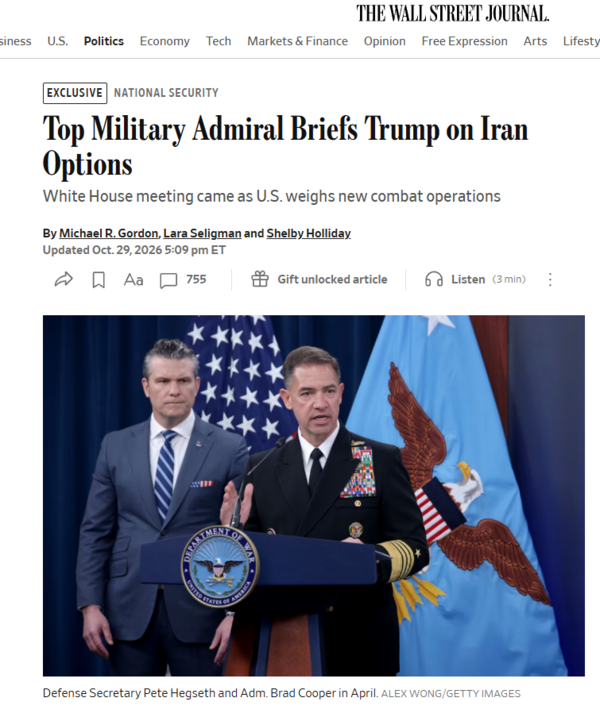
The Wall Street Journal (WSJ) reported on the 30th that Admiral Brad Cooper, Commander of U.S. Central Command (CENTCOM), held an unusual in-person briefing at the White House with Defense Secretary Pete Hegseth and Chairman of the Joint Chiefs of Staff Dan Caine present. The paper noted that military commanders met separately with Vice President JD Vance the day prior, emphasizing that a direct briefing to the president by a regional combatant commander is exceedingly rare and may signal that the U.S. is inching closer to resuming major military operations.
This is not the first briefing delivered by Commander Cooper. On July 23, aboard Air Force One immediately following the dignified transfer ceremony for fallen service members at Dover Air Force Base in Delaware, he briefed the president on strike options. Since then, President Trump has steadily dialed up his rhetoric. During a campaign rally in Florida on the 23rd, referring to this spring's bombing operations against Iran, he said, "We could do another little 'Magnificent Anger' operation. Or they'll make a deal."
Operational maneuvers on the ground mirror this rhetoric. The Pentagon recently dispatched additional air defense hardware, munitions, and supplies to the Middle East, while repositioning some personnel away from bases vulnerable to Iranian retaliation. The Army is deploying additional Patriot batteries to defend Israel. Israeli Prime Minister Benjamin Netanyahu affirmed at a recent officer commissioning ceremony that Israel will take action alongside the United States if strikes resume.
[A Personal Letter Offered with Blade in Hand… The Recipient is a 'Hardliner']
While military options were being refined, Washington extended a negotiating card with its other hand. Vice President Vance sent a letter to Mohsen Rezaei, Secretary of the Supreme National Security Council (SNSC), testing the waters for resuming talks. Rezaei, who served as the longest-tenured commander of the Islamic Revolutionary Guard Corps (IRGC) from 1981 to 1997, is a prominent hardliner maintaining a direct line to Supreme Leader Mojtaba Khamenei.
The Guardian reported that the letter, drafted primarily through Qatari mediation, was delivered to Rezaei on the 25th. The letter is understood to propose that Iran provide early commitments regarding its nuclear program at the start of negotiations and reopen the Strait of Hormuz within seven days in exchange for sanctions relief. The New York Times (NYT) projected that it included a proposal for a high-level summit to establish a negotiating framework, noting that talks could take place as early as next week in Qatar or Türkiye if Iran accepts. Axios quoted a U.S. official stating that Vance made clear in the letter that discussing the nuclear issue is essential for any negotiation aimed at averting strikes.
The choice of recipient is itself a message. The WSJ pointed out that this selection suggests the standing of Parliament Speaker Mohammad Bagher Ghalibaf and Foreign Minister Abbas Araghchi, who have spearheaded talks with the U.S., may have diminished. Rezaei was received by Mojtaba Khamenei on the 27th, and Iranian state media reported that the Supreme Leader reaffirmed his insistence on Tehran’s core conditions for ending the war.
President Trump, however, downplayed the significance of the letter. Asked whether he instructed Vance to resume negotiations, Trump replied, "No," while stating that he had authorized the outreach itself. Regarding the contents of the letter, he characterized it as humanitarian assistance, stating that it was "basically getting things in to help sick people." The remarks are interpreted as a calculated effort to avoid giving the impression that the U.S. reached out first. Iran's semi-official Tasnim News Agency reported that while the letter was received, Tehran has yet to reply.
[Who Moves First… The Unbridgeable Chasm]
The core point of contention is "sequencing." From the outset of negotiations, the United States demands concrete commitments regarding the elimination of stockpiles of highly enriched uranium. Iran's position, however, is that lifting the naval blockade and returning frozen assets must come first, with the nuclear issue addressed only afterward. After conveying its "seven conditions" through Qatar and other channels last month, Iran has boycotted the negotiating table, asserting that "no stance contradicting this framework can be tolerated."
Mohammad Bagher Ghalibaf, Speaker of the Iranian Parliament and head of the Iranian negotiating delegation, wrote on X that day that "progress can only be achieved once an agreement on Iran's seven conditions is reached." These conditions include lifting sanctions, unfreezing assets, and ending the war on all fronts, including Lebanon. He added, "A carrot-and-stick approach has zero effect on Iran."
Mediators, centered around Qatar, have tabled a compromise under which Iran would allow inspections of its nuclear facilities while the United States eases a portion of its sanctions. Axios reported that mediators are attempting to persuade Tehran by warning that accepting this proposal may be the only way to avert large-scale military strikes.
[The 'Mine Warfare Dispute' in Hormuz]
At sea, rhetorical exchanges and physical strikes unfold in tandem. President Trump has maintained since August that mine-clearing operations along major shipping lanes have concluded. In response, the IRGC warned in a statement that "unauthorized routes in the Strait of Hormuz remain mined, and the responsibility for transiting these corridors rests entirely with vessel owners and crews." An IRGC spokesperson taunted the United States on X, demanding proof if mines had indeed been cleared.
Iran claimed that several tankers (three to four vessels, depending on the report) struck mines in the strait and adjacent waters that day. The United Kingdom Maritime Trade Operations (UKMTO) confirmed that one tanker had been struck. State-run IRNA refuted claims of the navy's destruction, asserting that "the Iranian Navy conducted over 20 operations against U.S. warships during the war." Brent crude closed at $113.72 per barrel on the 27th. Caught between hopes for diplomacy and persistent clashes, high oil prices appear increasingly entrenched.
[The 'Invisible Supply Line' Breaching the Blockade]
An investigation has surfaced illustrating how Iran managed to conduct sustained precision strikes against Gulf energy infrastructure and maritime vessels for months. According to tracking conducted by Reuters in partnership with the Israeli-American risk intelligence firm 240 Analytics, Iran brought in at least $2 billion worth of weapons components, explosives, and heavy trucks since January 2025 through more than 5,000 entities operating under numerical identifiers beginning with 'MOD.' These entities all share the same Tehran address as the Ministry of Defense and Armed Forces Logistics (MODAFL), with most having been established around 2013 when sanctions crippled Iranian crude exports.
The primary conduit, 'MOD 346428,' imported $2.3 billion in military hardware between January 2025 and June 2026. The origins were predominantly listed as China, Russia, and Germany. Between January and April 2025, 886 tons of Chinese-origin chemicals, including perchlorates used as solid rocket propellant precursors, entered the port of Bandar Abbas; three days after the final shipment on April 26, a massive blast at the port killed at least 70 people. In the month leading up to the outbreak of hostilities, 268 tons of Chinese-origin nitrocellulose were delivered, followed in February 2026 by 93 tons of Chinese titanium that can be utilized in missile airframes. Since early 2025, Russian-made detonators worth $7.6 million arrived across five separate shipments. An additional 435 Iveco trucks, capable of being deployed as mobile transporter-erector launchers, were also imported.
Despite the blockade, supplies did not halt. Monthly imports dipped 47% month-on-month in March to $54 million before rebounding to $77 million in May. Approximately 97% of transactions bypassed foreign currency wire transfers, settled instead through local escrow accounts maintained by offshore intermediaries. Miad Maleki, a former deputy director of the U.S. Treasury's Office of Foreign Assets Control (OFAC), stated, "This has been the Iranian regime’s military lifeline throughout this conflict and for years prior." The Chinese Foreign Ministry responded only by stating, "We are not aware of the circumstances you describe." This stands in sharp contrast to President Trump's remarks on the 12th, when he stated he did not believe claims that China and Russia were assisting Iran.
[Key Joint Staff Post Purged on the Brink of Conflict]
At a moment when tensions are running at their absolute peak, Defense Secretary Hegseth dismissed Lieutenant General Brett Sylvia, Director for Strategy, Plans, and Policy (J5) on the Joint Staff. Pentagon spokesman Sean Parnell explained that the action followed an Air Force Office of Special Investigations (OSI) probe into unauthorized disclosures of classified information, declaring that "the Department of Defense (Department of War) maintains a zero-tolerance policy regarding the deliberate, unauthorized leak of classified information," with the matter referred to the Department of Justice.
In September, as reported by the NYT, the Pentagon subjected approximately 50 Joint Staff personnel to polygraph examinations in connection with media leaks concerning shortages of long-range missiles and Patriot interceptors.
Administrative disarray also surfaced. The Joint Staff initially issued a statement expressing gratitude for Lieutenant General Sylvia's "32 years of dedicated military service." However, the statement was retracted after President Trump commented, "He has problems. He is going to face big problems." Given that a critical post bridging long-term strategy, the White House, and operational commands has been vacated immediately ahead of the resumption of operations, controversy is bound to persist.
[Why Times Insight]
① This marks the final phase of classic 'coercive diplomacy.' The direct briefing by the CENTCOM commander, the reinforcement of air defense assets, and the redeployment of troops from vulnerable bases were immediately followed by the Vice President's letter. This is closer to an ultimatum with a strict timeline than an open proposal for talks. With the midterm elections (November 3) serving as a domestic political inflection point, the immediate window thereafter is likely to become the moment of decision.
② Selecting Rezaei as the recipient indicates that Washington has acknowledged the shifting balance of power in Tehran. Bypassing the Ghalibaf-Araghchi diplomatic channel and heading straight to the core security apparatus reflects an assessment that real decision-making power has consolidated around former IRGC hardliners and Mojtaba Khamenei. While dealing with hardliners allows agreements to suppress domestic pushback, it carries the acute risk of immediate military escalation should negotiations collapse.
③ The Reuters investigation punctures U.S. claims of having severed Iran’s economic and military lifelines. Amid the maritime blockade, military supplies continued to flow through overland corridors via the Caspian Sea and Central Asia, as well as cargo flights originating from China. Records showing that Chinese rocket propellant precursors and Russian detonators sustained Iran's missile and drone arsenals reveal that this war is being waged atop a shared supply line connecting the authoritarian bloc. Should airstrikes resume, targets are likely to expand beyond production facilities to encompass the broader procurement architecture.
④ The longer Iran stalls, the narrower the room for diplomacy becomes. Tehran seeks to raise its leverage through silence and mine-laying threats; however, with U.S. military preparations completed, sustained inaction risks handing Washington the very justification it needs to strike.

-중국 푸단대학교 한국연구원 객좌교수
-전 EDUIN News 대표
-전 OUR NEWS 대표
-제17대 대통령직인수위원회 정책기획팀장
-전 대통령실 홍보기획비서관
-사단법인 한국가정상담연구소 이사장
-저서: 북한급변사태와 한반도통일, 2012 다시우파다, 선거마케팅, 한국의 정치광고, 국회의원 선거매뉴얼 등 50여권