


Update2026.11.09 (월)


[Chinese Female Spy: Alice Huang Assessed to Have Passed Intelligence to Beijing]
U.S. intelligence agencies have shocked the global tech community by concluding that a female executive at a Singapore-based data center firm—who maintained close ties with Nvidia CEO Jensen Huang—was a "Chinese intelligence asset," effectively serving as a spy passing information to Beijing. The fallout is expected to be extensive, as allegations involving the rerouting of advanced semiconductors have now escalated into a high-stakes counterintelligence issue surrounding a pivotal figure in the U.S. AI industry. Crucially, this is far from the first time such suspicions involving Chinese female operatives have emerged. The repercussions are heightened by recurring patterns—also seen in South Korea—where women linked to Beijing have cultivated access to political, diplomatic, and industry circles to gather strategic information.
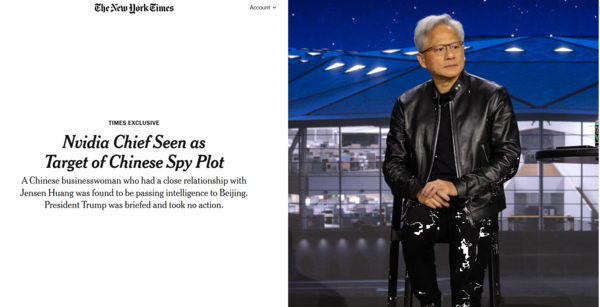
The New York Times (NYT) reported on the 29th (local time) that Alice Huang (黃樂), a Chinese businesswoman and senior executive at Singapore-based Megaspeed, is under scrutiny as a suspected Chinese intelligence asset. U.S. authorities had been investigating whether Megaspeed facilitated the diversion of Nvidia's cutting-edge AI chips to China; during close surveillance of Alice Huang, intelligence agencies discovered her direct contacts with Jensen Huang. Despite sharing the same surname, the two are not related.
Through electronic surveillance of Alice Huang, U.S. intelligence agencies detected communications with an American citizen. Under U.S. law, intelligence bodies cannot conduct warrantless surveillance on American citizens. However, when an American appears in intercepted communications, authorized government agencies may uncover the individual's identity through a procedural process known as "unmasking." The identity revealed through this protocol was Jensen Huang.
The NYT further reported that the two shared drinks with other AI industry executives in Taipei in June 2024 and were seen together departing a business dinner the following year. The paper noted that while there is no evidence of a romantic or sexual relationship between them, no public details have yet emerged regarding how Alice Huang allegedly transmitted intelligence to Beijing or precisely what information was relayed.
According to the NYT, intelligence officials were primarily alarmed by Jensen Huang's vast access and policy influence. As the helm of Nvidia, he has been an outspoken voice regarding the Trump administration’s semiconductor policy toward China. The report highlighted mounting concerns over whether Alice Huang could have leveraged this relationship to glean insights into Trump's strategic thinking or sensitive Nvidia corporate intelligence.
[A $4.8 Billion Transaction: Legitimate Business or a Sanctions Bypass?]
Suspicions surrounding Megaspeed stem from the sheer scale of its transactions. Trade data cited by the NYT revealed that its Malaysian affiliate procured at least $4.8 billion (approximately 6.4 trillion KRW) worth of advanced AI hardware powered by Nvidia technology between June 2024 and February 2026. For a relatively obscure and modest-sized company, such transaction volumes defy commercial norms. A critical lead emerged in late 2024 during an on-site inspection of a Malaysian data center by U.S. Department of Commerce officials, who discovered Nvidia server units left unopened inside their original shipping crates.
Megaspeed procured the equipment through the U.S. subsidiary of Chinese server manufacturer Inspur and subsequently provided computing capacity to Chinese corporations, including Alibaba. While Inspur's parent company is blacklisted under U.S. sanctions for supplying technology to the Chinese military, its American subsidiary was not designated on the sanctions list. Megaspeed channeled the compute power acquired through this pipeline to prominent Chinese enterprises such as Alibaba.
[A Veiled Background and the 'Jensen Huang Network']
Much of Alice Huang’s career profile remains shrouded in ambiguity. An online biography from a Chinese investment fund where she once worked identified her as a former television reporter in China. She later transitioned through several major Chinese state banks before joining Hexi Capital, a Shanghai-based private equity fund investing in semiconductor and AI ventures.
Her direct connection with Jensen Huang was documented in public photographs. In June 2024, mere weeks before Megaspeed launched its massive chip acquisition drive, a photograph posted to LinkedIn captured the two drinking whiskey alongside other AI industry figures at a Taipei bar. A year later, in May 2025, they were spotted exiting a restaurant together following a business dinner in Taipei. Tech investors noted that Alice Huang’s camp actively flaunted close ties with Jensen Huang to raise capital. Megaspeed continues construction on a massive hyperscale data center facility in Johor, Malaysia.
[Nvidia Calls It a "Routine Customer Relationship"… Beijing Slams "Baseless Slander"]
Nvidia flatly rejected the allegations. Spokesperson John Rizzo stated that interactions between Jensen and Ms. Huang were neither unusual nor unexpected, underscoring that engaging customer executives is part of an executive's routine duties and that Jensen Huang speaks with thousands of client representatives each year. In a Bloomberg interview that same day, Jensen Huang described the transactions with Megaspeed as "normal and customary." He added that his engagement with Alice Huang aligned with standard practices for dealing with Chinese clients and executives, noting that she had already departed Megaspeed and that the U.S. government had never notified him of any suspicions regarding her. In response, Liu Pengyu (Liu Chang), spokesperson for the Chinese Embassy in Washington, pushed back forcefully, accusing the United States of waging "groundless slander and smears against China."
[The 'Jensen Huang Effect' Captivating Washington]
This incident carries heightened gravity due to the immense sway Jensen Huang has exercised over the second Trump administration’s China tech policy. When the administration weighed sweeping bans on Nvidia chip exports to China, Huang and his wife visited Mar-a-Lago to lobby for continued trade allowances. Nvidia contributed at least $20 million toward the White House ballroom construction fund and committed to investing $500 billion into U.S. domestic manufacturing.
At a White House state dinner honoring Chinese President Xi Jinping last month, Jensen Huang was seated at the head table. He also brokered a regulatory pact granting the U.S. government a 25% take of revenues derived from specific chip sales authorized for China. Current and former officials disclosed to the NYT that the close alignment between Huang and the White House effectively brought Commerce Department investigations and sanctions debates regarding Nvidia's China dealings to a standstill.
[Not the First Time: The Genealogy of Chinese Female Operatives]
Beijing’s deployment of female operatives to penetrate strategic targets spans several decades. A prominent case involved Katrina Leung, codenamed "Parlor Maid." For two decades, Leung served as an FBI asset while carrying out romantic relationships with her handler agents; the U.S. government ultimately arrested her after determining she was operating as a double agent for Beijing.
Another case that shook Capitol Hill centered on Christine Fang (Fang Fang). Between 2011 and 2015, while enrolled as an international student at California State University, East Bay, she forged extensive ties with local and national politicians through campaign fundraising and civic event organizing. U.S. intelligence agencies assessed that she took direct operational cues from China's Ministry of State Security (MSS). She aided fundraising efforts for Congressman Eric Swalwell's 2014 reelection bid and placed an intern inside his congressional office.
Declassified FBI files released in August revealed that Swalwell admitted to FBI investigators that he engaged in several intimate encounters with Fang Fang, with their final contact occurring in March 2015. Swalwell first entered Congress in 2013. In April, Swalwell stepped down from his congressional seat amid separate, unrelated sexual misconduct allegations, which he denies. An FBI search executed on the 27th stemmed from that misconduct investigation.
In the United Kingdom, intelligence services issued rare public security alerts. In January 2022, MI5 notified the House of Commons that solicitor Christine Lee was covertly collaborating with the Chinese Communist Party's United Front Work Department (UFWD) to orchestrate political interference within the UK. Her law firm had funneled over £427,000 (roughly 76.6 million KRW) in political donations to Labour MP Barry Gardiner since 2015.
The strategic crosshairs have steadily pivoted toward the technology corridor. Last year, The Times of London reported that China and Russia are actively conducting "sex warfare" targeting Silicon Valley tech leaders. James Mulvenon, an analyst at risk consultancy Pamir Consulting, cautioned that tech figures are facing a deluge of highly sophisticated LinkedIn outreach originating from remarkably similar profiles of attractive, young Chinese women.
South Korean diplomatic institutions have weathered comparable crises. The 2011 "Shanghai Consulate Scandal" exposed illicit relationships between a Chinese national named Deng Xinming and several South Korean consular officials, leading to severe document leaks and visa irregularities. Deng obtained personal contact numbers for over 200 high-profile South Korean political and government leaders, the consulate's emergency contact roster, visa issuance internal records, and personnel rosters from the Ministry of Foreign Affairs. While the Prime Minister’s Office concluded the incident reflected gross operational discipline failure rather than verified espionage targeting state secrets, investigators never had the opportunity to interrogate Deng directly. Although not definitively classified as an MSS espionage operation, the episode illustrated how private relationships can fracture diplomatic intelligence security.
[Why Times Insight | Blocking Hardware Leaves Human Conduits Vulnerable]
The core lesson of this episode is that personal relationships serve as prime vectors for intelligence collection. While the exact dynamic between Alice Huang and Jensen Huang remains unproven in declassified records, an undeniable thread links Katrina Leung, Fang Fang, Christine Lee, and Alice Huang. Chinese intelligence services frequently avoid deploying traditional covert operatives, opting instead to position figures bearing ordinary civilian profiles—such as students, entrepreneurs, or venture capitalists—alongside high-level power brokers over extended horizons.
The targeting matrix has also shifted. Where intelligence efforts once focused on lawmakers and federal investigators, they now zero in on tech executives who hold sovereign strategic assets like AI semiconductors. The more sobering takeaway lies in Washington’s policy posture. When counterintelligence alarms are subordinated to sales volume targets and bilateral trade concessions, it reveals vulnerabilities running far deeper than an isolated espionage plot—exposing structural gaps in the U.S. export control regime itself.
This serves as an urgent wake-up call for South Korea as well. As the Shanghai diplomatic scandal demonstrated, compromising interpersonal ties paired with lax operational discipline can unravel core institutional security. Both corporations and state institutions must vet not only the corporate structures of trade counterparts, but also the contact networks and information-handling procedures of their key leadership. Defending AI primacy cannot end at monitoring the shipment of physical silicon; it demands full vigilance over who approaches the individuals designing, selling, and shaping policy around those chips—and for what hidden motives. When it comes to [China Watch], round-the-clock vigilance remains paramount.

-중국 푸단대학교 한국연구원 객좌교수
-전 EDUIN News 대표
-전 OUR NEWS 대표
-제17대 대통령직인수위원회 정책기획팀장
-전 대통령실 홍보기획비서관
-사단법인 한국가정상담연구소 이사장
-저서: 북한급변사태와 한반도통일, 2012 다시우파다, 선거마케팅, 한국의 정치광고, 국회의원 선거매뉴얼 등 50여권



