
Update2026.11.09 (월)


[As the Top Buyer's Throne Wobbles, Suppliers Shift Their Stance]
Apple's formidable bargaining leverage, which for years squeezed memory suppliers to extract the industry's lowest prices, is beginning to fracture. What upended the board are the tech giants building artificial intelligence (AI) data centers. By snapping up vastly larger volumes, accepting premium pricing, and committing to long-term contracts, these tech giants have left memory vendors with little reason to accede unconditionally to Apple's demands. Apple—which previously generated immense margins by securing rock-bottom memory prices and slapping steep storage-tier markups on consumers—now finds itself squeezed from both ends by surging bill-of-materials costs and consumer price resistance.
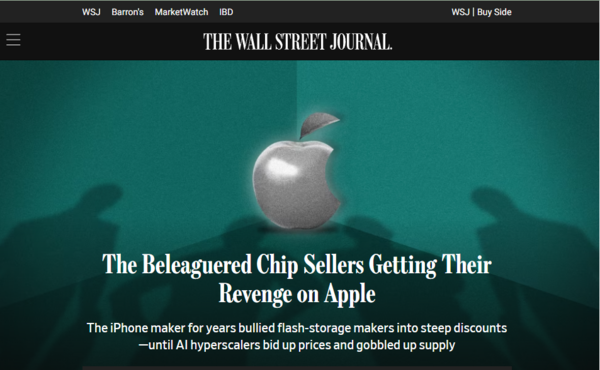
The Wall Street Journal (WSJ) reported in detail on the 29th (local time) on Apple’s long-standing playbook of wringing bottom-tier prices out of NAND flash suppliers, alongside how that market power crumbled in the face of an unprecedented explosion in AI demand. The report opens with an emblematic scene set in the Southern California desert: Scott Nelson, who handled flash sales to Apple for Japan’s Kioxia (a NAND flash memory manufacturer headquartered in Tokyo, Japan), pulled over his dirt bike, took out a rifle, and blasted his old iPod to pieces. The iPod was the pioneer device where Apple first deployed flash memory. Enraged by years of being on the losing side in transactions with Apple, Nelson had used only Android phones in protest. The shattered wreckage of that iPod now sits atop his desk. In today’s upended market, those remnants have become a trophy of sorts.
[A Reversal in Purchasing Power: The 'Top Customer' Flips Within Two Years]
The structural shift is laid bare in procurement volumes. According to TechInsights estimates cited by the WSJ, Apple’s flash procurement volume two years ago nearly doubled that of Microsoft, Amazon, Meta, and Google combined. Today, that ratio has completely inverted: the purchasing volume of these hyperscale data center operators is now double that of Apple. Analysts also estimate that over the past year, intense AI demand has driven flash prices up by roughly five times. The memory in question is NAND flash—used for storing photos, videos, and applications—as distinct from the High Bandwidth Memory (HBM) integrated into AI compute accelerators.
Suppliers have seized the opportunity to reset not only prices, but commercial terms as well. According to the WSJ, Meta, Microsoft, and Amazon signed multiyear supply agreements with Japan’s Kioxia this year, accepting elevated price points. These arrangements reportedly include provisions shielding Kioxia's margins even if overall market prices soften. Where suppliers once lived in dread of losing Apple’s purchase orders, they can now selectively partner with clients offering higher prices and predictable, stable volume commitments.
AI-driven hyperscalers also possess significantly more runway to absorb rising memory costs than Apple. The WSJ explained that flash components represent a smaller share of overall data center capital expenditures than they do within the manufacturing cost of an iPhone, and data center operators can capitalize these investments across balance sheets over multiple years. This dynamic is compounded by fierce competitive urgency to secure AI infrastructure without delay. Rather than any emotional reckoning from vendors, Apple’s waning leverage stems primarily from the arrival of alternative anchor buyers offering far more lucrative terms.
[From Book Audits to Refusing Shipments… How Apple Used to Crush Prices]
Apple's procurement muscle expanded in tandem with the runaway success of the iPod and iPhone. At the launch of the iPod nano in 2005, Apple made an upfront advance payment of $1.25 billion to five suppliers to lock down guaranteed flash volume through 2010. As iPhone shipments subsequently skyrocketed, Apple grew into the premier customer consuming more than one-fifth of global flash output. For capital-intensive semiconductor fabrication plants saddled with immense fixed costs, Apple's high-volume orders were indispensable for maintaining plant utilization rates.
Apple weaponized this structural dependency during negotiations. Suppliers were compelled to accept "most-favored-customer" clauses guaranteeing that no competitor would receive lower pricing than Apple. To enforce compliance, Apple routinely audited vendor books, gleaning granular operational insights including factory yields and line capacities, the WSJ reported. In effect, Apple negotiated while knowing exactly how desperate suppliers were to retain its orders. In one notable instance, Apple uncovered that Micron had sold chips to another buyer at lower prices, extracting a tens-of-millions-of-dollars settlement through arbitration.
When market downturns struck, the financial pain was pushed down onto suppliers. According to the WSJ, if spot flash prices dropped after an order was placed, Apple would at times refuse to take delivery. Suppliers were left holding bloated stockpiles of chips tailored specifically to Apple’s proprietary specifications, and the resulting standoffs almost invariably concluded with suppliers conceding deeper discounts. The dynamic was structured so that Apple reaped the rewards of massive volume while forcing component makers to shoulder downside price volatility. This asymmetry fueled enduring grievances among sales executives dealing with Cupertino.
The archetype of this uncompromising negotiation posture was procurement chief Tony Blevins, who departed Apple in 2022. Dubbed "The Blevinator," he was known for choreographing meetings so rival sales teams crossed paths in waiting rooms and running grueling sessions past midnight. Around 2017, when Western Digital requested a capacity reservation fee, Blevins threatened retribution; when prices plunged the following year, he reportedly extracted a binding pledge that Western Digital would never seek such fees again, according to the WSJ. Today's sea change is not merely about the departure of a single executive; it signals that the underlying market conditions that enabled that coercive negotiating posture have fundamentally cracked.
[A Bill More Than Quadrupled for the Same Volume… Targeting Storage Profits]
The impending invoice for Apple is staggering. TechInsights projects that securing a volume of flash memory comparable to what Apple bought for roughly $6 billion last year will require an expenditure of around $25 billion this year. Even without a substantial increase in physical procurement volume, component expenditures are on track to more than quadruple. While this figure is an analyst projection rather than reported earnings, it underscores an operating environment where sheer purchasing scale no longer dictates price.
The margin compression is particularly visible in consumer storage tiers. Last year, doubling the storage tier from the base 256GB on the iPhone 17 Pro cost consumers a $200 premium. According to WSJ analysis, Apple's incremental hardware cost for that extra storage was around $15 at the time, but has since surged to roughly $66. Even while maintaining that same $200 retail markup, Apple's net margin per upgrade after deducting component costs contracts by $51. While this metric does not represent total device margin, it serves as a concrete snapshot of where Apple's profitability is absorbing severe margin squeeze.
The contrast with recent history is stark. Bernstein estimated that the flash memory industry suffered roughly $19 billion in cumulative operating losses in 2023. By contrast, the WSJ reported that Apple generated approximately $14 billion in gross profit in that same year purely from selling storage upgrades. While direct comparisons between industry-wide operating losses and company gross profits require analytical nuance, the structural takeaway is unmistakable: while component manufacturers were drowning in red ink, Apple harvested windfall profits through aggressive storage tiering. Today, the ultra-low-cost supply chain foundation underpinning those profits is crumbling.
Apple's countermeasure has been retail price hikes. According to the WSJ, recent iPhone prices have risen by an average of 13%, with price increases even applied to older legacy models that traditionally saw post-cycle price cuts. Sources familiar with Apple’s procurement operations indicated that senior leadership—confident in their unmatched grasp of supply chain dynamics—did not sufficiently heed early market warnings. Today, absorbing higher component costs compresses gross margins, while passing those costs directly onto retail buyers risks depressing consumer demand. A challenge historically resolved by demanding supplier concessions has boomeranged into a dilemma concerning Apple’s own top-line sales and profitability.
[Why Times Insight | Apple's Humiliation: Suppliers Now Have Options]
Framing this development as supplier "revenge" makes for a dramatic narrative. However, what has fundamentally shifted the balance of power is not vendor sentiment, but the emergence of alternative buyers. For decades, Apple wielded its massive volume to dictate prices and contract terms. Today, component manufacturers have access to hyperscale clients willing to purchase even larger quantities while locking in long-term profitability. That Apple remains an important anchor customer is undeniable; that it can no longer unilaterally dictate commercial terms is equally clear.
This does not mean the NAND memory cycle has ceased to exist, nor does it imply Apple has permanently forfeited its bargaining power. A moderation in AI capital spending coupled with memory capacity expansions could eventually recalibrate market pricing. However, as long as AI enterprises maintain sustained procurement volumes and multiyear commitments, Apple will find it difficult to claw back its historical bottom-dollar terms. Apple—which long issued ultimatums of "lower your price if you want our business"—has stepped into a reality where vendors can reply that others are ready to pay full freight. That is precisely where the humbling of Apple lies.

-중국 푸단대학교 한국연구원 객좌교수
-전 EDUIN News 대표
-전 OUR NEWS 대표
-제17대 대통령직인수위원회 정책기획팀장
-전 대통령실 홍보기획비서관
-사단법인 한국가정상담연구소 이사장
-저서: 북한급변사태와 한반도통일, 2012 다시우파다, 선거마케팅, 한국의 정치광고, 국회의원 선거매뉴얼 등 50여권