
Update2026.11.09 (월)


[Up to $2 Million for Corporate Work Logs]
AI enterprises are now moving to purchase internal records of how human employees actually do their work. The race to capture specialized expertise—which previously meant paying doctors and lawyers hundreds of dollars per hour—has now expanded into employees' enterprise chat logs, corporate documents, and day-to-day business procedures. For companies, this represents an unexpected revenue stream; for employees, it means the very records they produce are turning into the training raw material that sharpens AI capabilities. Who authorizes these sales, who governs the boundaries of data usage, and who reaps the financial proceeds have rapidly emerged as critical controversies.
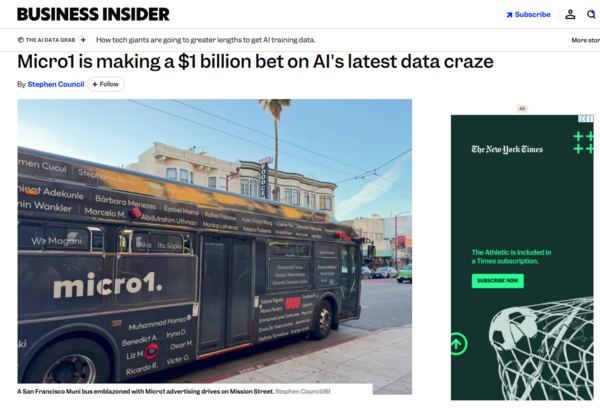
Business Insider, a leading global news outlet covering digital business, finance, and technology, reported on the 27th that “AI data startup Micro1 plans to spend $1 billion over the coming year to acquire proprietary corporate data,” noting that “the transaction value proposed by the company for a single mid-sized firm ranges from $100,000 to $2 million.” The report added that “this is not a uniform payment made to every enterprise, and the $1 billion figure represents a forward-looking plan rather than capital already deployed.”
Business Insider observed that “the scope of data targeted goes well beyond finished reports to include enterprise chat logs on Slack, documents from Google Workspace tools, CRM customer management records, design assets, and internal project checklists.” The outlet stated, “While these represent ordinary accumulated artifacts of routine work from an enterprise standpoint, for AI developers they provide a blueprint revealing how real organizations function. Micro1 explained that it places value not only on the sheer volume, complexity, and specialized nature of the records, but crucially on the degree to which these artifacts are interconnected.”
According to Business Insider, looking up the right answer on the public web is fundamentally different from successfully executing a task within a corporation. In practical workflows, workers assemble fragmented materials, verify historical decisions, and consult colleagues to determine their next action. What AI firms seek is precisely this contextual tissue preserved alongside the final deliverables. This is why a rich corpus linking conversations, documents, and customer records proves far more effective for reproducing real-world workflows than any isolated standalone file.
The acquired data also functions as a simulated training ground for developing agentic, task-executing AI. By snapshotting an enterprise's operational dataset at a specific point in time, developers test the AI's ability to locate necessary data and solve assignments within that historical ecosystem. This represents an endeavor to cultivate the model's ability to operate within incomplete information rather than merely answering neatly curated prompts. Nevertheless, securing such corporate data does not imply that an enterprise’s entire workflow can be automatically fully automated overnight.
[From $400-an-Hour Experts to Entire Enterprises]
At the vanguard of this trend lies the expert data marketplace. Bloomberg reported on the 16th that “there are recruitment listings offering $400 per hour to civil rights lawyers, $170 to condensed matter specialists, and up to $120 to software engineers.” These efforts seek qualified personnel capable of identifying errors in AI outputs and explicating rigorous professional judgment criteria.
According to Business Insider, individual expert contributions and enterprise corporate records supply distinct types of knowledge. An individual specialist can articulate why a particular judgment is sound, while organizational records preserve the step-by-step actions that led up to that judgment in real-world scenarios. The data acquisition race is thus simultaneously expanding across personal domain knowledge and organizational execution processes. Rather than corporate records simply replacing individual human experts, it is more accurate to view both pipelines as expanding in tandem.
The motivations driving experts to participate are also multifaceted. Dr. Anu Brixey, a radiologist interviewed by Bloomberg, anticipated that “AI will help meet the growing demand for imaging interpretations.” Her primary rationale for participating in selected projects was advancing patient outcomes. Framing an expert's involvement in AI model training solely as a self-defeating step toward eliminating their own livelihood overlooks the complementary potential of the technology and the professional motivations present on the ground.
[From "Leasing" to "Owning": The Real Threat Felt by Professionals]
Yet the influx of domain experts exposes a more fundamental dilemma. Professor Danielle Li of MIT, who investigates AI and labor markets, explains that “historically, employers have ‘leased’ labor.” Whether manual labor or cognitive work, when wage payments ceased, access to that labor vanished as well. However, when labor becomes the proprietary asset of an employer in the form of an AI model, this structural dynamic collapses. Professor Li warned that “a small cohort of data specialists could theoretically substitute for an entire profession or heavily depress its market value,” cautioning that “those who supply data find their future heavily determined by the choices of others.”
Researcher Fan Yang of Melbourne Law School views this dynamic as “a new form of outsourcing.” Companies purchase AI software tools instead of hiring in-house personnel directly, while those tools are continually refined through the labor of short-term contracted specialists. According to Yang’s assessment, AI is not strictly displacing humans wholesale, but rather reallocating the structural positions people occupy across the labor market. Professor Li, conversely, argues that the outsourcing analogy downplays the severity of the transformation. While subcontracting still utilizes living human labor, knowledge absorbed into an algorithmic model is permanently and indefinitely reproducible once acquired.
Anxieties on the ground have already taken concrete shape. Dr. Polly Chea, another radiologist who takes on data work as a side gig, remarked, “People are worried.” She noted that this climate of uncertainty weighs particularly heavily on medical students and residents facing years of rigorous clinical training ahead. Dr. Brixey, however, highlighted a different perspective: although she witnessed a lung nodule detection AI make diagnostic misclassifications at her own healthcare institution, she remains confident that AI will prove indispensable in handling soaring imaging workloads. Limiting herself to at most two projects per year, she affirmed, “I do this work to improve patient care.”
Significant disparities also emerge across professions. While clinicians frequently take on secondary consulting gigs, investment bankers are tightly constrained by employment contracts and have virtually no discretionary time. To recruit time-poor, high-earning professionals, data platforms continue to bid up hourly compensation. Ana Price, vice president at Prolific, observed, “There is high demand for white-collar talent, who are generally time-poor and cash-rich,” adding, “The incentives, therefore, must be compelling.”
[The Next Step: Every Employee Becomes a Data Worker]
Certain data enterprises envision a future that bypasses individual expert recruitment entirely. Under this model, platforms purchase employees' aggregate workplace activity data directly from employers in bulk. Micro1 CEO Ali Ansari contends that “enterprises should view employees not merely as agents producing goods and services, but as creators generating data of measurable market value.” He wrote in January that “every hour an employee works can simultaneously run the company, train AI models, and generate new revenue.”
This concept has already manifested in practice. Meta deployed monitoring software on US employees’ work computers to track mouse trajectories, clicks, and keystrokes for AI training purposes, forming part of a broader push to develop autonomous agentic AI. The initiative, internally designated the "Model Capability Initiative (MCI)," captured periodic desktop screen captures. Meta spokesperson Andy Stone countered that captured data is not utilized for performance evaluations or purposes outside model training, citing built-in safeguards to shield sensitive personal data. Nonetheless, the program sparked sharp internal backlash over privacy incursions and the total absence of an opt-out mechanism. As such frameworks spread, virtually anyone working via a personal computer risks becoming an involuntary data worker, regardless of consent.
Hanson, an industry observer tracking data labor over the past decade, maintains that human intervention will not disappear entirely. The bulk of his recent tasks consists of conducting Zoom video calls of up to 20 minutes with unfamiliar participants. He surmises that these conversational exchanges are employed to refine AI conversational cadences so they sound less robotic. Hanson asserts that models cannot achieve full completion without human input.
[Why Times Insight]
First, “$400 per hour” is not mere wages; it is an acquisition buyout price. The underlying reality of expert data labor resembles a permanent liquidation of specialized intellectual capital rather than a temporary lease of human time. When an individual doctor dedicates dozens of hours to teaching diagnostic evaluation criteria, that clinical judgment becomes infinitely reproducible inside the neural network. As Professor Li cautions, $400 is not generous hourly compensation—it may well represent a one-time buyout premium surrendered at a steep discount, ceding the future bargaining power of an entire profession.
Second, the structural bifurcation of platform labor is congealing into the foundational hierarchy of the AI sector. The demise of Amazon Mechanical Turk alongside the soaring valuations of Mercor and Micro1 represent two sides of the same shift. Elite knowledge workers command an expert premium, while lower-tier labelers face severe wage depression under automated pre-annotation algorithms. Class-action misclassification lawsuits can be understood as the initial collective legal pushback waged by this vulnerable labor tier.
Third, the data supply chain carries significant potential to evolve into a geopolitical asset. Nvidia’s funding discussions with Mercor and Micro1’s public refusal to license proprietary data to Chinese AI developers indicate that expert-grade training datasets are increasingly handled as strategic materials akin to advanced semiconductors. If English-language professional data functions as a competitive moat for American AI ecosystems, data sovereignty across non-English expert communities will surface as the next major geopolitical flashpoint.
Fourth, South Korea must proactively establish clear terms and frameworks governing the utilization of proprietary enterprise work data. The precise domestic transaction volume of corporate data sales requires verification. However, formulating sound regulatory principles regarding how professional judgments and internal corporate records are deployed in AI engineering remains an urgent priority. If operational workplace records generated by human staff are treated as new balance-sheet assets, stakeholders must determine who appraises their valuation and how resulting gains are apportioned.
A further critical hazard demands scrutiny: internal corporate communications inevitably capture private employee circumstances and confidential client disclosures. Even when names are stripped out, correlating organizational roles, incident chronologies, and discursive contexts creates severe re-identification risks. With AI services consistently exhibiting vulnerabilities around prompt leaks, training data extraction, and conversation history exposure, corporate data licensing deals must rigorously verify not only superficial anonymization, but strict data minimization, granular access controls, and comprehensive exfiltration barriers. In short, organizations must reckon seriously with the reality that routine enterprise logs may inadvertently expose and commercialize deeply private information without the worker’s knowledge or consent.

-중국 푸단대학교 한국연구원 객좌교수
-전 EDUIN News 대표
-전 OUR NEWS 대표
-제17대 대통령직인수위원회 정책기획팀장
-전 대통령실 홍보기획비서관
-사단법인 한국가정상담연구소 이사장
-저서: 북한급변사태와 한반도통일, 2012 다시우파다, 선거마케팅, 한국의 정치광고, 국회의원 선거매뉴얼 등 50여권