Update2026.11.10 (화)


[Carriers Loaded with Bunker Busters… Combat Preparations off the Iranian Coast]
A U.S. aircraft carrier positioned off the coast of Iran has been fully loaded with bunker-buster bombs designed to destroy underground facilities. President Donald Trump stated that the moment to decide whether to reach an agreement with Iran or resume military strikes is fast approaching, while U.S. Central Command (CENTCOM) has presented multiple airstrike options to Defense Secretary Pete Hegseth. Although final authorization for an attack has not been confirmed, the convergence of on-the-ground rearmament and Washington's signaled intent has pushed the Middle East into a critical juncture where large-scale airstrikes could resume at any moment.
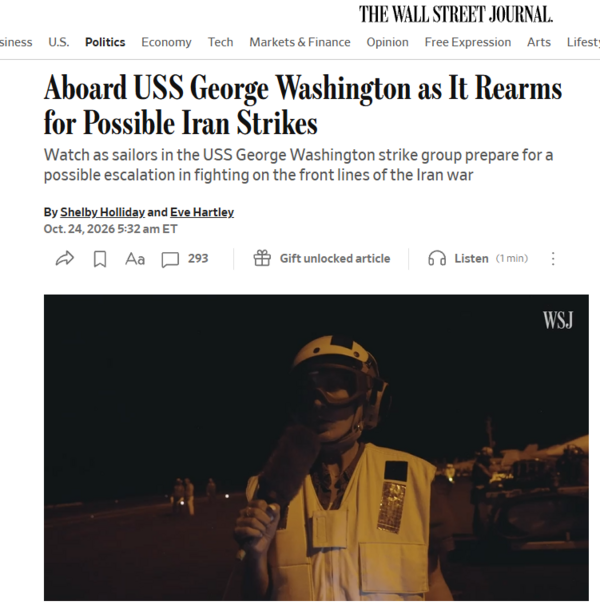
The Wall Street Journal (WSJ) reported on the 24th (local time), citing on-scene video coverage from the USS George Washington operating in the Arabian Sea, that "massive stockpiles of bunker-buster bombs and missiles were brought aboard the U.S. aircraft carrier off the Iranian coast." The WSJ added, "We confirmed the loading process of standoff land-attack missiles and bunker busters intended for underground facilities. While the president continued his warnings, the military at sea was restocking weapons intended for actual combat."
What stands out is the nature of the resupplied munitions. Bunker busters are specifically designed to penetrate heavily fortified subterranean structures. Securing such specialized ordnance just as renewed strikes against Iran are under discussion demonstrates that the carrier strike group is actively bolstering its practical offensive capabilities. However, the presence of these weapons alone does not conclusively prove that a decision to strike specific nuclear facilities or missile bases has already been finalized.
According to the WSJ, the urgency of the current situation stems from the simultaneous alignment of ammunition replenishment with political and military signaling. The aircraft carrier is restocking bombs, military leadership is presenting strike packages, and the president is publicly declaring that a decision is imminent. While each development individually could serve as part of a diplomatic pressure campaign, their combination substantially reinforces the conditions required to transition rhetorical threats into operational military action.
[Trump: "The Time to Decide is Near"… A Deal or Additional Strikes?]
During an interview on Fox News' "Sunday Morning Futures" on the 25th, President Trump remarked, "The time is approaching when we will have to decide whether to make a deal with Iran or resume attacks." Presenting a decisive military solution alongside the prospect of negotiations, he emphasized, "We are not playing games." While falling short of an explicit declaration of war, it served as a clear warning that the administration will not tolerate an indefinite diplomatic impasse.
This statement carries far greater weight when paired with the carrier's rearmament, as the U.S. is concurrently demanding concessions while fine-tuning its strike capabilities. Washington may be intentionally escalating the credible threat of attack to force a breakthrough at the negotiating table. However, if Tehran interprets these moves not as leverage for talks but as an imminent precursor to war, reciprocal defensive and offensive preparations by both sides could significantly amplify the risk of an unintended confrontation.
[CENTCOM Presents Strike Options… Awaiting the White House's Decision]
The Hill reported on the 24th that "CENTCOM has prepared multiple strike options against Iran and presented them to Defense Secretary Pete Hegseth." It noted that "plans are ready to execute follow-up airstrikes should the White House grant approval." While the Department of Defense stated that presenting military alternatives to the president is its fundamental duty, it declined to provide specific details regarding future operations.
This represents a distinct shift beyond mere theoretical discussions of potential strikes. Actionable military options have been laid before political leadership, and physical ordnance is being loaded in theater. Nevertheless, briefing operational contingencies does not necessarily equate to immediate presidential sign-off or the absolute readiness of every operational asset. What is confirmed is that the strategic plans and force posture necessary to support a strike decision are actively falling into place.
According to foreign press citing The Hill, more than 50,000 U.S. military personnel and approximately 20 warships are currently deployed across the Middle East. With two carrier strike groups deployed in theater, the USS Theodore Roosevelt is also underway. Deploying an additional aircraft carrier broadens the array of offensive and defensive courses of action, though the actual scale of concurrent operations will depend on the overlap between carrier rotation schedules and deployments.
[Post-Midterm Window as a Watershed… Can It Be Kept to a Short Strike?]
The window drawing the keenest attention for a prospective strike is immediately after the U.S. midterm elections on November 3. President Trump previously indicated that he would not strike Iran prior to the election. The electoral calendar imposes distinct political costs on military calculations; large-scale strikes could reignite oil supply disruptions and spike gasoline prices, posing a major liability for Republicans. Once the election concludes, this immediate political risk diminishes. However, potential U.S. casualties, allied anxieties, and congressional pushback will remain. An "election-preconditioned delay" must not be automatically conflated with a "guaranteed post-election attack."
Foreign affairs magazine The Atlantic also reported that "the administration is weighing a multi-day strike campaign immediately following the midterms," while noting that "no final decision has been reached." This reflects a calculation that punitive strikes could compel Iranian concessions and bring the conflict to a close. Yet, even if the United States plans for a brief, limited strike campaign, there is no guarantee Iran would limit its retaliation accordingly.
[From the Coastline to the Interior… Expanding Targets Changes the Nature of War]
The strategic nature of the next strike will hinge heavily on target selection. The New York Times (NYT), citing officials familiar with the matter, reported that "CENTCOM has assembled an expanded target list that includes critical economic infrastructure, such as Iranian energy facilities." Officials also noted that in private discussions, President Trump appears to lean increasingly toward launching additional strikes.
Striking coastal military installations is fundamentally different from broadly targeting energy and economic infrastructure deep within the interior. The latter would deliver a devastating blow to industrial output and civilian livelihoods. While this drastically increases coercive leverage, it also sharply escalates the danger that Iran will expand the geographic and operational scope of its retaliation.
Congressional news outlet The Hill quoted former Defense Intelligence Agency (DIA) official Harrison Mann as noting that "the United States has predominantly targeted Iranian coastal assets since April," warning that "resuming strikes into the interior marks a primary pathway to escalation." He added that "if Israel participates, the target scope could broaden to include civilian and energy infrastructure."
[Iran's Retaliatory Front… Expanding Beyond Oil Facilities to Subsea Cables]
Iran is likewise preparing for potential incoming strikes. The Associated Press (AP) reported on the 25th that "Iran has renewed its threats against U.S. military bases and regional allies, additionally naming undersea data cables traversing the Strait of Hormuz as potential new targets."
According to the AP, should this threat materialize, the fallout will not be confined to crude oil transit. Strikes against oil infrastructure and power plants would destabilize regional energy supplies, while disruptions to subsea cables would cripple communications and commercial operations reliant on those networks. AI data centers, which are heavily dependent on reliable power and fiber connectivity, would not be exempt from these risks. While this does not mean an attack on a specific data center is imminent, it points to the broader exposure of the entire Gulf economic infrastructure to retaliatory disruption.
The United States is also reassessing the security of its regional personnel. The Washington Post (WP) reported that "an intelligence memo indicated Iranian plotting against Americans had advanced," adding that "moves are underway to review security protocols and staffing operations at diplomatic missions."
[Why Times Insight | Bombs Are Loaded… But Ending a War Cannot Be Dictated]
The current posture cannot be taken lightly because real-world military movements are directly substantiating the president's rhetoric. Operational strike packages have been presented, aircraft carriers have taken on bunker busters, and additional assets are in transit. The urgency is unmistakable in that the prerequisite operational conditions for Trump to launch a strike—should he choose to do so—are strengthening.
The post-midterm window represents a critical hazard zone. However, analysts must look beyond just the calendar. The actual deployment timeline of incoming forces, shifting diplomatic redlines, and concrete strike orders will be the definitive indicators. It remains entirely plausible that a carrier stocked with bunker busters will serve primarily as maximum-pressure leverage to extract last-minute concessions from Iran.
The real dilemma confronting Washington is not whether it possesses the military capability to strike Iran, but rather whether heavier blows will force Iranian capitulation or trigger region-wide retaliation across the Gulf. Destroying infrastructure from the air is a military accomplishment; compelling a fundamental policy change from an adversary is a vastly different political objective.
The defining dynamic of this juncture is a "convergence of timelines." The approximately two-month span between ① the Israeli general election (October 27), ② the U.S. midterms (November 3), ③ the arrival of the USS Theodore Roosevelt (late November), and ④ the seating of the new Congress (next January) represents an overlap where political risk is minimized while military readiness peaks. President Trump's declaration that strikes will not occur before the election serves less as a sign of de-escalation than as an informal telegraphing of the prospective timeline.
More concerning is the doctrinal shift in targeting logic. Moving from the "limited objective" of keeping waterways open to the "coercive objective" of dismantling energy and economic infrastructure makes it far more probable that Iran's response will shift from military targets to civilian and digital infrastructure across the Gulf. The moment subsea fiber cables and AI data centers are targeted, this conflict expands beyond oil volatility into an immediate crisis for the global financial and telecommunications architecture. South Korea cannot view this as a distant conflict. Should Gulf energy supplies, maritime shipping, and regional hubs face disruption, the compounding costs of crude imports, supply chain logistics, and multinational operations will inevitably reverberate domestically. Still, the prospect that a three-carrier posture and vocal threats are intended as the ultimate iteration of "maximum pressure" to drive Tehran into an agreement cannot be dismissed.

-중국 푸단대학교 한국연구원 객좌교수
-전 EDUIN News 대표
-전 OUR NEWS 대표
-제17대 대통령직인수위원회 정책기획팀장
-전 대통령실 홍보기획비서관
-사단법인 한국가정상담연구소 이사장
-저서: 북한급변사태와 한반도통일, 2012 다시우파다, 선거마케팅, 한국의 정치광고, 국회의원 선거매뉴얼 등 50여권