Update2026.11.10 (화)


[‘State-Sponsored Terrorism’ Warned by the British Defence Secretary]
The UK government has advised households to stockpile three days' worth of drinking water, emergency food, cash, and battery-powered or wind-up radios. The directive aims to prepare citizens for potential disruptions to everyday essentials—such as electricity, telecommunications, and payment networks—caused not only by severe storms and floods but also by cyberattacks. Compounded by warnings from the Defence Secretary regarding Russian threats to disrupt critical infrastructure, this measure demonstrates that the frontline of national security is expanding directly into the daily lives of citizens. The core premise is that society can be destabilized well before a full-scale war breaks out, requiring both the state and individual households to be resilient against such shocks.
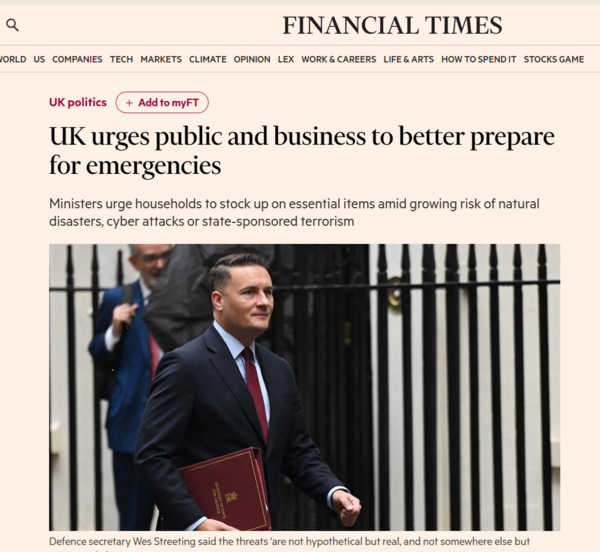
On the 24th, Britain's Financial Times (FT) reported that "the UK government urged citizens and businesses to prepare for disruptions caused by natural disasters, cyberattacks, and state-sponsored terrorism." The report noted that Defence Secretary Wes Streeting initiated national discussions on crisis resilience, emphasizing that "alongside military defense, society’s overall capacity to absorb shocks must be strengthened."
According to the FT, Secretary Streeting deliberately used the term "state-sponsored terrorism," pointing out that terms like "hybrid warfare" or "gray-zone threats" fail to convey the tangible danger to ordinary citizens. In the House of Commons, warnings were also issued that Russian hostilities are unfolding across Europe and will continue to test the UK and its allies. This reflects a concerted effort to translate specialized national security jargon into language that resonates with the public's daily reality.
Crucially, such hostile actions do not require a formal declaration of war. Hostile actors can disrupt corporate operations, logistics, and financial transactions without crossing the threshold of direct military conflict. Therefore, the scenarios Britain is preparing for extend beyond conventional armed clashes at borders, encompassing sudden breakdowns in the public services people rely on daily.
[The Significance of Cash and Radios: More Critical Than 9 Liters of Water]
"Be Ready," unveiled by the UK Cabinet Office on the 23rd, is a three-year public preparedness campaign. The government revamped its existing "Prepare" portal and plans to disseminate guidance through more than 500 partner organizations, including charities and private enterprises. However, this is not the first emergency guidance issued since the Cold War. The government has provided household preparedness guidance since May 2024, noting that substantial portions of the previous recommendations remain in effect.
The official checklist advises stocking 3 liters of drinking water per person per day for three days, with additional water needed for cooking and hygiene. Suggested non-perishable foodstuffs include canned goods, dried fruit, and nuts that require neither refrigeration nor cooking. Flashlights, spare batteries, blankets, power banks, first aid kits, and essential prescription medications are also listed. Passports and vital documents do not mean fleeing with original copies, but rather keeping printed physical backups readily accessible.
Particularly noteworthy is the inclusion of cash and battery-operated or wind-up FM radios. Cash serves as an essential contingency when electronic payment networks or ATMs fail, while radios ensure access to emergency broadcasts during widespread telecommunication blackouts. This list ultimately poses a fundamental question: when our hyper-connected, digital-dependent lives are severed, what manual tools will sustain basic survival?
[Why Three Days? A Standard for Initial Response, Not a Guarantee of Restoration]
The "72-hour" threshold is not a pledge that power and tap water will be fully restored within three days. Minister of State for Security Dan Jarvis explained that when capable households secure baseline supplies, it alleviates the strain on frontline emergency responders, allowing authorities to prioritize aid for the most vulnerable. Public readiness directly preserves emergency rescue capacity.
This necessity was demonstrated during recent real-world disasters. When Storm Goretti battered the UK this past January, over 250,000 customers suffered blackouts. According to government remarks in the House of Commons on January 13, power had yet to be restored to 193 sites across the South West as of that morning, with 82 categorized as vulnerable customers. Individual repair operations in remote regions and access routes blocked by fallen trees and debris severely hampered recovery efforts.
Hence, severe weather events should not be viewed merely as a pretext to conceal the Russian threat. While storms and hybrid attacks stem from different origins, the immediate hardship households face during telecommunication and power cuts is identical. Britain's approach is designed to institutionalize basic multi-hazard resilience into regular civic life.
[Subsea Infrastructure Protection Aligned with Warnings on Russia]
The security context is evident. Reuters reported on the 13th that Ken McCallum, Director General of the UK Security Service (MI5), warned that Russia is intensifying hybrid operations targeting nations supporting Ukraine. McCallum stated that state-level threats have quadrupled over the past decade.
A primary vulnerability for the UK lies in its subsea infrastructure. The British government notes that roughly 99% of global data traffic travels via undersea cables. Beyond internet communications, these cables underpin critical economic lifelines such as banking, financial markets, and commerce. While damage to a single cable does not automatically paralyze the entire nation, actual disruptions depend heavily on the scale of physical damage, redundant rerouting pathways, and rapid repair capacities.
Significantly, on the very day the UK government announced the "Be Ready" initiative, it also unveiled plans to impose harsher penalties for intentional sabotage against subsea cables and pipelines. Although not yet enacted into law, this demonstrates a two-pronged policy approach: fortifying critical infrastructure at the state level while building resilience in individual homes.
The UK government stated that the three-day preparedness standard is already utilized in countries such as France, Ireland, and the Netherlands. Sky News assessed that "Nordic and Baltic states have long communicated risks of crises and conflict directly to their citizens," noting that "the UK's public campaign is actually more restrained than those of certain allies." Britain is not adopting survival readiness in isolation, but rather integrating into a broader European resilience framework.
[Immediate Market Reaction… Political Clashes Over 'Passing the Buck']
Civic response was swift. Jack Brown, co-owner of Sergeant Prepper Shop—an emergency food and survival gear retailer—reported that "within 24 hours of the campaign's launch, we received an entire month’s worth of regular orders." The government’s emphasis on stocking up "gradually, one or two items at a time" appears intended to prevent such demand surges from devolving into panic buying.
Political reactions diverged sharply. Conservative Party Leader Kemi Badenoch criticized the initiative, arguing that "rural residents already prepare themselves for power cuts" and that "the government's priority must be properly securing our borders, armed forces, and national infrastructure." Conversely, the Prime Minister emphasized preventing public panic, stating on BBC Radio 5 Live: "This is not about panicking; it is about keeping a sensible amount of provisions at home, as such disruptions are becoming increasingly probable in today's world." When asked if he would include wine—referencing Housing, Communities and Local Government Secretary Angela Rayner’s lighthearted remark that she would pack a bottle of Sauvignon Blanc—he replied that wine might not be the most sensible choice in a crisis, adding that he prefers sticking to the essentials. He shared that his personal stock includes canned baked beans, soup, and Twiglets savory crackers.
[Why Times Insight | A Citizenry Prepared to Endure, A State Equipped to Protect]
The strategic objective of this guidance is to dilute the political dividends an adversary can extract from hybrid disruptions. If disruption to critical infrastructure instantly triggers societal disorder and panic, hostile actors can inflict immense political leverage with minimal resources. Conversely, if households and businesses can weather temporary outages while maintaining access to verified information and basic functions, the ripple effect of the shock is contained. Civic preparedness constitutes a pillar of national defense capability.
However, state responsibility begins on day one. Government obligations do not commence only after citizens endure three days on their own. The state must deter attacks, safeguard critical infrastructure, and deploy restoration crews and specialized equipment immediately when breakdowns occur. Advising citizens to keep cash on hand requires the state to secure redundant payment fail-safes; urging them to hold radios requires verified, resilient emergency broadcasting networks.
The yardstick for evaluating Britain's crisis strategy going forward is neither the sales volume of canned food nor the participation statistics of public campaigns. It will depend entirely on how reliably vital societal functions are sustained during an actual disruption and how swiftly assistance reaches vulnerable populations. Britain has asked its citizens: "Are you prepared to endure for 72 hours?" The question the public poses back to the state is equally clear: "During those three days, what is the government prepared to protect, and what is it prepared to restore?"

-중국 푸단대학교 한국연구원 객좌교수
-전 EDUIN News 대표
-전 OUR NEWS 대표
-제17대 대통령직인수위원회 정책기획팀장
-전 대통령실 홍보기획비서관
-사단법인 한국가정상담연구소 이사장
-저서: 북한급변사태와 한반도통일, 2012 다시우파다, 선거마케팅, 한국의 정치광고, 국회의원 선거매뉴얼 등 50여권