


Update2026.10.24 (토)

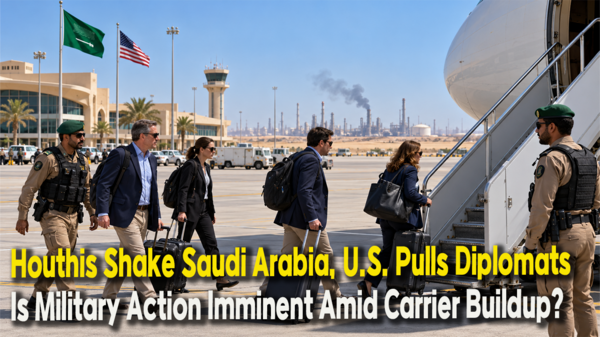
[U.S. Pulls Diplomatic Personnel Again… Threat Extends to Airports and Oil Fields]
The risk of regional escalation in the Middle East is surging again as Houthi strikes on Saudi Arabian airports and oil infrastructure prompt the withdrawal of U.S. diplomatic personnel. While reducing staff at its diplomatic missions, the United States is expanding its military options by deploying additional aircraft carriers. Tensions have mounted further alongside reports of Israeli preparations for a large-scale offensive against Iran. Although President Trump has ruled out strikes on Iran prior to the midterm elections, further provocations by the Houthis retain the potential to alter Washington's strategic calculus.
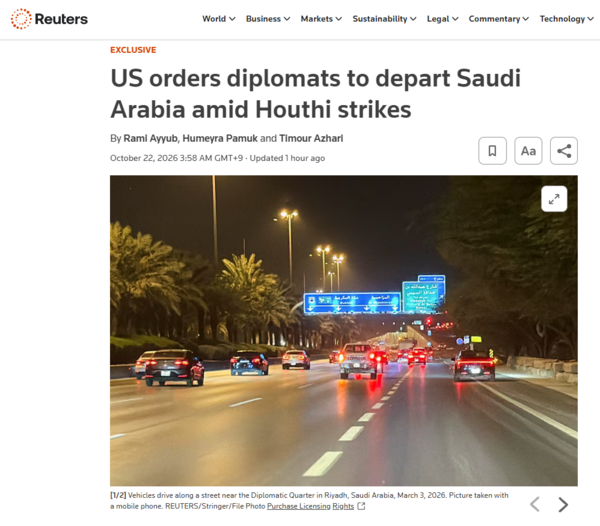
Reuters reported on the 22nd that "the U.S. Department of State ordered non-emergency government personnel and family members at diplomatic posts in Saudi Arabia to depart." The report cited State Department spokesperson Tommy Pigott explaining that Houthi attacks on civilian airports and vital infrastructure have resulted in civilian casualties and severe transport disruptions. While not a mandatory evacuation order for all private American citizens, the measure signals that the U.S. government assessed the risk to be severe enough to warrant cutting embassy staff.
According to Reuters, an attack on King Fahd International Airport in Dammam, eastern Saudi Arabia, left one person dead and eight injured. The Saudi Ministry of Energy also confirmed that two people were killed during an operation to intercept drones targeting Aramco's Shaybah oil field. However, widespread destruction or production halts at the oil field have not been confirmed. The gravity of the current crisis lies not solely in the casualty figures, but in the reality that civilian aviation and core energy infrastructure are simultaneously exposed to hostile strikes.
While the United States had gradually returned some of the regional diplomatic personnel it drew down following the outbreak of hostilities, it has been forced to reduce headcount once more. According to the AP, the formal departure order applies directly to Saudi Arabia, with temporary personnel adjustments being carried out at diplomatic posts across other Gulf states. While this move reflects both the immediate threat inside Saudi Arabia and the potential for wider regional escalation, it should not be construed as a complete evacuation of U.S. missions across the entire Gulf.
[Repeated Airport Strikes… Air Defense Burden Spills Into the Economy]
Saudi Arabia's crisis is not confined to isolated, one-off attacks. Turki al-Malki, spokesperson for the Saudi-led coalition, stated on the 15th that "King Khalid International Airport in Riyadh has been targeted 20 times during October alone." While not all attack attempts scored direct hits, the fact that a civilian airport serving the capital can be repeatedly targeted demonstrates the persistent nature of the Houthi threat.
Coverage reporting the coalition's announcement placed the cumulative casualty count from Saudi airport strikes at 19 dead and 364 injured. This figure reflects coalition data released on the 15th, and should be distinguished from updated figures that incorporate the subsequent incident in Dammam. Recurrent strikes on commercial hubs not only heighten passenger anxiety, but also trigger flight cancellations, schedule disruptions, and reassessments by international carriers regarding route viability.
Airports represent a critical pillar of Saudi Arabia's economic diversification agenda. When the gateways for inbound tourists, foreign business executives, and international conference attendees become volatile, the hospitality, retail, and event sectors absorb significant strain. When oil facilities come under simultaneous threat, the kingdom must defend its traditional revenue streams and nascent growth industries at the same time. Even if facilities remain operational, persistent attack risks are inevitably priced into insurance premiums, shipping schedules, and corporate investment decisions.
[Additional Carrier Deployment… Capability to Strike Differs From the Decision to Strike]
American military preparations are also moving forward. The assets featured in reports on additional deployments include the USS Theodore Roosevelt Carrier Strike Group alongside Navy and Marine Corps expeditionary units. Citing U.S. officials, Fox News reported that "these forces are expected to arrive in the Middle East by late November."
Augmenting aircraft carriers and amphibious assault capabilities broadens operational options across sustained air campaigns, sea control, and force protection. For Iran and the Houthis, this signals Washington's capacity to maintain prolonged military pressure. However, the operational significance hinges on whether the deployment represents a routine rotation or an overlapping dual-carrier posture for a designated window. The volume of relocating hardware must not be reflexively interpreted as an imminent decision to launch an offensive.
Military buildups also serve to strengthen leverage at the negotiating table. By maintaining credible strike capabilities, the United States forces Iran to factor in the steep costs of diplomatic breakdown. At the same time, executing an actual offensive dramatically increases the burden of deterring retaliation and shielding U.S. troops and regional partners. Expanding force posture yields more options; it does not eliminate the inherent costs of exercising them.
[FT Report on Massive Offensive Preparations… Why Trump Blocked It]
The Financial Times (FT) reported on the 21st that "Israeli Prime Minister Netanyahu ordered preparations earlier this month for a massive offensive against Iran, but the plan was not executed due to Trump's opposition." The report indicated that "targets under review included nuclear installations, regime-linked facilities, and power plants." However, with pushback from sources cited by The Jerusalem Post, differences remain regarding the concrete details of the preparation orders and operational plans.
The crucial takeaway is that alongside active military planning, tangible political constraints have acted as a brake on execution. Trump previously made public his stance of not launching an attack on Iran before the midterm elections. Taking into account the risk of surging energy prices and domestic public backlash from a widening conflict, the prevailing calculation seeks to maintain strike readiness while exercising operational restraint.
This does not mean, however, that military action will commence automatically once the November 3 election passes. While one specific political constraint will recede after the vote, the risks of Iranian retaliation, U.S. casualties, and severe disruptions to global energy markets will remain intact. The path chosen will continue to depend on diplomatic progress, Tehran's actions, and Israel's strategic assessments. Election Day stands as a major variable, not a confirmed launch date for war.
[Why Times Insight | Houthis Shake Trump's War Timetable]
The core dynamic of the current crisis is that even if Washington intends to control the timing of a large-scale strike, it cannot micromanage the pace of clashes on the ground. Should further Houthi attacks result in American casualties or force prolonged shutdowns of vital Saudi installations, the pressure on Washington to retaliate will surge. The policy of pre-election restraint will face severe stress tests as field conditions evolve.
The strategic dilemma confronting the United States is far from simple. Merely stepping up air defense support does little to alleviate Saudi anxiety if incoming barrages persist. Conversely, executing massive strikes against Houthi launch sites and weapons depots means accepting the hazards of retaliatory counter-strikes and deeper regional entanglements. Expanding the target set to mainland Iran fundamentally alters both the scope and objectives of the war. Conflating the punishment of the Houthis with strikes on Iranian nuclear sites obscures these distinct strategic realities.
One must also be cautious not to characterize every Houthi operation as a direct command from Tehran. While Iranian backing and strategic alignment are substantial, the Houthis pursue their own independent objectives and internal interests rooted in the Yemeni conflict. This explains why diplomatic breakthroughs with Tehran cannot guarantee an immediate halt to Houthi attacks. The United States must contend with an adversarial network whose components are linked, yet do not act as monolithic proxies.
For Saudi Arabia, this crisis extends well beyond air defense interceptor inventories. Perfectly shielding airports, oil fields, and seaports dispersed across vast territory remains practically impossible. An attacker needs only a handful of breakthrough hits to trigger widespread instability, whereas the defender must prove safety continuously. As this structural asymmetry persists, military expenditures escalate alongside uncertainty in the civilian economy. For a leadership actively engineering a national economic transformation, the costs of defense and growth must be borne simultaneously.
Attacks on civilian airports carry economic consequences that reverberate far beyond localized kinetic damage. Foreign investors look past air defense interception metrics to assess whether business operations can proceed with predictable stability. International travelers, likewise, are far more responsive to whether their flights are grounded than to official assurances regarding defense capabilities. The more Saudi Arabia positions itself as an international hub for commerce and tourism, the steeper the economic toll exacted by recurring strikes.
The drawdown of diplomatic personnel represents a defensive move by Washington to minimize the risk to American lives amid escalating threats. Combined with force posture enhancements, it can be viewed as posturing for regional contingencies, but the drawdown itself does not constitute a strike authorization. Key indicators moving forward will be the scale of Houthi strikes, potential American casualties, concrete operational disruptions across Saudi facilities, and the progress of additional force deployments and diplomatic talks.
While Trump seeks to control the operational clock, repeated Houthi strikes are systematically forcing Washington's hand. The latest departure order does not reflect an established war timetable; rather, it serves as a stark warning that field hazards are actively upending Washington's strategic calculations. Even as decisions are deferred in Washington, the security and economic costs borne by Saudi Arabia continue to accumulate.

-중국 푸단대학교 한국연구원 객좌교수
-전 EDUIN News 대표
-전 OUR NEWS 대표
-제17대 대통령직인수위원회 정책기획팀장
-전 대통령실 홍보기획비서관
-사단법인 한국가정상담연구소 이사장
-저서: 북한급변사태와 한반도통일, 2012 다시우파다, 선거마케팅, 한국의 정치광고, 국회의원 선거매뉴얼 등 50여권



