Update2026.10.24 (토)

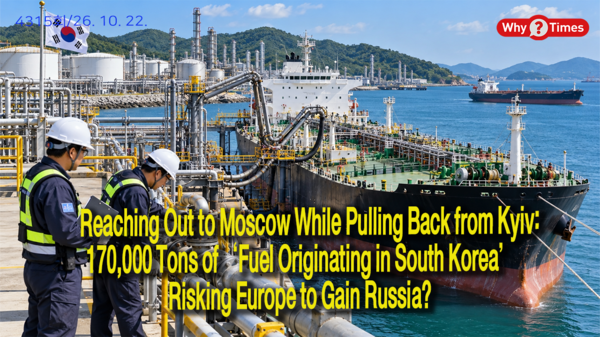
[South Korea Deepens Ties with Moscow While Withdrawing Diplomatic Staff from Kyiv]
The South Korean government's foreign policy trajectory toward Russia faces a major test as Seoul emphasizes managing relations with Moscow while concurrently drawing down its diplomatic presence in Ukraine. Adding to the friction, reports have surfaced indicating that fuel shipments departing from South Korean ports entered Russia, in some cases via tankers designated under international sanctions. While individual commercial transactions cannot automatically be characterized as state-level assistance to Russia, merely asserting compliance with domestic law will hardly quell mounting international skepticism. It is high time to scrutinize whether the economic gains Seoul hopes to secure from Moscow outweigh the damage to trust with European partners and the secondary sanctions risks confronting South Korean firms. In particular, intense scrutiny is centering on why the South Korean administration is keeping Kyiv at arm’s length while gravitating closer toward Moscow.
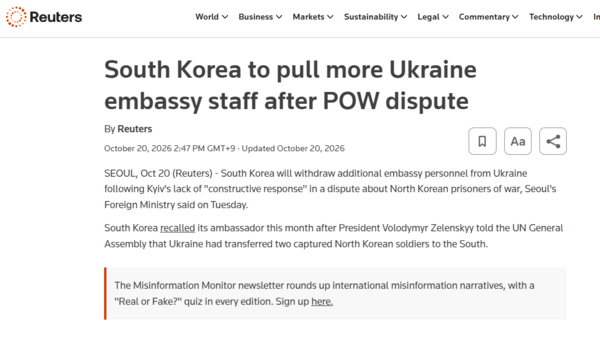
Reuters drew keen attention on the 20th (local time), reporting: "The South Korean government has decided to pull additional personnel from its embassy in Ukraine amid a diplomatic row triggered by the public disclosure of a transfer involving North Korean prisoners of war (POWs)." Reuters further noted that "following the earlier recall of its ambassador to Seoul, this move marks an escalation in diplomatic protest. South Korean authorities maintain that Ukraine failed to deliver a constructive response. Against this backdrop, the divergence in foreign policy stands in sharp relief as Seoul's relations with Kyiv deteriorate precisely when it is stressing the strategic necessity of managing ties with Russia."
To be sure, scaling back embassy personnel cannot automatically be branded an overt pro-Russian pivot. The government argues that an understanding to safeguard the confidentiality and physical safety of the POWs and their families was breached, citing heightened risks from Russian aerial bombardments as operational justification for the drawdown. Nonetheless, many observers view the official explanation with deep skepticism, given that other foreign diplomatic missions in Kyiv are not executing comparable withdrawals. Outside observers have questioned whether unpublicized diplomatic complications lie behind the POW friction, the fuel-shipment controversy, and the push for economic cooperation with Russia. Regardless of the tactical explanations offered for each incident, the aggregate picture inevitably raises the troubling question: is Seoul deliberately drifting away from Ukraine?
[‘Fuel from South Korea’ Raised by The Guardian: Government Probes Transaction Details]
At the center of this controversy lies an investigative report published by The Guardian on the 6th. The Guardian reported: "An analysis of port records and vessel-tracking data shows that over 176,000 tons of refined petroleum products were loaded at South Korean ports in July and August and transported to the Russian Far East." The outlet noted: "The shipments consisted predominantly of diesel, and out of seven tankers involved in the transit, three were subject to UK and EU sanctions. The South Korean government subsequently stated that it is verifying additional information and will take action if violations of domestic laws are identified."
However, stating that "fuel originated from South Korean ports" does not necessarily imply that the products were refined domestically or sold directly to Russia by South Korean refiners. Reuters also covered the volumes and their mitigating impact on regional Russian fuel shortfalls by citing claims from Ukrainian sanctions officials. A definitive assessment of the legality and accountability of the transactions requires establishing the complete chain of custody: the original suppliers, brokers, end buyers, and actual end-users.
The South Korean government explained that official customs export statistics show zero exports of diesel, jet fuel, or gasoline to Russia. Yet, when customs records diverge from physical vessel-tracking trajectories, the focus of investigation becomes obvious. Authorities must verify whether the initial declared destination diverged from the final discharge port, and precisely who authorized any diversion at sea. The mere absence of transactions in official statistics cannot substitute for an on-the-ground investigation into the actual shipping logistics.
[‘Permitted Under Domestic Law’ vs. ‘International Trust’]
Some domestic media outlets in South Korea emphasize that commercial refined oil products are not included on South Korea’s national export restriction lists against Russia, and that transport operations are not banned under South Korean domestic law solely because a vessel has been designated by foreign sanctions regimes. Under this reasoning, the transactions should not be prematurely categorized as violations of South Korean sanctions.
However, legal permissibility is entirely separate from policy appropriateness. If Seoul proclaims alignment with multilateral sanctions while failing to exercise due diligence over port access by designated vessels or fuel shipments bound for Russia, European counterparts will inevitably question the efficacy of South Korea’s export compliance infrastructure. The core issue is not simply whether the government engaged in deliberate evasion, but whether regulatory authorities possess the capability to identify and interdict sanctions-sensitive transactions.
[What Drives the Approach to Russia: The Economic Calculus of the Northern Sea Route]
The clearest area where the government has publicly defended its engagement with Russia is the development of the Northern Sea Route (NSR). The presidential office stated at a Cabinet meeting on the 13th that managing bilateral ties with Moscow is essential for developing the Arctic maritime passage. The underlying rationale is that stable passage through waters hugging the Russian coastline requires Moscow's active cooperation. Official reports submitted during the session acknowledged Western diplomatic sensitivities and the complexities of utilizing icebreaker operators targeted by international sanctions.
Concurrently, the presidential office reaffirmed its commitment to international norms and sanctions frameworks. There is insufficient evidence to conclude that Seoul has formally decided to break with international sanctions. The true test is whether the stated commitment to pursue diplomatic engagement and sanctions compliance simultaneously can function in practice. Potential motivations may include keeping dialogue channels open regarding the Korean Peninsula or hedging for post-war economic ties. Furthermore, notable speculation suggests Seoul may be attempting to leverage ties with Russia to influence Moscow's deepening alliance with Pyongyang and facilitate an opening with North Korea.
[To Europe, It Is a Question of Security, Not Economic Cooperation]
Europe sees the landscape through a starkly different lens. EU leaders reaffirmed their resolve to intensify pressure on Russia during summits held on the 15th and 16th. As South Korea pursues deeper cooperation with Moscow for perceived commercial opportunities, European nations are compelled to evaluate whether such engagements undercut the effectiveness of sanctions. What Seoul might view as a limited commercial transaction risks being interpreted by European allies as providing economic relief to sustain Russia’s war machine.
The Northern Sea Route cannot be framed simply as a commercial maritime venture. According to Reuters, the EU unveiled a revised Arctic strategy on the 20th that prioritizes maritime surveillance and the protection of critical undersea infrastructure in response to mounting Russian military activity. While Seoul highlights the commercial viability of Arctic shipping, Europe views the identical geographic domain as an acute security flashpoint. South Korea must articulate not just its commercial interest, but how it intends to navigate and counter Russia’s expanding strategic footprint in the high north.
Such perceptual disconnects threaten to spill over into defense and security partnerships with Europe. If South Korea—a key partner contributing to European deterrence—comes to be viewed as a vulnerable transshipment conduit for sanctions evasion, its strategic credibility will be eroded. While there are no indications that defense procurement contracts have been canceled over this controversy, the risk of reputational damage to South Korea's standing in Europe requires serious caution. In particular, Seoul must guard against the mounting diplomatic costs of having to defend its reliability during future procurement negotiations and parliamentary deliberations across Europe.
[Could South Korean Companies Face Sanctions?]
The possibility cannot be dismissed. The U.S. Office of Foreign Assets Control (OFAC) explicitly warns that non-U.S. entities engaging in material support for Specially Designated Nationals (SDNs) or facilitating sanctions circumvention face exposure to secondary sanctions. However, secondary sanctions are not triggered automatically solely because a transaction involves Russia; OFAC assesses the specific designation status of the counterparty, the nature and materiality of the support, and applicable general licenses or exemptions.
European authorities are likewise targeting third-country intermediaries. On the 15th, the EU introduced sanctions against three individuals and nine corporate entities implicated in sanctions circumvention, including shipping and brokerage firms registered in the United Arab Emirates, India, and Seychelles. While this does not indicate that South Korean entities face imminent designations, it provides clear precedent that corporate entities in third countries are actively subject to asset freezes and commercial prohibitions based on specific facilitation acts.
Significant financial headwinds can emerge well before formal designations occur. If foreign correspondent banks, marine insurers, or international shipping lines demand heightened due diligence or refuse transactions out of risk aversion, cross-border clearance and maritime transport face immediate bottlenecks. This is not an established casualty of the current episode, but a foreseeable commercial fallout. The government must take proactive measures to ensure that transparency issues surrounding select shipments do not inflate the compliance overhead for law-abiding South Korean exporters.
[Why Times Insight] The Cost of Lost Trust Far Outweighs Moscow’s Economic Dividend
Maintaining diplomatic communication channels with Russia is not intrinsically objectionable. However, genuine realpolitik requires weighing tangible dividends against the loss of strategic trust. When potential economic returns from the Northern Sea Route remain speculative while tangible diplomatic frictions with Europe mount, policy priorities must be fundamentally reassessed. Improving relations with Moscow does not inherently translate into advancing South Korea's core national interest.
Europe’s benchmark for evaluating these developments differs fundamentally from Seoul’s. While South Korean authorities focus narrowly on whether items are restricted under domestic export statutes, Europe focuses on whether these movements undermine collective containment of the Russian war effort. Against the backdrop of European leaders recommitting to maximum pressure against Moscow, maritime fuel transits originating in South Korean ports directly feed skepticism regarding Seoul’s commitment to sanctions enforcement. While this does not represent a formal European finding against South Korea, it constitutes a serious diplomatic risk that requires careful handling.
The ingress and egress of the "shadow fleet" across South Korean ports, including Busan, must be audited against these same strict criteria. The core vulnerability is not confined to direct petroleum sales to Russia; if sanctioned tankers receive port services such as bunkering, ship repairs, or provision replenishment in South Korean harbors, Seoul risks being viewed as an operational hub facilitating the logistics of illicit shipping networks. The EU has already barred designated vessels from accessing EU ports and prohibited maritime service provision to them.
Beyond diplomatic fallout, shadow fleet activity poses direct hazards to maritime safety. The EU emphasizes that substandard, uninsured vessels jeopardize maritime security, coastal environments, and submarine critical infrastructure. South Korean authorities must scrutinize vessels beyond flag state and paper names to identify beneficial ownership, verified P&I insurance coverage, automatic identification system (AIS) gaps, and ship-to-ship transfer histories. While it is hyperbolic to suggest that Busan Port itself faces systemic sanctions, Seoul must actively prevent one of the world's premier transshipment hubs from being perceived as a lax harbor for sanctions risks.
The threat of sanctions hitting South Korean firms must not be taken lightly. The EU has already demonstrated a readiness to penalize third-country maritime brokers, and the U.S. retains robust authorities to sanction non-U.S. entities providing material assistance to designated parties. Granted, designations are not triggered automatically simply for providing generic services or engaging in commercial trade with Russia. Each engagement is evaluated on counterparty status, the operational nature of services rendered, and applicable exemptions. Yet, merely asserting legality under domestic legislation does not insulate corporate actors from international secondary sanctions.
Even absent formal designations, private-sector friction will mount. Heightened risk perceptions will prompt international insurers, banks, and maritime carriers to demand extensive documentation or exit transactions altogether, causing severe delays in letters of credit and cargo delivery. The government must act preemptively to ensure that opacity surrounding certain transactions does not spill over into crippling compliance burdens for honest, rule-abiding domestic enterprises.
Furthermore, partial sanctions waivers granted by the United States do not confer global legal immunity. Even where Washington carves out specific exemptions for select vessels or activities, restrictions imposed by the EU and the UK remain operative. Reuters noted that even if the U.S. were to review relaxations for certain vessels, European marine insurance prohibitions would still impose binding operational constraints. South Korean firms must not assume that U.S. regulatory clearance guarantees safe harbor within European financial and insurance networks.
Seoul's diplomatic posture toward Russia must align with its broader security diplomacy. South Korea has consistently warned the international community about the grave threats posed by deepening Russia–North Korea military ties, actively soliciting multilateral coordination. If Seoul concurrently gives the impression of being ambivalent toward measures curbing Russia’s war capability, its moral and strategic leverage in rallying international support for Korean Peninsula security will inevitably crumble. South Korea must exercise calibrated judgment: managing diplomatic frictions with Kyiv while refusing to compromise strategic and defense alignment with European partners.
The government cannot stop at defensive assertions of technical legality. It must uncover the full transaction trail—identifying suppliers, buyers, brokers, and actual discharge locations—while overhauling inspection standards and service-provision rules for sanctioned vessels across domestic ports, including Busan. We must not build a paradigm where the administration claims the political gains of engagement with Moscow while leaving domestic firms to shoulder the crushing commercial and sanctions liabilities. The success of pragmatism in foreign policy is measured not by how close Seoul gets to Moscow, but by how steadfastly it defends South Korea's national security and corporate credibility on the global stage. In short, one cannot help but question whether the current administration's foreign policy toward Russia and Ukraine is operating with strategic coherence.

-중국 푸단대학교 한국연구원 객좌교수
-전 EDUIN News 대표
-전 OUR NEWS 대표
-제17대 대통령직인수위원회 정책기획팀장
-전 대통령실 홍보기획비서관
-사단법인 한국가정상담연구소 이사장
-저서: 북한급변사태와 한반도통일, 2012 다시우파다, 선거마케팅, 한국의 정치광고, 국회의원 선거매뉴얼 등 50여권