


Update2026.10.24 (토)

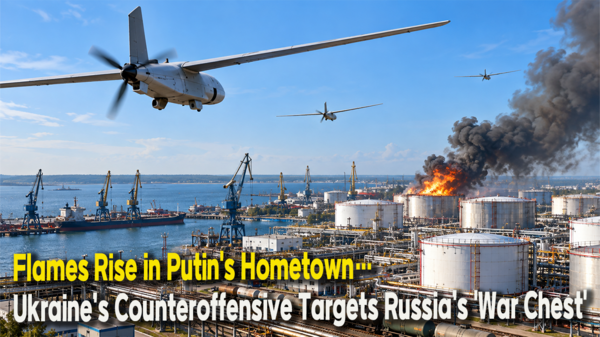
[Flames in Putin's Hometown, Zelensky's Uppercut]
As Ukraine launched a large-scale drone attack on the Russian mainland, oil facilities in St. Petersburg—President Vladimir Putin's hometown—were engulfed in flames. Russia, which had been trying to force Ukraine into submission through winter cold and power outages, now faces the burden of defending its own energy and logistics hubs. Ukraine has directly challenged Putin’s calculation that dragging out the war will ultimately guarantee a Russian victory.
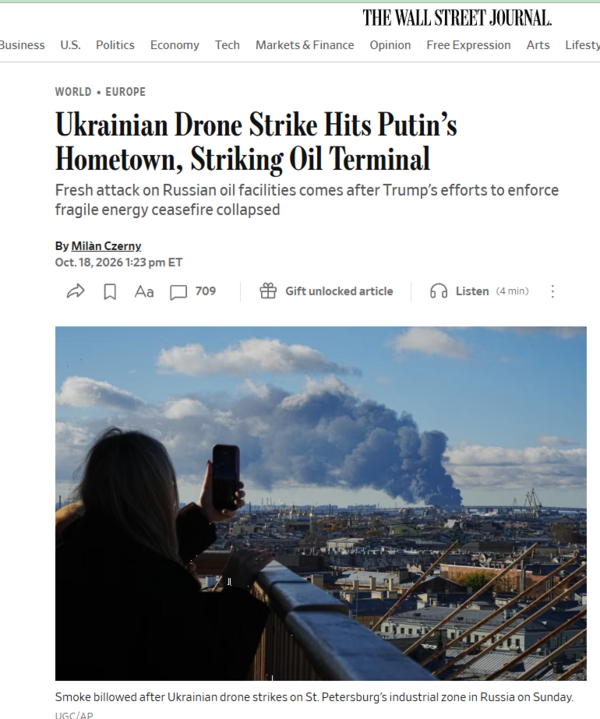
The Wall Street Journal reported on the 18th (local time) that "a Ukrainian drone strike hit an oil terminal in St. Petersburg, Putin's hometown," adding that "the attack carries symbolic significance beyond military damage, as it struck Russia’s second-largest city and Putin’s political launching pad". While the Kremlin continues to advertise its war progress, vulnerabilities in the rear of Russia’s major metropolitan centers have been exposed.
Reuters also reported that "oil facilities, logistics hubs, and data centers in St. Petersburg and the surrounding Leningrad region came under attack, with local authorities reporting 1 death and 15 injuries". It added that "fires broke out at an oil terminal, oil storage facilities, and industrial warehouses, while e-commerce giant Ozon confirmed a fire at its logistics center, and internet company VK confirmed damage to its data center".
According to ABC News, the Russian Ministry of Defense claimed to have shot down 1,015 Ukrainian drones across multiple regions overnight. However, despite claims of massive interceptions, fires at key economic facilities were confirmed. A clear discrepancy has emerged between Russia’s assertions of successful defense and the visible damage in its rear areas.
[Ukraine Targets the Oil Network Feeding the War]
The primary focus of this attack was oil infrastructure. Unlike refineries that convert crude oil into fuel, oil terminals and storage depots serve as key hubs for storing, moving, and shipping refined petroleum products. Even if production facilities remain operational, disruptions in storage and transport inevitably impact distribution and supply. While the exact extent of shipment delays caused by the fires requires further confirmation, Ukraine’s focus on Russia’s economic weak point is clear.
Repeated strikes incur costs far beyond repairing damaged facilities. Russia must spend resources on alternative transport routes and inventory management, as well as reinforce air defense networks to prevent follow-up strikes. Moscow is forced to allocate resources to secure both the frontline and the home front simultaneously. Ukraine’s objective is to ensure that the longer Russia continues the war, the higher the financial burden it incurs.
As the scope of attacks expands from energy assets to logistics and digital infrastructure, the defensive burden grows exponentially. Russia must protect not only military bases and ammunition depots, but also ports, storage yards, and major urban economic hubs. This strike alone will not paralyze the Russian economy, but the challenge of safeguarding critical assets across a vast territory forces the strain of a long-term war back inside Russia’s borders.
[Strikes Unstopped Even by 'Energy Ceasefire']
To fully grasp this attack, one must review the developments in Washington over the past ten days. President Trump has raised concerns about Ukrainian strikes on Russian refineries since September. In September, he urged Ukraine to halt attacks on Russian refineries, identifying them as a primary cause of global diesel shortages. On October 9, he announced a deal with President Putin, claiming Russia would immediately release over 300,000 tons of diesel and supply an additional 1.5 million tons. The U.S. Treasury Department subsequently issued a temporary waiver allowing transactions involving Russian diesel—including imports into the U.S.—until April 7, 2027. AP noted, "This marks the first time since the outbreak of the war that diesel sanctions have been eased for an extended period beyond the standard 30 days."
Two days later, on October 11, President Trump unilaterally declared a ceasefire. He posted on Truth Social that an "immediate 'energy ceasefire' between Russia and Ukraine has taken effect," without offering further specifics. Kyiv was caught off guard. President Zelensky told Axios on the same day that he was "hearing about the ceasefire for the first time," confirming that "Russian strikes on energy infrastructure continued that very day". Ukraine claimed it paused strikes on Russian energy targets for several days following the announcement, but resumed operations after Russian bombardments persisted. President Zelensky asserted, "Since the ceasefire announcement, Russia has carried out over 76 strikes on Ukrainian energy, oil, and gas facilities."
Citing these attacks, President Zelensky directly criticized Washington's appeasement policy toward Moscow. He stated, "The United States must understand that Russia is making no reciprocal concessions in exchange for sanctions relief or deals. Instead, Russia treats every revenue-generating opportunity as proof that its war gamble is succeeding and that it can keep fighting". Conversely, President Trump placed the blame on Kyiv. In an October 15 interview with Newsmax host Rob Finnerty, Trump vented his frustration, stating, "If President Zelensky says he is attacking oil refineries again, that only drives global oil prices higher. It's a absolute disgrace. There are plenty of other targets to hit".
[Diesel Prices, Midterm Elections, and Sanctions Waivers]
Domestic politics lie behind President Trump’s calculations. According to the American Automobile Association (AAA), average U.S. diesel prices hit an all-time high of $6.5276 per gallon in late September. Diesel prices surged nearly 70% following the outbreak of the war with Iran in February, and the sanctions waiver arrived less than three weeks before the midterm elections. However, Russia’s capacity to bring down global prices remains limited. Due to domestic supply shortages caused by Ukrainian refinery strikes, Russia has restricted diesel exports since July, and the International Energy Agency (IEA) estimates that Russian diesel output has fallen by roughly 30%. One expert noted that the volume of Russian diesel entering the market under Trump's policy is negligible. Given that Ukraine’s strikes on refineries have systematically undermined Russia’s supply capacity, demanding that Kyiv stop these attacks is equivalent to asking it to surrender its primary geopolitical leverage.
Washington’s policy shift reached its peak on October 16. President Trump signed an executive order waiving a substantial portion of the sanctions under the so-called "Graham Act" (Lindsey O. Graham Sanctioning Russia and Iran Act). In the executive order, he argued that the waiver served U.S. national security interests. The bill, which Trump himself had signed into law just last month, was a comprehensive sanctions package aimed at squeezing Russia’s energy revenues. On October 17, Trump defended his decision, stating, "We will find a solution, and you will find a solution. But this is a very good decision, a decision good for the country, and I believe it will be good for the world". Pushback was swift and fierce. Senate Democratic Leader Chuck Schumer condemned the measure as a "deal with the devil" that hands an economic lifeline to Russia.
[U.S. Intelligence Sharing Resumes… Counteroffensive and Defense Must Progress Hand in Hand]
In an NBC interview aired on October 18, President Zelensky revealed that "U.S. intelligence sharing was temporarily suspended but has now resumed." According to Reuters, the shared intelligence primarily focuses on early warnings against incoming Russian missile strikes. While the restoration of intelligence flows represents a crucial development for Ukrainian defense, there is no confirmed evidence directly linking it to the execution of the St. Petersburg strike.
Ukraine’s ability to strike deep into Russia’s rear and its capacity to defend its own cities must be reinforced in tandem. Even if long-range drones inflict significant damage on Russia, Ukraine’s long-term endurance will suffer if its own power grids and industrial bases are destroyed at a faster rate. To sustain the dividends of offensive operations, robust early-warning capabilities, interception systems, and rapid power grid restoration must follow.
NATO has also underscored the urgency of boosting air defense assistance ahead of winter. On October 14, Secretary General Mark Rutte declared, "Allies must step up support, particularly for Ukraine’s air defense." Proposals like that of British military expert Hamish de Bretton-Gordon—suggesting Western air forces assist in defensive missions—reflect this heightened concern. However, deploying NATO air power remains an unconfirmed proposal, requiring careful weighing of operational feasibility against the risks of direct escalation with Russia.
[Why Times Insight | A War of Attrition Started by Putin Is Burning Away Russia’s Future]
The significance of this strike extends beyond the mere fact that fires broke out in St. Petersburg. What matters most is that the framework of the long-term war Putin counted on is unraveling. His calculus—that mobilizing more troops and resources to endure would eventually collapse Ukraine and exhaust the West—is now confronted with the fresh burden of persistent, mounting losses in the Russian rear.
First, prolonging the war has turned into a self-draining strain on Russia’s national power. Rebuilding damaged infrastructure, re-establishing defenses, and covering economic losses require vast financial and human capital. As these costs compound, Moscow must constantly weigh its marginal gains on the frontline against the escalating damage at home. The premise that time automatically favors Russia in a war of attrition is no longer guaranteed.
Second, Putin’s political promise is coming under severe strain. The Kremlin has sought to maintain domestic stability by promising normal daily life alongside a strong state while prosecuting the war. But when key energy and logistics hubs in major metropolitan areas are hit, it becomes increasingly difficult to dismiss the war as a distant conflict on far-off frontlines. As the state promises victory, citizens and businesses witness firsthand the vulnerabilities in national defense.
Third, Ukraine’s ultimate goal is to force Putin to confront the true cost of continuing the war. A single fire will not bring down Russia. However, as relentless strikes and repair burdens undermine military gains, Moscow will find it impossible to avoid the fundamental question: Is continuing the conflict building Russian power, or destroying it?
It is premature to declare Russia’s defeat. Yet, there is no guarantee that continuing the war brings Putin any closer to victory. An invasion intended to wear down and subjugate Ukraine has morphed into a war that eats away at Russia’s own economic foundation and national capability. The flames rising from Putin’s hometown stand as a stark warning: the prolonged conflict he set in motion may ultimately jeopardize his own rule and the future of Russia.


-중국 푸단대학교 한국연구원 객좌교수
-전 EDUIN News 대표
-전 OUR NEWS 대표
-제17대 대통령직인수위원회 정책기획팀장
-전 대통령실 홍보기획비서관
-사단법인 한국가정상담연구소 이사장
-저서: 북한급변사태와 한반도통일, 2012 다시우파다, 선거마케팅, 한국의 정치광고, 국회의원 선거매뉴얼 등 50여권



