Update2026.10.24 (토)

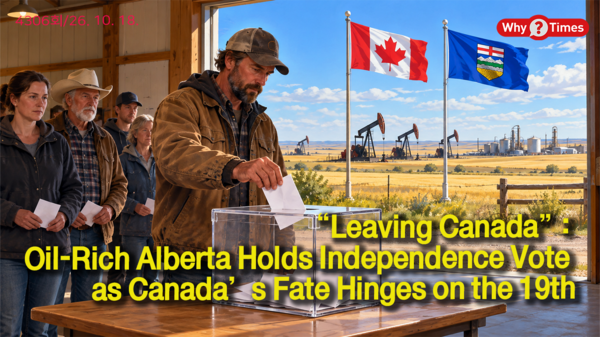
[Non-Binding Referendum Asks Whether to Pursue Alberta Separation Process]
Alberta, Canada’s top oil-producing province, is holding a referendum to ask voters whether to initiate formal procedures toward separation. While not an immediate vote on independence, cracks in Canadian unity have spilled over into the polling booth amid trade pressure from U.S. President Donald Trump and his remarks about a potential "51st state". Prime Minister Mark Carney warned that casting a ballot merely to lodge a protest against the federal government could plunge the entire country into prolonged uncertainty.
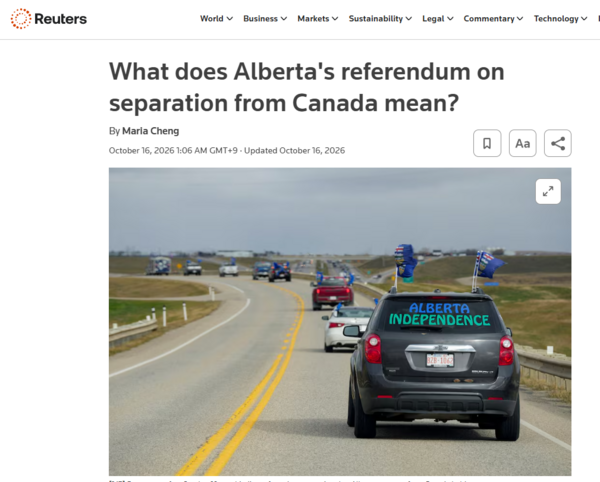
Canada’s province of Alberta will hold a non-binding referendum asking residents whether to remain part of Canada. This marks the first time the oil-rich province has put the question of secession to a referendum, though opinion polls indicate around 70% of Albertans favor staying in Canada, with roughly a quarter supporting independence.
Keith Wilson, co-leader of the pro-independence group 'Let Alberta Decide,' stated that the independence movement will continue even if the referendum fails. Wilson argued that elevating the separation issue into a major political agenda item is already a victory—highlighting a clash in strategy between a federal government seeking to settle the debate through a 'remain' victory and separatists who view the vote as the starting point of a long-term campaign.
The nature of the vote must be clearly understood. On the ballot containing 10 items, voters will address a final question asking whether Alberta should remain in Canada or initiate the constitutional legal process to hold a future binding separation referendum. The question itself carries no immediate legal force. Even if the option to pursue separation procedures wins, it does not automatically guarantee independence or a follow-up referendum. Unofficial results are expected within 48 hours after polls close.
[PM Carney Warns “This Isn’t Poker”: The High Risks of a Protest Vote]
Prime Minister Carney's warning is directed not only at hardline separatists, but also at voters considering a 'yes' vote on separation procedures simply to pressure the federal government in Ottawa. In an Edmonton speech, he emphasized, "Do not be fooled into thinking you can send a message with your vote." He cautioned, "This isn't poker," warning that a vote against Canada risks becoming a dangerous bluff that invites long-term uncertainty and lost opportunities.
At the heart of the separatist movement lies a deep-seated sentiment of "Western alienation". Separatists argue that while Alberta's energy wealth is used to support other regions, federal regulations and bureaucracy hinder the province's own industrial growth. Under this pressure, Premier Danielle Smith moved forward with the referendum, though she publicly stated that she voted 'remain' during advance polling. In effect, even the leader who brandished the separation card drew a firm line against actual secession.
[Shadow of Washington: Contacts and Commitments Are Not the Same]
Contacts between U.S. officials and Alberta separatists have indeed occurred. U.S. officials met with representatives from the 'Alberta Prosperity Project'. The organization pursued further meetings to request a $500 billion U.S. credit facility to finance a transition to independence. However, this represents the separatists' own design rather than any promise of financial aid or independence guarantees from Washington. U.S. officials maintained that no support or promises were offered during these contacts.
In connection with this, Prime Minister Carney warned in a Calgary speech that "forces beyond our borders are attempting to divide and conquer Canada." Against the backdrop of Trump's annexation remarks and ongoing trade pressure, Carney linked regional grievances to national sovereignty. Nevertheless, pursuing Alberta independence remains distinct from U.S. annexation, and mere contact with U.S. officials does not serve as definitive proof of an organized foreign-backed separation plot.
[Holding On via Pipelines: Implementation Matters More Than Announcements]
The economic solution offered by the federal government is the Pacific Link pipeline. The Carney government designated the project—aimed at transporting Alberta crude to the Pacific Coast—as a project in the national interest. Estimated at CA
35.2billiontoCA43.7 billion, the project is a strategic card designed to expand export routes beyond the U.S. and demonstrate that Alberta can unlock greater economic opportunities within Canada.
However, national interest designation does not equal immediate completion. Proponents have outlined regulatory filing processes stretching through September 2027, with the final route still requiring consultations with Indigenous communities and local municipalities. If construction stalls or costs escalate, separatists' arguments that Ottawa's promises cannot be trusted could regain momentum.
[The Cost of Independence: Ultimately Paid in Taxpayer Dollars and Jobs]
Actual separation faces formidable hurdles, including constitutional frameworks and Indigenous treaties. Canada's Clarity Act—which sets the terms for federal negotiations if a province seeks secession—does not recognize unilateral state withdrawal, requiring broader constitutional amendment negotiations instead. Indigenous communities also oppose separation based on existing treaties with the Canadian Crown. A court halted an earlier independence petition approval process, citing insufficient consultation with Indigenous peoples.
A University of Calgary report commissioned by the Alberta government estimated that "establishing a new nation could cost between CA50billionandC A170 billion over the first five years." A separate study by the Calgary Chamber of Commerce analyzed that "increased trade costs could lead to reduced investment and employment alongside heightened fiscal pressure." Secession would not simply mean keeping funds previously sent to Ottawa; Alberta would also have to absorb expensive state functions such as national defense and federal administration. Ultimately, the bill delivered to residents could take the form of higher taxes or reduced public services.
[Why Times Insight]
First, resource wealth does not automatically translate into strong post-independence bargaining power. While Alberta is rich in oil, it remains a landlocked province with no direct maritime access. Leaving Canada will not magically build ports or export corridors. On the contrary, constructing pipelines to access non-U.S. markets requires deep cooperation with neighboring provinces and the federal government. Albertans must beware the paradox where attempting to escape Ottawa's oversight only deepens reliance on U.S. buyers.
Second, politicians who use the separation card for leverage must take responsibility for the flames they ignite. Premier Smith voting 'remain' does not absolve her of the duty to manage political conflict. Separatist groups have already announced their intention to continue their campaign regardless of a referendum defeat. The separatist sentiment once useful for pressuring Ottawa could easily turn back to pressure the provincial government itself. Managing the aftermath and reconciling division is far harder than holding a referendum.
Third, regardless of the outcome, the vote leaves Prime Minister Carney with a heavy political burden. Even if 'remain' wins, the fact that a vote on pursuing secession took place in Canada's core energy province cannot be erased. Conversely, if the mandate to pursue separation procedures prevails, Carney will face dual pressure: managing trade friction with the U.S. while safeguarding national unity at home. Confronting Trump externally while holding onto Alberta domestically threatens to constrain Carney's negotiating leverage and overall governance.
Fourth, Carney’s firm stance toward the U.S. and approach toward China must be rigorously evaluated against national interest. Although Carney reached an agreement with China to lower tariffs on EVs and agricultural products, Trump threatened 100% tariffs, warning that Canada could serve as a back-door transit route for Chinese goods into the U.S. While improving ties with Beijing was not the original root of bilateral friction, it has undeniably become a fresh trigger. Even if trade diversification is necessary, Canada must weigh whether gains from closer relations with China outweigh the costs of deteriorating ties with its largest trading partner, the United States.
Firmness in defending sovereignty is essential. However, whether that response effectively protects jobs, exports, and domestic unity requires separate evaluation. Carney will ultimately be judged not by how harshly he criticizes Trump, but by how well he preserves Canada’s national interest throughout the process.
It is through these four lenses that the results of the referendum command close attention. While the vote is expected to be defeated, the specific percentage of support for Alberta independence will likely exert a profound influence on Canada's political landscape.

-중국 푸단대학교 한국연구원 객좌교수
-전 EDUIN News 대표
-전 OUR NEWS 대표
-제17대 대통령직인수위원회 정책기획팀장
-전 대통령실 홍보기획비서관
-사단법인 한국가정상담연구소 이사장
-저서: 북한급변사태와 한반도통일, 2012 다시우파다, 선거마케팅, 한국의 정치광고, 국회의원 선거매뉴얼 등 50여권