


Update2026.10.24 (토)

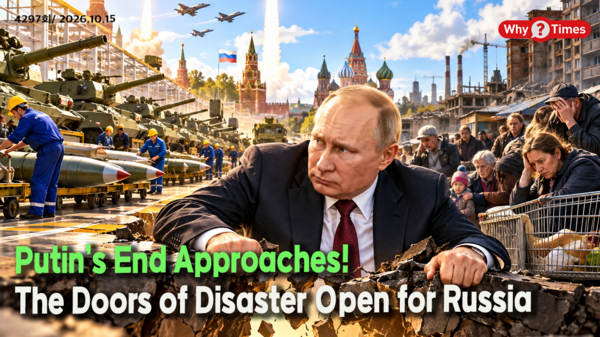
[Booming Arms Factories, Suffocating Private Economy: The Two Faces of Russia]
The war economy built by Russian President Vladimir Putin is turning into a massive trap destroying Russia's future. While the defense industry—flooded with vast resources to sustain the war in Ukraine—is booming, the private sector and technological innovation ecosystem, which are essential for Russia's long-term future, are steadily deteriorating.
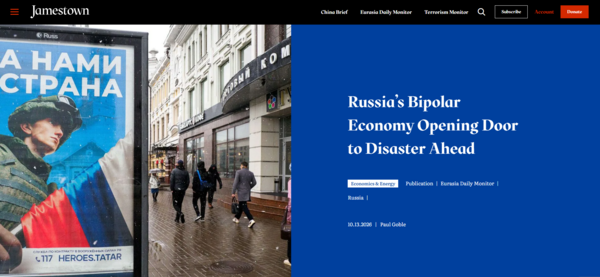
The Jamestown Foundation, a U.S. security think tank, warned that this "bipolar economy" could ultimately threaten Russia’s military competitiveness over the long term. More critically, as Putin prolongs the war, he must sacrifice Russia's future; yet even if the war ends, normalizing an economy so heavily reliant on the defense industry will be extremely difficult.
On October 13 (local time), the Jamestown Foundation published an analysis by Russia expert Paul Goble pointing out that "under Putin, there are effectively two economies in Russia: one is the expanding defense industry backed by full state support, and the other is the stagnating private economy suffering from high interest rates and declining investment." Goble cited Russian analyst Alexey Levinson/Rogov's diagnosis to describe this phenomenon as a "bipolar economy."
According to the Jamestown Foundation, evaluating these two sectors through a single Gross Domestic Product (GDP) growth figure obscures the reality of Russia's economy. While increased weapons production boosts top-line GDP numbers, artillery shells and missiles consumed on the battlefield do not improve citizens' living standards or enhance future productive capacity.
The Jamestown Foundation noted, "While the Kremlin boasts of economic health by highlighting defense sector achievements, some Western analysts make the mistake of excessively anticipating an imminent total collapse based on the decline of the private economy." The core takeaway of the analysis is that "Russia retains the capacity to conduct war in the immediate term, but the long-term economic foundation supporting that capacity is eroding."
[Defense Spending Soars While Economic Growth Stagnates]
Russia's budget and economic indicators clearly reflect this imbalance. According to an Interfax report published on September 28 regarding budget plans, Russia’s planned defense budget for 2027 stands at 17.1 trillion rubles—an increase of approximately 27% from the previously planned 13.5 trillion rubles. This represents an increase compared to original projections rather than year-over-year actual spending.
Conversely, broader economic growth has slowed sharply. According to estimates from the Russian Ministry of Economic Development, GDP growth for January through July this year stood at a mere 0.6%. The Central Bank of Russia also lowered its annual economic growth forecast to a range of 0% to 1%.
Despite channeling colossal sums into the defense sector, the overall economy has ground to a virtual standstill. Fiscal pressures are also intensifying: the Russian government raised its budget deficit forecast for this year to 3.2% of GDP. Spending required to maintain the war effort is massive, yet the economic growth and tax revenue expansion needed to support it are insufficient.
[Putin’s High-Interest Trap: Private Enterprise Becomes the Scapegoat]
The most direct pressure weighing on the civilian economy is high interest rates. On September 11, the Central Bank of Russia held its key interest rate at 14% per annum, meaning businesses still face burdensome borrowing costs to obtain bank financing.
This high-interest environment is inextricably linked to Putin’s war economy. When the government pumps vast funds into defense manufacturing, government spending and demand rise, exacerbating inflationary pressures. Consequently, the central bank finds it difficult to lower interest rates sufficiently to control inflation. As a result, state-backed defense contractors expand production, while ordinary manufacturers and private enterprises struggle to invest or expand due to exorbitant borrowing costs.
State funds intended for war flow into defense industries, while the economic burden falls squarely on private enterprises and ordinary citizens. Russian independent media outlet Meduza analyzed this situation as a "vicious cycle in which the war economy sacrifices the private sector."
[Pumping Out Weapons While Eroding the Foundation for Next-Gen Tech]
However, the Jamestown Foundation issued its grave warning on a deeper issue: the decline of the technological innovation foundation that will dictate Russia's future military power. Putin has invested heavily to scale up the production of artillery shells, missiles, and legacy weapon systems. Yet the capability to mass-produce existing weapons is fundamentally distinct from the ability to develop next-generation armaments.
Today’s critical defense domains—such as artificial intelligence, semiconductors, drones, and communications technology—depend heavily on innovation within private firms, universities, and research institutions. In the past, military technology trickling down into civilian sectors was paramount; today, the ability to rapidly integrate cutting-edge commercial technologies into military applications is increasingly decisive.
Putin, however, is charting the exact opposite course. Tightened state control over academia following the invasion of Ukraine, an exodus of research talent, and Western tech sanctions are steadily crippling Russia's innovation ecosystem. The Jamestown Foundation observed that "while Russia has succeeded in expanding production of legacy weaponry, it faces relative difficulty in rapidly developing and adopting emerging technologies."
[What the Drone War Exposes About the Putin Regime’s Weakness]
This vulnerability is most evident in the drone warfare unfolding in Ukraine. Russia has established large-scale drone manufacturing and operational capabilities, adapting quickly on the battlefield. However, the Jamestown Foundation analyzed that "Russia’s centralized military R&D approach risks restricting field-driven technological innovation."
In contrast to Russia’s top-down control where the Ministry of Defense oversees development and procurement, Ukraine has fostered tight collaboration among civilian developers, volunteer organizations, and military units to test and refine new technologies iteratively. This does not mean Ukraine leads Russia across all drone technologies—Russia has achieved substantial results in tactical innovation and mass production.
The real challenge lies in long-term technological competition. Suppressing civilian autonomy and research infrastructure in the name of short-term military expansion may boost immediate weapon outputs, but it risks undermining future military competitiveness. The primary warning of this analysis is that Putin is sacrificing Russia's future military strength for short-term wartime demands.
[Industrial Espionage Over Innovation: Putin Targets the West]
Faced with a weakening innovation base, Russia is seeking alternative breakthroughs. The Jamestown Foundation noted that "rather than easing controls on civilian research institutions, the Putin regime is responding by intensifying industrial espionage and sabotage operations targeted at the West."
Indeed, European intelligence agencies have warned that Russia continues efforts to acquire advanced electronic components, computing technology, and precision machine tools. The Finnish Security and Intelligence Service reported that Russia is attempting to adapt commercial cameras and laser technologies for military use. British intelligence has similarly cautioned against threats of Russian technology theft and sabotage inside Europe.
Acquiring foreign technology, however, is vastly different from fostering self-sustaining technological development. Tech theft may resolve immediate component shortages, but it cannot replace a healthy innovation ecosystem built on free inquiry, corporate competition, and talent development. While Putin targets Western technologies to overcome technical inferiority, he is undermining the internal foundations required to generate innovation within Russia itself.
[Crisis in War, Crisis in Peace: Putin’s Dilemma]
The most critical dilemma facing Putin is that the war economy is ossifying into a structural trap from which escape is difficult. Continuing the war requires funneling immense state resources into defense industries, leaving fewer resources for private economic growth and technological innovation. Conversely, ending the war and curtailing defense orders would deliver a severe shock to enterprises and regional economies that have grown reliant on state procurement.
This does not imply that Russia faces an immediate economic collapse. Russia retains significant energy resources, a substantial industrial base, and strong state control over its economy. However, short-term warfighting capability is fundamentally distinct from long-term national competitiveness.
The longer Putin continues the war in Ukraine, the more weapons Russia may produce in the short run—yet the weaker its economic and technological foundation to build the weapons of the future will become. Ultimately, the war Putin launched to restore Russia as a great power is morphing into a self-destructive structure eroding Russia’s future.
[Why Times Insight | Putin’s True Nightmare: Winning the War Could Still Destroy Russia’s Future]
Putin's most fatal delusion is the belief that bolstering military power automatically makes Russia stronger. However, if the foundation of the private economy and technological innovation deteriorates while building up defense industries, Russia will gain the capacity to prolong war at the expense of its future competitiveness.
Putin is becoming a hostage to the war economy of his own making. Continuing the war causes ballooning military expenditures to choke the private sector; stopping the war requires restructuring an economy dependent on defense production. Neither choice is easy.
Russia’s most dangerous crisis is not economic bankruptcy, but technological regression. While artillery shells and tanks can be mass-produced through state budget allocations, next-generation drones, artificial intelligence, and advanced electronic warfare technologies cannot advance continuously without a dynamic civilian innovation ecosystem. Putin is sacrificing the foundation of future military power for immediate conflict.
This is not merely an economic crisis, but a crisis of the Putin model of governance. The Soviet Union possessed formidable military strength yet failed to overcome its structural economic contradictions. While Russia may not share the exact same fate, the lesson is clear: military expansion alone does not guarantee sustained national development.
It is impossible to predict when the Putin regime will end. However, it is undeniable that the long-term price Russia must pay increases with every day the war continues. Putin initiated this war to break Ukraine, but that very war is emerging as the most formidable threat breaking Russia’s future.


-중국 푸단대학교 한국연구원 객좌교수
-전 EDUIN News 대표
-전 OUR NEWS 대표
-제17대 대통령직인수위원회 정책기획팀장
-전 대통령실 홍보기획비서관
-사단법인 한국가정상담연구소 이사장
-저서: 북한급변사태와 한반도통일, 2012 다시우파다, 선거마케팅, 한국의 정치광고, 국회의원 선거매뉴얼 등 50여권



