


Update2026.10.24 (토)

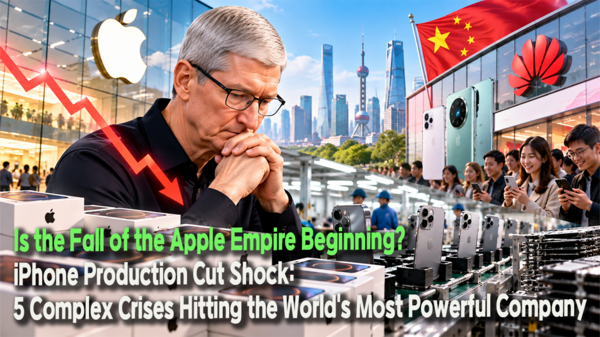
[Production Cut Notice Just 3 Weeks After Launch… What Is Happening to Apple?]
Unsettling cracks are appearing in the golden era of Apple, long reigning as one of the world's premier corporations. Reports that orders for certain components dropped by up to 20% just three weeks after the release of the iPhone 18 Pro have raised serious doubts about Apple's long-standing formula for success—selling new products at premium prices at a rapid pace. Manufacturing costs are surging due to an AI memory crunch, Huawei has surpassed Apple in China, and consumers face growing financial pressure when upgrading smartphones. Analysts suggest the issue facing Apple is not merely a transient slump in iPhone sales, but a threat to the sustainability of the core business model that has dominated the global smartphone market for over a decade.
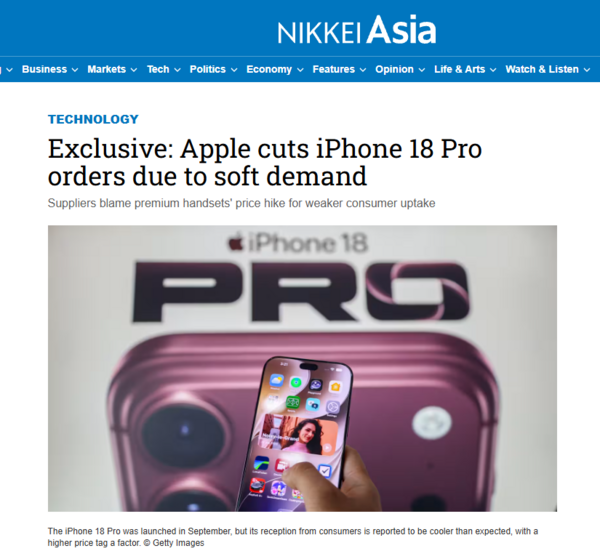
Nikkei Asia reported, citing multiple supply chain sources, that "Apple has requested some suppliers to reduce component production for the iPhone 18 Pro and Pro Max". The report noted that "October component orders dropped by at least 15% compared to initial plans, with some suppliers seeing cuts between 15% and 20%".
What makes this notice extraordinary is its timing—coming just three weeks after the two models went on sale on September 18. The starting price for the iPhone 18 Pro was set at $1,199, while the Pro Max opened at $1,299, each reflecting a $100 price hike over their predecessors. Suppliers suggested that these price increases likely weighed on consumer demand.
However, the production cut reports specifically concern component orders from select suppliers and do not imply an overall 20% reduction in total iPhone assembly. Counterarguments from Chinese supply chain sources suggest that part of the Pro orders merely shifted to the Pro Max, keeping total volumes largely stable. Regardless of the report's absolute veracity, questions are intensifying regarding whether Apple's high-price strategy can sustain its historical growth trajectory.
[Crisis ① Expensive Yet Sold Out… Cracks Emerge in Pricing Power]
Apple's most potent weapon has long been its exceptional pricing power. While competitors engaged in price cuts and discounting wars, Apple maintained premium pricing while securing a fiercely loyal consumer base. Consequently, it established an unrivaled position in the smartphone market in terms of both sales volume and profitability.
However, the price hikes for the iPhone 18 Pro are testing the boundaries of this strategy. While consumers are asked to pay higher prices, whether the performance upgrades offered by the new models justify the extra cost remains a separate question. As smartphone performance reaches a high maturity baseline, an increasing number of consumers see little compelling reason to upgrade.
A more severe threat ensues if rising production costs cannot be passed on to consumers. Raising prices risks suppressing sales volume, while freezing prices squeezes profit margins. If the pricing power supporting Apple's high-margin business model weakens, the fallout could extend far beyond sluggish sales to impact overall corporate valuation.
[Crisis ② Counterstrike of the AI Revolution… Surging Memory Prices Hit Apple]
At the core of Apple's price hike pressure is the explosive expansion of the AI industry. As global big tech firms pour vast capital into building AI data centers, demand for high-performance memory has skyrocketed, leading memory manufacturers to reallocate production capacity.
Market research firm TrendForce noted that "prices for certain mobile memory products have risen dramatically compared to last year." Estimates suggest that "the price of 12GB LPDDR5X memory surged by 175% compared to a year ago." Although specific to certain components, this figure highlights the severe cost pressures confronting smartphone manufacturers.
Ironically, the AI revolution presents Apple with both a new growth opportunity and a severe threat to existing profitability. While Apple must offer consumers more advanced AI capabilities, the cost of semiconductors and memory to power those features continues to escalate. This creates a risky dynamic: investing heavily in technological innovation without certainty that consumers will absorb the higher price tag.
This shockwave is equally visible at Samsung Electronics. Reports indicate Samsung has recently taken a conservative stance on its smartphone production targets. While the AI boom benefits its semiconductor division, it acts as a severe headwind for its mobile device business through elevated component costs. The fact that both Samsung and Apple face identical pressures demonstrates that this issue transcends individual sales strategies and reflects structural shifts across the entire tech industry.
[Crisis ③ World Smartphone Market Hit Worst Slump in 14 Years… Replacement Demand Disappears]
An even more acute threat to Apple is the sharp contraction of the broader smartphone market. Market research firm Counterpoint Research announced that "global smartphone shipments in Q3 fell by 20% year-over-year." This marks the weakest third-quarter performance since 2012—the worst in 14 years. The firm noted that "as surging memory prices pushed smartphone retail prices up, consumers delayed upgrade cycles and turned toward second-hand and refurbished devices."
This shift poses a direct threat to Apple's growth strategy. As smartphone capabilities reach overall parity, consumers have fewer reasons to replace their devices annually. If prices rise substantially on top of this parity, replacement cycles will inevitably lengthen further.
To be sure, Apple is performing relatively better than the overall market. In Q3, global market share stood at 23% for Samsung Electronics and 22% for Apple, with Apple recording its highest Q3 market share to date. However, expanding market share within a shrinking overall market is fundamentally different from operating in an expanding one. If the market pie shrinks, Apple cannot evade pressure on sales volume and profit margins.
[Crisis ④ Huawei Gains in China as Apple Retreats… An Unrivaled Position Falls Apart]
Another critical vulnerability for Apple lies in the Chinese market. Reuters reported, citing market research firm IDC (International Data Corporation), that "Q3 smartphone shipments in China declined 15.4% year-over-year to 57.9 million units," marking the sixth consecutive quarter of contraction.
Yet despite the market-wide slump, Huawei posted double-digit growth, claiming 1st place with a 21% market share. In contrast, Apple dropped to 2nd place with a 17.8% share, as its shipments slipped by 4.3%. Huawei secured competitiveness through a diverse product lineup spanning multiple price tiers and relatively modest price increases. Conversely, Apple narrowed consumer choice by skipping the fall launch of the standard iPhone 18. Even so, some analysts note that initial sales of Apple's flagship products remained relatively solid.
Nevertheless, the structural shift in China carries immense significance. Unlike the era when Apple held an undisputed monopoly over the high-end smartphone market, domestic Chinese manufacturers are now competing head-to-head with advanced technology and product diversity. Should Apple's competitive edge erode in China—one of the world's largest smartphone markets—it will place a heavy burden on its global growth strategy.
[Crisis ⑤ Betting Future on Foldables and AI… New Growth Drivers Remain Uncertain]
Apple is adjusting its product strategy to overcome the growth limits of the standard iPhone. This fall, Apple concentrated on high-end models such as the iPhone 18 Pro and Pro Max, while staggering the launch of the base iPhone 18 to next spring. On October 23, Apple is also scheduled to launch the foldable "iPhone Duo," priced at approximately $1,999. This strategy aims to secure profitability by increasing the sales mix of premium products while sparking replacement demand with an entirely new product tier.
However, these maneuvers carry no guarantee of success. A strategy centered on high-tier products can raise the average selling price (ASP), but it simultaneously raises entry barriers for consumers with diminished purchasing power. It remains uncertain whether foldable products will generate genuinely new demand or simply cannibalize existing high-end iPhone sales. The same applies to the AI race: if Apple fails to deliver a sufficiently differentiated AI user experience to compel consumer purchases, justifying massive tech investments and elevated component costs will prove difficult.
Ultimately, Apple faces the daunting task of maintaining the profitability of its core iPhone lineup while simultaneously establishing new engines of growth. Failing to resolve both challenges in parallel could fracture Apple's long-standing business model built on premium margins and powerful brand loyalty.
[November Earnings as the First Test… Is Apple's True Crisis Just Beginning?]
It is premature to declare the downfall of Apple based solely on production cut reports. Counter-analyses within the Chinese supply chain suggest total order volumes remain stable, reflecting a production shift toward the Pro Max. Furthermore, Apple's global market share remains strong.
However, the critical factor is directionality. Whether consumers will continue to accept elevated iPhone prices, whether AI innovations can stimulate fresh upgrade cycles, and whether Apple can defend its edge in the Chinese market are the vital variables shaping its future.
Apple is scheduled to report its Q4 FY2026 earnings on November 2. This release will mark the first opportunity to gauge initial iPhone 18 sales momentum and margin performance. Determining the full trajectory of demand will require monitoring subsequent quarterly results and supply chain order trends. The crisis facing Apple is not a confirmed collapse, but a profound structural test evaluating whether its historic formula for success can endure.
[Why Times Insight | What Can Overthrow the Apple Empire Is Not Its Competitors, But Apple's Own Success Formula]
For years, Apple stood as an exceptional enterprise capable of extracting higher profit margins while charging consumers premium prices. However, there is no guarantee that this success formula will function indefinitely. Apple's true crisis will not originate from a competitor building a superior smartphone, but from the moment consumers no longer see a compelling reason to pay top dollar for an iPhone.
A Double-Edged Sword: Apple's premium pricing strategy has become high-risk. Passing cost increases to retail prices compresses sales volume, while freezing prices erodes profit margins. Brand loyalty resolved this tension in the past, but its ability to do so indefinitely is far from guaranteed.
AI Threat to the Core Model: The AI revolution threatens Apple's existing business model. Rising memory costs drive up bill-of-materials costs, yet enhanced AI features offer no guarantee of triggering proportional consumer demand. Without capturing the full value of this technological shift, Apple risks absorbing higher costs without reaping the revenue upside.
Loss of Absolute Supremacy: The surge of Huawei in China serves as a stark warning that Apple's position is no longer inviolable. While Apple must maintain premium price points, consumers are gaining access to increasingly viable alternatives.
This does not imply that Apple faces an immediate collapse. However, the decline of great enterprises rarely happens overnight; it unfolds gradually from the moment their most potent competitive advantages cease to perform as they once did. The most alarming scenario for Apple is not a world where iPhones do not sell, but a world where iPhones still sell—yet consumers refuse to pay Apple a premium for them. That is the exact moment the true crisis of the Apple Empire begins.


-중국 푸단대학교 한국연구원 객좌교수
-전 EDUIN News 대표
-전 OUR NEWS 대표
-제17대 대통령직인수위원회 정책기획팀장
-전 대통령실 홍보기획비서관
-사단법인 한국가정상담연구소 이사장
-저서: 북한급변사태와 한반도통일, 2012 다시우파다, 선거마케팅, 한국의 정치광고, 국회의원 선거매뉴얼 등 50여권



