


Update2026.10.24 (토)

[Krugman's Shock Warning: “Is France Too Big to Save?”]
France has emerged as a dangerous economic time bomb for Europe. Nobel laureate Paul Krugman warned that France may have become a country "too big to save," while President Emmanuel Macron’s approval rating crashed to a record low of 15% since taking office. With national debt reaching 119% of GDP and sovereign bond yields surging, anxiety across Europe is rising over whether a French fiscal crisis can actually be managed. The core dilemma is that France is trapped: if the government implements austerity to stave off crisis, the public revolts; if it abandons austerity, financial markets turn their backs.
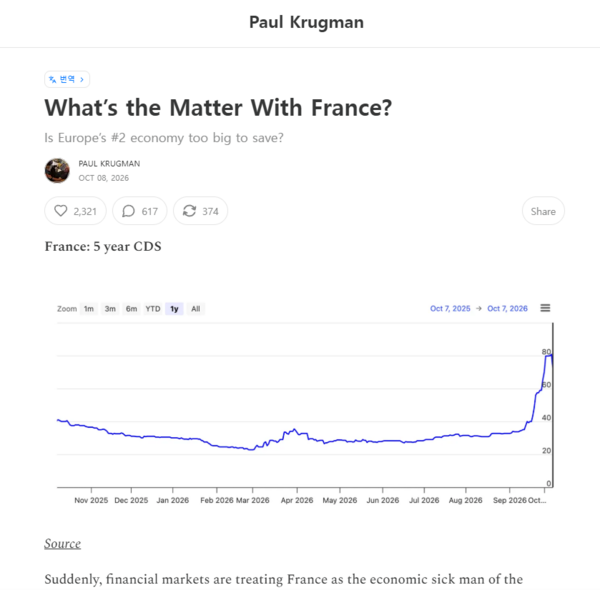
Paul Krugman, the 2008 Nobel laureate in Economics, vividly captured the anxiety gripping European financial markets in a post on his Substack. Titled "What's the Matter With France?" and subtitled "Is Europe's #2 economy too big to save?", Krugman outlined the deepening structural risks facing the nation.
Krugman highlighted that French government bond yields are rising more sharply than those of its peers, while Credit Default Swap (CDS) spreads—essentially insurance against sovereign default—have spiked. Rising CDS premiums reflect growing skepticism among global investors regarding France’s ability to service its debt.
He noted that France’s vulnerability stems not merely from its high level of debt, but from persistent fiscal deficits and compounding interest burdens, paired with a political environment incapable of forging consensus. Furthermore, as a Eurozone member, France faces the structural constraint of being unable to print its own currency to resolve a sovereign liquidity squeeze.
Krugman’s critique is not a declaration of imminent bankruptcy. Rather, it serves as a warning: unlike Greece, France's massive economic scale means that a full-blown sovereign bond crisis in Paris would place an unprecedented financial burden on the European Central Bank (ECB) and Eurozone member states.
[Macron’s Approval Rating Hits 15%: The French Public Turns Its Back]
Two days after Krugman’s warning, a public opinion poll underscored the depth of President Macron’s political crisis. An Ipsos BVA-Cesi poll showed positive evaluations of Macron dropping to 15%—the lowest figure since he took power in 2017—while negative ratings reached a staggering 82%. With roughly seven months left in his presidential term, the poll signals that his administration has essentially run out of political momentum to govern.
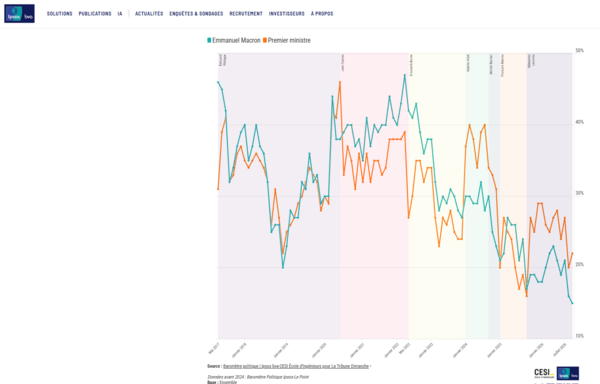
The primary concern among French citizens was declining purchasing power, cited by 54% of respondents as the most urgent issue. Meanwhile, 44% expressed concern over the future of the social security system, and 33% worried about national debt—a 3 percentage point increase from the previous month.
Macron navigated severe political crises in the past, including the Yellow Vest movement in 2018 and massive pension reform protests in 2023. However, the current situation is fundamentally different. As the government attempts to curb spending to restore fiscal balance, households facing severe cost-of-living pressures are unwilling to tolerate further sacrifices.
[National Debt Reaches €3.6 Trillion: Interest Payments Become Unbearable]
The most critical issue facing the French economy is national debt, which has expanded to hazardous levels. According to France’s National Institute of Statistics and Economic Studies (INSEE), public debt stood at approximately €3.5955 trillion (roughly 119% of GDP) as of late June. This is nearly double the European Union’s fiscal rule capping national debt at 60% of GDP.
Fiscal deficits remain equally severe. The French government consistently spends far more than it collects in tax revenues. Failure to reduce spending forces the treasury to issue additional sovereign bonds to plug the deficit, driving debt and interest obligations into an upward spiral.
According to Euronews, France’s annual interest payments on national debt are estimated to reach around €79 billion this year. While low interest rates previously allowed the government to sustain heavy debt loads, market conditions have shifted. Surging bond yields mean the cost of refinancing existing debt is accelerating rapidly.
While former peripheral Eurozone crisis countries like Spain and Portugal successfully reduced their debt-to-GDP ratios, France’s fiscal position worsened. Consequently, a core European state that once led bailout efforts for Southern Europe is now viewed as a potential epicenter of a new fiscal crisis.
[French Bond Sell-off Spreads Anxiety Across Europe]
Financial market reactions are growing increasingly volatile. The Financial Times (FT) reported that a sell-off in French government bonds is heightening volatility across Eurozone debt markets. France’s 10-year bond yield approached 5%—its highest level since 2002—while the spread over German Bunds widened to approximately 1.4 percentage points.
The FT noted that German Bunds are regarded as among the safest assets in the Eurozone. The fact that France must pay significantly higher yields than Germany indicates that investors are pricing higher risk into French debt.
Even more notable is the behavior of major institutional investors. According to the FT, asset managers, rather than buying the dip in French debt, are increasingly reallocating capital toward relatively attractive Italian sovereign bonds or European corporate debt. The historical perception of French sovereign bonds as a safe-haven asset in Europe is rapidly fracturing.
While this does not mean European nations have formally abandoned France, markets are clearly beginning to decouple French fiscal risk from the broader Eurozone baseline.
[Eurozone Finance Ministers Warn: “France Must Solve This First”]
European institutions are taking a firmer stance than in past crises. Reuters reported that Eurozone finance ministers and the European Central Bank urged the French government to pass its 2027 budget to restore market confidence. France plans to borrow roughly €340 billion next year, but borrowing costs are climbing as markets demand higher risk premiums.
The challenge is that European relief mechanisms do not trigger automatically. Although the ECB possesses the Transmission Protection Instrument (TPI) to curb bond market fragmentation, activation requires compliance with strict fiscal rules. Because France is currently subject to the EU’s Excessive Deficit Procedure (EDP), its eligibility for intervention remains questionable.
Ultimately, France cannot count on an unconditional bailout from Europe. This is not a matter of neighboring countries discarding France, but rather intentional pressure on Paris to present a credible, long-term fiscal consolidation plan first. However, the Macron administration lacks the domestic political leverage required to pass such reforms.
[Austerity Triggers Protests, Abandoning Reforms Triggers Ruin: France's Brutal Choice]
The core dilemma for the French government is not a lack of policy options to address fiscal imbalances, but the collapse of the political environment needed to execute them. The Guardian reported that France is trapped between financial markets demanding spending cuts and street protesters demanding higher public expenditure. Amid ongoing student demonstrations and labor union resistance, Macron’s pension reform continues to encounter severe political friction.
If the government cuts spending, public discontent over pensions, healthcare, and education intensifies. Conversely, accommodating public demands by expanding spending inflates fiscal deficits and pushes bond yields higher. Compounded by energy cost burdens driven by higher international oil prices, convincing citizens under financial strain to accept further sacrifices for national debt reduction is becoming nearly impossible.
The 2018 Yellow Vest protests left a lasting lesson in French politics: even fiscally rational policies can trigger destabilizing political crises if they fail to secure public consent.
[Far-Right Leads Presidential Polls: A Rocky Road for Fiscal Reform Regardless of Who Wins]
Upcoming political cycles continue to generate market uncertainty. An Ipsos survey indicated that if taking office as the next president, Jordan Bardella of the National Rally (RN) received the highest approval sentiment at 33%, followed closely by Marine Le Pen at 32%. Center-right former Prime Minister Édouard Philippe stood at 20%.
While the far-right leads in popularity, they face equal difficulty in presenting straightforward solutions to the fiscal crisis. The National Rally has historically advocated for softening pension reforms and expanding purchasing power support, while radical left coalitions push for increased welfare spending.
Consequently, whichever political faction assumes power next will be forced to confront the unavoidable challenge of asking the public to bear fiscal sacrifices. Expecting a electorate that fiercely resisted Macron’s austerity to passively accept fiscal tightening under a new administration remains unrealistic.
This structural gridlock explains why global financial markets view France's political instability so gravely. It is not merely a reflection of Macron’s low approval ratings, but a broader fear that fiscal reform will be indefinitely postponed regardless of leadership changes.
[Why Times Insight | France's True Crisis Is Not Sovereign Bankruptcy, Unresolvable Political Gridlock]
It is premature to conclude that France faces an immediate sovereign default. The nation possesses a massive economy, advanced financial markets, and a crucial backstop in the European Central Bank. However, the gravity of the current situation lies not in the debt figure itself, but in the rapid erosion of the political capacity needed to manage it.
First, France's crisis stems not from a lack of capital, but from a loss of political authority to implement reform. With President Macron’s approval rating at 15% and no stable parliamentary majority, fiscal reform requires sacrifices that leadership can neither persuade the public to accept nor enforce.
Second, France's predicament poses a fundamental dilemma for Europe. If France destabilizes, the broader Eurozone cannot avoid the contagion. Yet, if Europe provides unconditional bailouts, moral hazard and fairness concerns arise among other member states. Europe must safeguard France, yet it cannot do so without strict conditions.
Third, Krugman’s warning centers on a vicious feedback loop. Prolonged political paralysis fuels investor distrust, driving bond yields higher and swelling interest burdens that further degrade public finances. This forces calls for even harsher austerity, provoking greater public backlash. Political crises breed financial instability, which in turn deepens political paralysis.
Ultimately, the key question is not whether France will suffer an immediate sovereign default. It is whether Europe's second-largest economy can restore its political capacity to correct its fiscal trajectory. Whether Paul Krugman's warning becomes reality hinges on that single question.


-중국 푸단대학교 한국연구원 객좌교수
-전 EDUIN News 대표
-전 OUR NEWS 대표
-제17대 대통령직인수위원회 정책기획팀장
-전 대통령실 홍보기획비서관
-사단법인 한국가정상담연구소 이사장
-저서: 북한급변사태와 한반도통일, 2012 다시우파다, 선거마케팅, 한국의 정치광고, 국회의원 선거매뉴얼 등 50여권



