Update2026.10.24 (토)

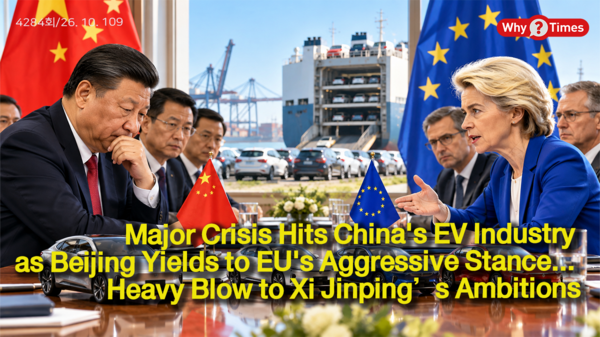
[Beijing-EU Marathon Negotiations… “Cut Chinese Vehicle Exports by More Than Half”]
A major crisis has erupted in the Chinese automotive industry. As the European Union (EU) secured an agreement that could reduce exports of Chinese hybrid vehicles by more than half, Chinese automakers—who had been expanding their push into the European market to circumvent high tariffs on pure electric vehicles (EVs)—now face a critical new setback.
Particularly because Beijing shifted its stance to accept the EU's demand for export volume controls, this agreement could mark a major turning point for China's automotive sector. Furthermore, as 15 economies led by the United States begin a coordinated response against structural overcapacity, Xi Jinping's export-driven industrial strategy has entered a state of emergency.
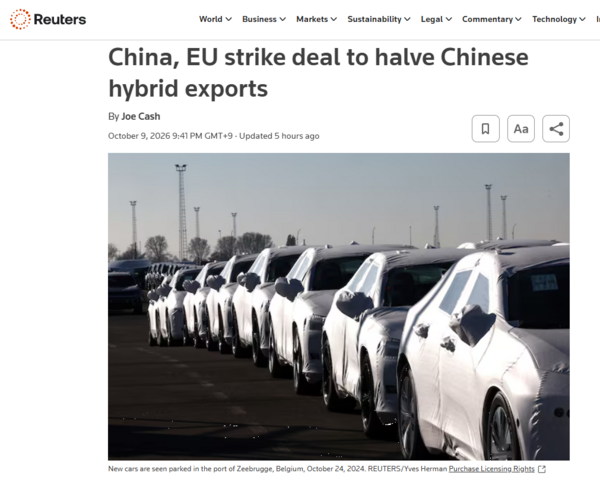
Reuters reported on October 9 that “China and the European Union (EU) have reached a trade agreement that could drastically cut exports of Chinese hybrid vehicles to Europe,” noting that “Maroš Šefčovič, EU Commissioner for Trade and Economic Security, announced the outcome of the negotiations in Beijing.”
Reuters added, “Šefčovič stated that following two days of talks with Chinese Commerce Minister Wang Wentao and other officials, both sides agreed to appropriately manage EU-bound exports of hybrid and plug-in hybrid vehicles.” The report highlighted that “if implemented, this agreement could slash China's exports of such vehicles by more than half, reducing the expected influx of Chinese vehicles into Europe over the next four years by millions of units.”
The fact that China, which has relied on export expansion as a primary engine of economic growth, accepted volume controls in its core European market underscores the severe predicament facing its auto industry.
[Bypassing EV Restrictions via Hybrids… That Route Is Now Blocked Too]
This agreement poses a severe threat to Chinese automakers because hybrid vehicles—their primary bypass route for penetrating the European market—have now come under regulation. In October 2024, the EU imposed additional countervailing duties on Chinese pure battery electric vehicles (BEVs). With these additional tariffs stacked on top of the existing 10% rate, total tariffs on certain Chinese EVs reached approximately 45%. However, hybrid vehicles were exempt from these extra tariffs.
In response, Chinese automakers, including BYD and Chery Automobile, aggressively expanded into the European market using hybrid and plug-in hybrid vehicles. Consequently, EU imports of Chinese hybrid cars surged from 3,800 units per month in October 2024 to roughly 50,000 units by July 2026. The import value of Chinese plug-in hybrid passenger cars also jumped from approximately €1.3 billion in the first half of 2025 to €3.4 billion in the first half of 2026.
From Europe's perspective, imposing tariffs on pure EVs simply led Chinese firms to re-expand their market share through hybrid vehicles. Ultimately, the EU moved to restrict this loophole as well. Consequently, the core strategy of Chinese companies—expanding European market share through massive scale and price competitiveness—has been fundamentally shaken.
[Beijing Resisted Until Two Days Ago… Ultimately Backed Down Under European Pressure]
A notable aspect of these negotiations was China’s shift in attitude. Since September, the EU had demanded voluntary export restraints on Chinese hybrid vehicles, but China resisted, arguing it could conflict with WTO rules. Reports as late as October 7 indicated Beijing's rejection. However, just two days later, China agreed to manage hybrid vehicle trade in a manner consistent with WTO rules.
Of course, China did not make unilateral concessions. China agreed to improve market access for EU goods—such as automotive parts, olive oil, and footwear—and to streamline export licensing for rare earth elements and permanent magnets bound for Europe. The EU, for its part, agreed to maintain cooperation regarding export licensing for certain dual-use items to China. Nevertheless, the fact remains that China backed away from its previous refusal and accepted the possibility of export volume controls.
[Even Playing the Rare Earth Card… What Did China Trade Away for Car Exports?]
This trade agreement was not limited to restrictions on vehicle exports alone. According to Reuters, China and the EU discussed automotive trade, market access, and rare earth supply chains within a single unified framework. Commissioner Šefčovič noted that China agreed to expand market access for EU products including auto parts, olive oil, and footwear.
The existing export value of these related goods is approximately €4 billion, and the EU expects tariff reductions to save at least €225 million in duty costs. This suggests that in exchange for concessions on vehicle exports, China sought to stabilize its economic relations with Europe and secure cooperation in other areas.
Another crucial factor was rare earths. According to the WSJ, China signaled its intent to streamline export licensing procedures for rare earth elements and permanent magnets bound for Europe. The EU also agreed to continue cooperation on export licenses for dual-use items to China. This indicates that both sides aimed to manage not only the automotive dispute but also broader tensions surrounding strategic material supply chains.
However, Europe's stance remains clear: this agreement is a beginning, not the end. Šefčovič characterized the outcome as a crucial first step toward correcting trade imbalances, while emphasizing that the EU reserves the right to employ necessary trade defense measures if negotiations fail to produce tangible results. This means Chinese automakers remain exposed to further pressure down the road.
[A Deficit of €1 Billion a Day… Even Germany Turns Against China]
Behind the EU’s firm stance lies a massive trade deficit. Last year, the EU's trade deficit in goods with China reached approximately €360 billion (around 541.2 trillion KRW)—an average daily deficit of about €1 billion (around 1.5 trillion KRW). Šefčovič characterized this situation as unsustainable.
Particularly noteworthy is the shift in Germany's stance. Germany, which historically prioritized economic cooperation with China, has joined France in demanding stronger trade defense powers for the EU. Both nations urged the creation of powerful mechanisms to swiftly counter unfair trade and, if necessary, restrict access to the EU single market. Even core European nations that once valued economic ties with Beijing are now moving to protect their domestic industries.
Šefčovič rated the agreement as a initial step toward rebalancing trade relations. He added a warning that if talks fail to yield concrete progress, the EU is prepared to deploy appropriate trade defense instruments—signaling that pressure on China's automotive industry is unlikely to stop here.
[US-Led 15-Economy United Front… International Pressure on Chinese Overcapacity]
Even more burdensome for Beijing is that Europe's actions coincide with an international effort, led by the United States, to address industrial overcapacity. On October 7, the Office of the United States Trade Representative (USTR) announced that 15 economies—including the US, EU, Japan, and South Korea—signed a joint ministerial statement to jointly address structural overcapacity.
While the statement did not explicitly name China, it highlighted that non-market policies and practices by governments maintain production capacity far exceeding global demand, threatening industries and employment in other nations. Participating countries agreed to jointly review policy measures to combat overcapacity. Although joint tariffs or import bans have not yet been decided, this joint action carries significant weight as major economies begin treating Chinese overcapacity as a collective trade issue.
[Overflowing Vehicles with Nowhere to Sell… The Real Crisis of Chinese Industry]
The fundamental vulnerability of China's automotive industry is that expanding production capacity no longer guarantees increased corporate profitability. China concentrated massive investments into EVs and batteries, designating them as strategic national industries. However, intense price wars are raging in the domestic market, leaving many firms struggling to achieve profitability despite rising sales volumes.
Under these circumstances, Europe served as a vital growth avenue for Chinese automakers. If Europe restricts imports, Chinese manufacturers must adjust production plans or seek alternative markets. Expanding local production within Europe is an option, but doing so dilutes the export-driven benefits for domestic Chinese factories and component industries. Ultimately, the Chinese automotive sector faces a difficult trade-off between preserving overseas markets and maintaining its domestic manufacturing base.
[Why Times Insight | Xi Jinping’s EV Ambitions: The True Cause of the Greatest Crisis]
This EU-China trade agreement demonstrates that the growth strategy of China's automotive industry faces a fundamental challenge. China expanded hybrid exports to counter tariffs on pure EVs, but Europe is now moving to block that bypass route as well.
Even more severe is the fact that Chinese automakers are already squeezed by domestic price wars and overcapacity pressure. Foreign exports previously acted as a key relief valve for these pressures, but as the US and Europe successively raise trade barriers, the limits of that strategy are becoming evident.
To be sure, China's automotive industry will not collapse overnight. Its technological capabilities and price competitiveness remain formidable, and local manufacturing in Europe remains an available countermeasure. However, if shifting production overseas becomes necessary to retain foreign markets, it will impose additional burdens on domestic factory utilization, employment, and the supply chain in China.
Ultimately, Xi Jinping faces the most difficult question of all: having built the world’s largest automotive production capacity, who will buy all those vehicles if overseas markets continue to close their doors?
This is where the true crisis of China’s automotive industry begins. The recent agreement with the EU serves as a symbolic event showing that the EV sector—built through the concentration of China's national capabilities under Xi Jinping—has entered an unprecedented trial.

-중국 푸단대학교 한국연구원 객좌교수
-전 EDUIN News 대표
-전 OUR NEWS 대표
-제17대 대통령직인수위원회 정책기획팀장
-전 대통령실 홍보기획비서관
-사단법인 한국가정상담연구소 이사장
-저서: 북한급변사태와 한반도통일, 2012 다시우파다, 선거마케팅, 한국의 정치광고, 국회의원 선거매뉴얼 등 50여권