Update2026.10.24 (토)

["Ending It the Good Way or the Tough Way"]
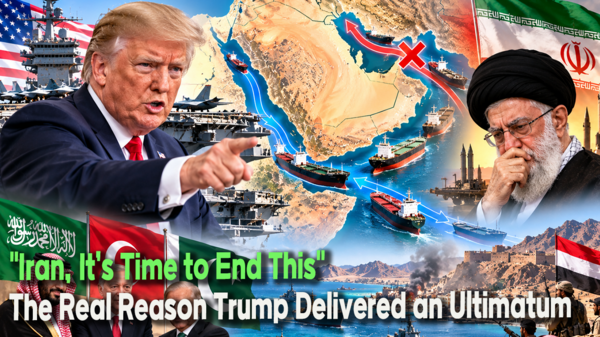
U.S. President Donald Trump delivered what effectively amounts to an ultimatum to Iran, declaring: "Whether it ends in a good way or an un-good way, we're going to find out fairly soon." The timing of this statement is far from ordinary. Amid a U.S. maritime blockade that has brought Iranian crude exports to a virtual standstill, even Chinese refiners—Iran's largest customers—have begun shifting to Iraqi and Qatari crude. Meanwhile, in Yemen, Saudi-backed government forces launched a swift counteroffensive, announcing the recapture of key areas around the Bab-el-Mandeb Strait previously held by the Houthis. Coupled with the activation of a collective defense mechanism involving Saudi Arabia, Türkiye, and Pakistan, the core leverage sustaining Iran's war effort has begun to crumble simultaneously. Why, then, did Trump choose this precise moment to declare that "Iran is no longer the bully of the Middle East"?
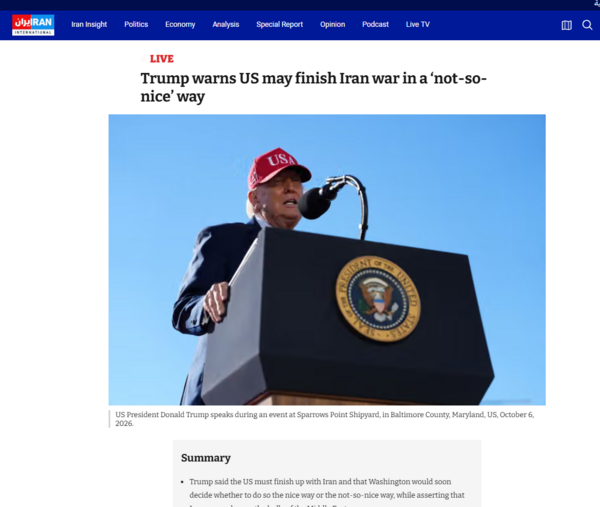
Iran International reported on the 7th that "President Donald Trump remarked on the 6th that the war with Iran must now be brought to a conclusion, leaving only the method to be decided," adding that "Trump's language was explicit, stating that it could end nicely or not nicely, and that 'we are going to find out fairly soon.'" This delivered a clear message to Tehran: choose negotiation, or face significantly harsher measures.
Trump also asserted that "Iran used to be the 'bully' of the Middle East, but they are no longer in that position." In Trump's assessment, the conflict is entering its final stage. What matters most is not merely the rhetorical intensity, but why these remarks were made now. Over the past few days, the military and economic landscape surrounding Iran has shifted dramatically and simultaneously.
[The First Crack - Iranian Crude Exports Truly Halt]
The most decisive shift lies in crude oil—the economic lifeline of Iran. Citing vessel-tracking data on the 6th, Reuters reported: "While U.S. maritime blockades have driven Iranian crude exports down to near-zero levels, oil exports from other Gulf producers—excluding Iran—have recovered to over 81% of pre-war levels."
Reuters further detailed: "In September, combined exports of crude oil, condensate, and refined products from Saudi Arabia, the UAE, Kuwait, Iraq, Qatar, Oman, and Bahrain averaged 19.2 million barrels per day (bpd), representing approximately 81% of the pre-war level of 23.6 million bpd." Notably, "Saudi crude exports alone rose by 4.2 million bpd from August, reaching 6.6 million bpd in September."
Reuters noted: "Early in the war, concerns ran high that an Iranian blockade of the Strait of Hormuz would paralyze oil exports across the entire Gulf, but reality has moved in a different direction," adding that "other Gulf producers identified bypass routes and novel shipping methods, enabling a substantial recovery in oil flows through Hormuz itself." In a separate analysis, Reuters observed that "Middle East oil exports briefly surpassed pre-war levels in late September," concluding that "Iran's operational control over Hormuz appears to have weakened."
[Even More Painful: China Makes Its Move]
An even more critical shift occurred in China, the largest buyer of Iranian crude. Reuters reported on the 6th: "Independent refiners in China's Shandong province have begun purchasing large volumes of Iraqi and Qatari crude to replace Iranian supplies." These independent refiners, commonly referred to as 'teapots,' had long served as the primary buyers of heavily discounted, sanction-bound Iranian crude. However, Chinese imports of Iranian crude dropped to roughly 590,000 bpd in September—half the volume recorded during the same period last year and the lowest level since January 2023. Floating offshore inventories of Iranian crude also halved to approximately 45 million barrels.
According to Reuters, Chinese refiners secured at least 12 million barrels—and potentially up to 20 million barrels—of crude for October and November delivery, primarily sourced from Iraq. In addition, they purchased roughly 3 million barrels of Qatar's Al-Shaheen crude. Considering that China represented one of Iran's vital safety cushions against sanctions, the fact that Chinese refiners are building alternative supply chains to maintain operations without Iranian crude signals a crisis far more severe than a temporary export drop.
[The Second Crack - Houthis Pushed Back in Bab-el-Mandeb]
Iran's setbacks extend well beyond the Persian Gulf. Reuters reported: "The tactical picture has also shifted rapidly at the Bab-el-Mandeb Strait, the southern gateway to the Red Sea," noting that "Saudi-backed Yemeni government forces launched a major counteroffensive on the 5th, advancing along the coastline toward Mokha and driving Houthi forces out of most areas seized last month."
Just a month ago, according to Reuters, the situation was reversed. As Houthi forces expanded their presence along Yemen's western coast, their influence over the Bab-el-Mandeb—a key choke point for global shipping—grew significantly. From Tehran's perspective, this appeared to establish a strategic position capable of applying direct pressure on Hormuz in the north while leveraging Houthi forces to disrupt Bab-el-Mandeb in the south. However, the recent counteroffensive has fractured that strategic posture.
The fighting, however, remains ongoing. Houthi forces have denied some territorial losses and continue to press government supply routes in Taiz. Reuters noted in a follow-up report on the 6th: "Clashes near Bab-el-Mandeb continue, with various factions intermingled within the government forces."
[Houthi Retaliation Strikes Saudi Mainland]
Houthi forces launched immediate retaliatory strikes, claiming responsibility for attacks on key Saudi facilities, including King Khalid International Airport in Riyadh, the Aramco refinery in Rabigh, Abha International Airport, and the Khamis Mushait military base. This highlights why securing Bab-el-Mandeb remains critical for Saudi Arabia. As transit through Hormuz faced disruptions, Saudi Arabia actively utilized its East-West Pipeline to transport crude from its eastern oil fields to Yanbu Port on the Red Sea. The Saudi Energy Minister confirmed on the 6th that crude transported via this pipeline reached 5.8 million barrels, with flows continuing uninterrupted. Saudi Arabia currently reroutes approximately 4 million bpd via this pathway.
[The Third Crack - The 'Mecca Alliance' Takes Actual Action]
On the 5th, another major development unfolded in Riyadh. Saudi Arabia, Türkiye, and Pakistan convened an emergency meeting to begin operationalizing their collective defense commitment, agreeing to "swiftly deploy" coordinated military forces and capabilities to Saudi Arabia. The meeting itself was confirmed earlier by the Turkish Foreign Ministry. Reuters reported: "Turkish foreign and defense ministers, alongside senior military leadership, attended the Strategic Committee meeting of the Mecca Defense Agreement in Riyadh on the 5th." Agenda items included Houthi attacks on Saudi territory, the battlefield situation in Yemen, and the institutionalization of the alliance.
This does not imply direct intervention by the three nations in the Yemeni domestic conflict. The official announcement focuses on the rapid deployment of troops and assets to protect Saudi territory; specific force numbers, equipment, and deployment timelines were not disclosed, nor was there any announcement of Turkish or Pakistani troops entering Yemeni territory. Thus, the primary significance at this stage lies in the initial operational activation of a collective deterrence framework dedicated to Saudi defense.
[Iran's Oil Minister Steps Down]
Amid these compounding pressures, Iranian Oil Minister Mohsen Paknejad resigned on the 4th. According to Iranian state media, the resignation was attributed to personal reasons, with Hamid Bouvard, CEO of the National Iranian Oil Company (NIOC), appointed as acting minister. While Paknejad's departure cannot be linked directly to an immediate economic collapse, the departure of the top official overseeing Iranian oil policy carries immense symbolic weight at a moment when U.S. blockades have halted crude exports and top buyer China is securing alternative suppliers. Reuters similarly observed: "The resignation occurred as the seven-month war with the United States continues to exert severe strain on the Iranian economy."
[Why Times Insight]
The central dynamic governing this landscape revolves around 'two straits.' In Iran's asymmetric strategy, Hormuz represented a card of direct control, while Bab-el-Mandeb served as a card of indirect leverage exercised through Houthi proxies. Exerting pressure on both choke points simultaneously offered Tehran leverage not only over Washington and the Gulf states, but over Europe and Asia as well.
However, events are unfolding contrary to Tehran's calculations. In Hormuz, crude exports from non-Iranian Gulf producers have recovered to over 81% of pre-war levels—with crude and condensate exports specifically recovering to 91%. In contrast, Iranian exports have plummeted to near-zero under the weight of the U.S. blockade.
Furthermore, top customer China has taken action. Faced with reduced Iranian crude flows, Chinese refiners secured substantial volumes from Iraq and Qatar. The fact that Chinese imports of Iranian crude fell by half year-on-year represents a particularly painful blow to Tehran.
At Bab-el-Mandeb, Houthi forces face a fierce counteroffensive. Sustaining influence around the strait provided Tehran with a low-cost, high-value strategic asset capable of disrupting global shipping. If Houthi forces are pushed away from the Red Sea coast and pinned down in Yemen's interior, Iran's strategic calculus changes fundamentally. Simultaneously, the collective defense framework uniting Saudi Arabia, Türkiye, and Pakistan has begun to move.
It is against this backdrop that Trump's question—"ending it in a good way or an un-good way"—must be interpreted. Washington's posture did not suddenly intensify in a vacuum. The ultimatum was delivered at the exact moment Tehran's available strategic cards began falling away one by one.
Ultimately, the key focus moving forward is not merely whether the war will continue, but what position Iran will be left in when it ends. Crude exports are blocked. China is establishing alternative supply lines. The Hormuz card failed to choke off Gulf-wide oil exports as initially intended, and the Houthis—Tehran's other Red Sea lever—are facing strong pushback at Bab-el-Mandeb.
It was precisely at this moment that Trump put the question to Tehran: "Will it end nicely, or not nicely?" This is no longer mere rhetoric. It is a fundamental question of how many cards Tehran truly has left to play.

-중국 푸단대학교 한국연구원 객좌교수
-전 EDUIN News 대표
-전 OUR NEWS 대표
-제17대 대통령직인수위원회 정책기획팀장
-전 대통령실 홍보기획비서관
-사단법인 한국가정상담연구소 이사장
-저서: 북한급변사태와 한반도통일, 2012 다시우파다, 선거마케팅, 한국의 정치광고, 국회의원 선거매뉴얼 등 50여권