Update2026.10.24 (토)

[An Unexpected Confession Breaks on Iranian State Television]
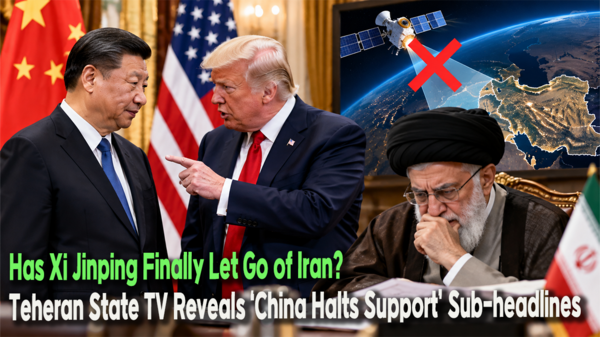
At Iran’s most desperate hour, China—the ally Teheran trusted most—has begun stepping back. Just ten days after President Trump pressed President Xi Jinping at the White House to halt intelligence and military support to Iran, claims emerged on Iranian state television that Beijing has cut off satellite imagery support. This aligns remarkably well with remarks made immediately following the summit by David Perdue, the U.S. Ambassador to China, who stated, “They listened to us. They backed off some of it.” Coupled with reports that Beijing delivered a message effectively urging Teheran to “resolve your issues with the U.S. first,” the limits of the “China card” Teheran relied on are coming into stark focus.
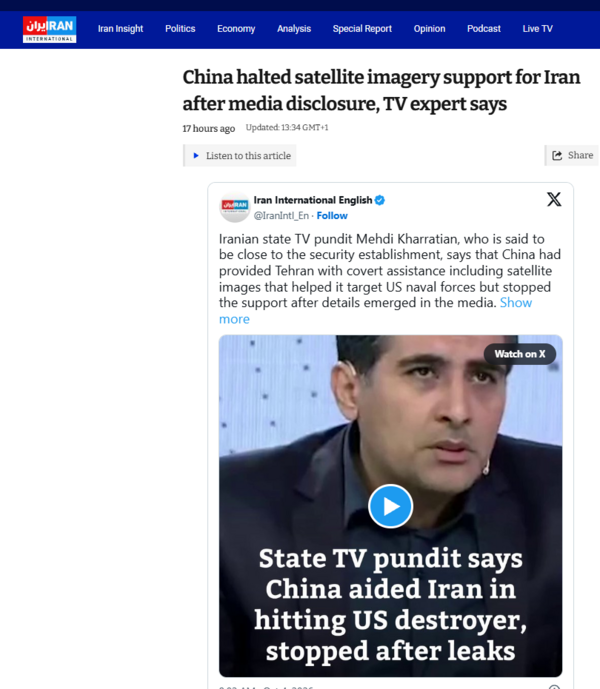
On October 5, Iran International—an Iran-focused outlet based in London and Washington, D.C.—reported on a startling revelation: "Mehdi Kharatian, a regular commentator on Iranian state broadcaster IRIB News Channel, claimed during a October 4 broadcast that China had provided intelligence support—including satellite imagery—to Iran during its war with the U.S. and Israel."
Iran International noted: "However, what was even more significant was what came next. According to Kharatian, once this cooperation was exposed in the media, China halted its satellite imagery support. It was also revealed on the broadcast that Beijing essentially delivered a message urging Iran to 'resolve your issues with the U.S. first.'"
While Beijing has not officially confirmed providing or stopping satellite intelligence, these statements carry immense weight—precisely because stories pointing in the exact same direction surfaced in Washington just ten days earlier.
[“They Listened to Us”… Perdue’s Telling Remark Ten Days Ago]
During the U.S.-China summit at the White House on September 24, President Trump raised the Iran issue directly with President Xi. The following day, U.S. Ambassador to China David Perdue stated in an interview with CNBC: “For weeks, the U.S. conveyed to China that any direct or indirect support to Iran—whether intelligence, components, or military equipment—was completely unacceptable. President Trump made that abundantly clear yesterday.” He added an even more telling remark: “We’ve seen evidence that they listened to us. They backed off some of it.”
Just ten days later, claims broke on Iranian state television that "China halted satellite imagery support." Washington reported that China "backed off some of it," while Teheran confirmed that "satellite imagery support was cut." Although a direct causal link between the two statements remains unverified, the timing and orientation match with striking precision. If both accounts refer to the exact same action, the tangible results of Trump’s pressure on Xi at the summit surfaced inside Iran in a matter of days.
[How Crucial Were China’s ‘Eyes in the Sky’ for Iran?]
Suspicions regarding Iranian military operations utilizing Chinese satellite technology did not originate with this broadcast. Drawing on leaked Iranian military documents, the Financial Times (FT) reported last April that the Islamic Revolutionary Guard Corps (IRGC) Aerospace Force had secretly obtained the TEE-01B earth observation satellite, built by Chinese firm Earth Eye. This was not a routine purchase of a few satellite photos; it meant the IRGC had secured "eyes in the sky" leveraging high-resolution Chinese satellites and control infrastructure to monitor U.S. troop movements across the Middle East.
An analysis of what the TEE-01B was actually observing reveals why Washington responded so sensitively. FT’s analysis of coordinates, satellite images, and orbital data indicated that the TEE-01B monitored major U.S.-related military installations, including Prince Sultan Air Base in Saudi Arabia, Muwaffaq Salti Air Base in Jordan, U.S. facilities in Bahrain, and Erbil in Iraq. Certain capture timestamps overlapped directly with periods when Iran launched or claimed attacks on those locations.
[Then on July 17, Three U.S. Service Members Were Killed]
An attack on a U.S. base in Jordan on July 17 altered the entire gravity of the issue. The Wall Street Journal (WSJ) reported in September, citing U.S. officials, that "before and after Iran attacked Muwaffaq Salti Air Base in Jordan on July 17, it acquired high-resolution satellite imagery of the base from Chinese entities." Subsequent Iranian missile strikes killed three U.S. service members and injured four others. U.S. officials stopped short of asserting that the Chinese government directly provided the images, concluding instead that they were supplied by Chinese entities.
From the U.S. perspective, however, the fundamental nature of the situation had shifted. Imagery from Chinese commercial satellites had moved beyond routine intelligence gathering; it was being actively utilized to enhance the precision of strikes targeting U.S. forces, resulting in actual American casualties. It could no longer be dismissed as ordinary commercial trade.
[Chinese Satellites Were Even Tracking U.S. Aircraft Carriers]
Washington’s concerns extended beyond land bases. According to Axios, citing U.S. officials, Iran recently used high-resolution imagery from Chinese commercial satellites to track not only U.S. bases in the Middle East but also American aircraft carriers and naval vessels in the Persian Gulf and the Arabian Sea. Upon uncovering this, the U.S. military reportedly altered operational procedures to make it harder for Iran to locate its fleet.
This detail meshes directly with reports that Kharatian mentioned both satellite imagery and the targeting of U.S. naval vessels on Iranian television. Ultimately, what Washington demanded of Xi Jinping was not mere diplomatic rhetoric to "stop helping Iran." It was a stern warning that the U.S. would no longer tolerate Chinese technology and intelligence directly targeting American troops.
[Chinese Support for Iran Continued Right Up to the Summit]
Satellite intelligence represented only one facet of alleged military cooperation between Beijing and Teheran. WSJ reported that "right up until the U.S.-China summit, China played a substantial role in sustaining Iran's military capabilities." WSJ noted U.S. assessments that "Chinese firms had been supplying Iran with dual-use electronic components, GPS equipment, engines, and chemicals necessary for producing drones and ballistic missiles."
Furthermore, China remains the largest buyer of Iranian crude oil. Even if the U.S. chokes off Iranian oil exports and financial networks, completely isolating Iran remains difficult as long as China serves as a massive lifeline. For Trump, addressing the China factor was the final piece of his Iran pressure strategy—a topic he brought directly to the table face-to-face with Xi Jinping.
[Why Did Beijing Step Back?]
Understanding Beijing’s strategic calculus is essential. Iran is indisputably an important partner for China: it offers discounted crude oil and serves as a geopolitical lever to keep U.S. strategic assets tied down in the Middle East. However, Iran’s value can never outweigh the broader scope of U.S.-China relations. The moment Chinese satellite intelligence became linked to American casualties, the costs Beijing had to bear shifted dramatically.
If U.S. sanctions against Chinese companies expand—spilling over into financial institutions and advanced technology firms—the resulting fallout would vastly outweigh the benefits of securing cheap Iranian oil. Thus, if the message to "resolve your issues with the U.S. first" indeed originated from Beijing, its implications are profoundly heavy.
[Of All Times… Iran Is at Its Weakest]
Beijing’s signals of strategic distancing are all the more painful because Iran is navigating its most grueling juncture since the conflict began. The United States is applying simultaneous pressure on Iranian oil exports and financial networks while enforcing a maritime blockade. The intensity of effort to sever the Iranian economy from the outside world is reaching unprecedented heights.
On October 4, the Iranian rial plummeted to a new record low of approximately 2.72 million rials per U.S. dollar on the open market, sounding alarms over a deepening economic crisis within Iran. Military pressure remains relentless: the U.S. is deploying additional carrier strike groups and personnel to the Middle East, while President Trump explicitly leaves military options on the table, offering Iran a choice between "the easy way or the hard way." Against this backdrop, if China begins retreating from sensitive military support, Teheran faces a predicament far beyond economic isolation—it faces strategic isolation.
[Has China Abandoned Iran?]
It is premature to reach that definitive conclusion. China will continue to require Iranian crude oil and will not easily forfeit Iran’s geopolitical utility in the Middle East. Nevertheless, three distinct scenes cannot be ignored: on September 24, Trump told Xi that support to Iran via intelligence, components, or military equipment was unacceptable; the next day, Ambassador Perdue affirmed evidence that China had reacted to U.S. warnings by backing off some support; ten days later, statements emerged publicly in Iran that China had cut satellite imagery support. Only the final connecting link remains to be formally confirmed.
[Why Times Insight | China Will Not Fight the U.S. for Iran’s Sake]
The core issue is not whether China has permanently abandoned Iran, but that Beijing has begun recalculating the price of supporting Teheran. To Beijing, Iran is a strategic asset—valuable when supplying cheap oil, tying down U.S. power in the Middle East, or serving as a bargaining chip to disrupt U.S. Middle East policy. However, if that support results in American casualties, exposes U.S. aircraft carriers via Chinese satellites, triggers sanctions against Chinese firms and financial institutions, and destabilizes overall U.S.-China relations, the balance sheet changes completely.
Therefore, if China has indeed curtailed its satellite intelligence support, it sends an unequivocal message: "Iran is necessary, but China will not fight the United States for Iran." This represents the most alarming signal Teheran could possibly receive.
Washington is tightening its grip at sea, severing oil exports and financial channels while augmenting military forces in the region. At such a critical juncture, if China—long relied upon as the ultimate strategic patron—steps back with advice to "deal with the U.S. first," Iran must worry about strategic intelligence isolation on top of economic isolation.
While decisive evidence explicitly linking all three scenes into a single chain of command and execution has not been made public, the direction they point toward is clear. At Iran's moment of greatest peril, rather than standing alongside Teheran against Washington, Beijing is stepping back to protect its own national interests. That represents the cold, hard limitation of the "China card" Teheran so heavily relied upon.

-중국 푸단대학교 한국연구원 객좌교수
-전 EDUIN News 대표
-전 OUR NEWS 대표
-제17대 대통령직인수위원회 정책기획팀장
-전 대통령실 홍보기획비서관
-사단법인 한국가정상담연구소 이사장
-저서: 북한급변사태와 한반도통일, 2012 다시우파다, 선거마케팅, 한국의 정치광고, 국회의원 선거매뉴얼 등 50여권