Update2026.10.24 (토)

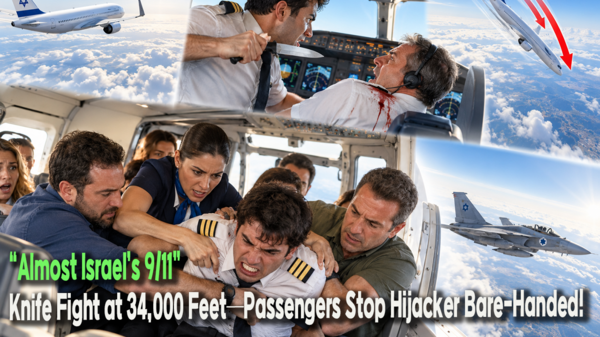
[Co-Pilot Attacks Captain with Weapon… Rapid Descent of ~14,000 Feet in Under 30 Seconds]
In the cockpit of an Israel-bound airliner flying at 34,000 feet, a co-pilot attacked the captain with a sharp weapon. Immediately after, the aircraft plummeted nearly 14,000 feet in less than 30 seconds, and emergency squawk code ‘7500’—signaling a hijacking or unlawful interference—was transmitted. The Israeli Air Force scrambled fighter jets. However, the bleeding captain opened the cockpit door, allowing passengers and crew to rush inside and subdue the attacker, initiating a desperate struggle that saved 174 lives. Israeli authorities suspect the co-pilot attempted to deliberately crash the airliner.
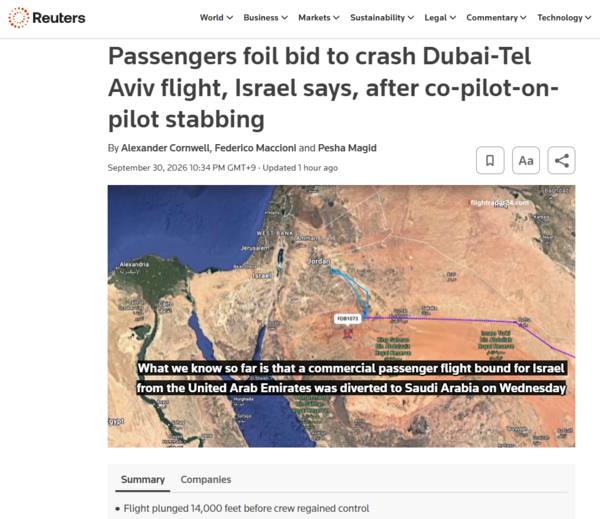
Reuters reported on September 30 (local time) that “one of international aviation security's nightmare scenarios since 9/11 25 years ago became reality.” The news shocked the public, revealing: “The aircraft involved was flydubai Flight FZ1073, en route from Dubai, UAE, to Tel Aviv, Israel, carrying 174 passengers—mostly Israeli citizens. The Boeing 737 family aircraft was flying over Saudi Arabia heading toward Israel when the incident occurred.”
Flight tracking data released by Flightradar24 clearly highlights the anomaly. The aircraft descended abruptly, losing almost 14,000 feet in under 30 seconds. In a segment analyzed by the Associated Press (AP), the plane descended from 33,000 feet to 17,000 feet in roughly one minute. While figures vary depending on the measurement interval, it was a drastic maneuver completely distinct from a standard descent.
Ominous signals soon began emanating from the aircraft. According to Flightradar24, the transponder initially broadcasted ‘Squawk 7700,’ indicating a general emergency. Soon after, the code was changed to ‘7500’—which indicates hijacking or unlawful interference—before switching back to 7700.
The Israeli military scrambled fighter jets to prepare for any contingency. In the cabin, passengers endured the sudden nose-dive and violent aircraft movements without knowing the cause, while inside the cockpit, a life-or-death struggle for control of the plane was unfolding.
[What Happened Inside the Cockpit?]
According to details released by the Israeli government, an Omani co-pilot attacked the captain with a sharp object mid-flight. Reuters noted that “the captain was Smit Machchhar, an Indian national, while the co-pilot is currently under investigation by Saudi authorities.” The AP added: “Despite sustaining severe injuries, the bleeding captain fought back and unlocked the cockpit door, allowing passengers and crew from outside to enter.” The injured captain opening the door was the crucial move that enabled passenger intervention.
Paradoxically, reinforced cockpit security doors introduced after 9/11 could have turned into a deadly trap in this situation. Designed to prevent external terrorists from breaking in, such doors act as an impenetrable barrier that hinders outside rescue if the assailant is already inside the cockpit.
[“Rushed into the Cockpit”… Passengers Save the Plane]
According to the AP, the moment the cockpit door opened, passengers and crew charged inside. Yaniv Hayoun, an Israeli passenger, was among those who helped overpower the attacker. Photos released by the AP after their return showed bloodstains on his clothes, testifying to the harrowing ordeal.
Reuters noted that “passengers in the cabin initially had no idea what was happening; passenger Almog Itali testified that when the plane suddenly plummeted, they thought they had encountered severe turbulence.” In reality, a desperate fight for survival was raging inside the cockpit at that exact moment.
Reuters added: “Passengers and crew ultimately pulled the attacker away from the controls and subdued him. Other crew members on board then stabilized the aircraft, diverting it toward Tabuk in northwestern Saudi Arabia.”
The plane landed safely in Tabuk. The captain and co-pilot were transported to a hospital, and all 174 passengers survived. The passengers were later flown to Tel Aviv on a substitute flight.
[Netanyahu: “A Catastrophe Was Averted”]
Immediately following the incident, Israeli Prime Minister Benjamin Netanyahu stated, “It is Israel’s assessment that the co-pilot stabbed the captain in an attempt to crash the airliner,” commending the actions of the passengers and crew for preventing a massive disaster. Immediately following the event, the Israeli government decided to tighten security vetting for pilots on flights entering the country.
However, the most crucial questions remain unanswered: Why did the co-pilot attack the captain, and why did he send the plane into a plunge? flydubai and UAE authorities maintained that “the root cause and motive behind the incident have not yet been established,” advising against speculation before investigation results are finalized.
[Did He Really Target an “Israeli 9/11”?]
What Israeli officials view with particular gravity is the possibility that this was not merely a suicide crash attempt, but a plan to fly the passenger plane into Israeli airspace to strike a specific ground target. If this hypothesis is confirmed, the nature of the incident changes dramatically—it becomes an attack using a commercial airliner as a massive weapon, mirroring September 11, 2001. However, no specific target or organizational background has been officially confirmed as of yet. The exact motive of the suspect remains under investigation by relevant authorities in Saudi Arabia and the UAE.
[A More Terrifying Question: “The Attacker Was a Pilot from the Start”]
What alarms aviation security authorities most about this incident is not how the attacker breached the cockpit, but that the individual identified as the assailant was seated inside the cockpit as a qualified co-pilot from the outset.
The AP observed, “This incident is likely to reignite questions surrounding security screening for pilots and flight crews,” adding that “it remains unclear how the sharp object used to attack the captain was brought into the cockpit in the first place.”
There is also the matter of identity verification. Reuters explained: “Israel’s decision to tighten security screening for pilots flying into its territory shows that this event could serve as a catalyst to examine vulnerabilities in the global aviation security framework beyond a single airline’s internal issue.”
[Skyways Opened by the Abraham Accords Face Security Test]
This incident carries diplomatic sensitivity due to the symbolic value of the Dubai–Tel Aviv route. The UAE and Israel normalized relations in 2020 through the US-mediated Abraham Accords, expanding cooperation in aviation, tourism, and trade ever since. flydubai's Dubai–Tel Aviv route stands as one of the key air corridors symbolizing this normalization. Consequently, how both nations handle aviation security and pilot background screening moving forward will be a vital variable.
However, there is no evidence to conclude that the Abraham Accords themselves are shaken by this single incident. Instead, the main point to watch is how the UAE, Israel, and Saudi Arabia—where the plane made its emergency landing—collaborate on the investigation and subsequent security measures.
[Why Times Insight: 25 Years After 9/11, the Premise That “The Enemy Is Outside the Cockpit” Has Broken Down]
Since 9/11, global aviation security has revolved around a single core question: “How do we stop terrorists from getting into the cockpit?” To that end, cockpit doors were reinforced, passenger shoes and bags were inspected, liquid restrictions were enforced, and metal detectors and full-body scanners were deployed.
Yet Flight FZ1073 poses the exact opposite question: “How do we stop a threat if the person posing it is already sitting inside the cockpit from the start?” This is the most frightening dimension that the global aviation industry must face in light of this event.
In the 2015 Germanwings Flight 9525 disaster, a co-pilot locked the captain out while he briefly stepped out, deliberately crashing the plane into the French Alps and killing all 150 people on board. While cockpit safety procedures were re-evaluated afterward, it proved challenging to completely eliminate the "insider threat" where a pilot themselves becomes the hazard.
On FZ1073, the outcome was different. A critically wounded captain managed to open the door. Passengers and crew rushed into the cockpit, subdued the attacker, and other crew members stabilized the plane—allowing 174 people to return alive.
Nevertheless, this incident leaves behind three urgent questions:
Are identity and security vetting procedures for pilots and crew sufficient?
How was a weapon smuggled into the cockpit?
What is the ultimate safety net if a pilot becomes the threat?
Whether an "Israeli 9/11" was the true objective requires waiting for the investigation results. But the warning this incident has sent to international aviation security is already loud and clear: This time, passengers saved the plane. Next time, we cannot rely solely on the bravery of 170-plus passengers to safeguard human lives.


-중국 푸단대학교 한국연구원 객좌교수
-전 EDUIN News 대표
-전 OUR NEWS 대표
-제17대 대통령직인수위원회 정책기획팀장
-전 대통령실 홍보기획비서관
-사단법인 한국가정상담연구소 이사장
-저서: 북한급변사태와 한반도통일, 2012 다시우파다, 선거마케팅, 한국의 정치광고, 국회의원 선거매뉴얼 등 50여권