Update2026.10.24 (토)


[“A personal hobby?”… A 40-year Interception Expert Frequented South Korean and US Military Bases]
It has been revealed that a retired lieutenant colonel-rank officer who served for 40 years in an interception unit of the Chinese People's Liberation Army (PLA) installed signal receiving equipment in a South Korean hotel room and eavesdropped on communications between South Korean and US fighter jets 13 times. On the very same day, court testimony was disclosed showing that the former CEO of ChangXin Memory Technologies (CXMT), China's largest DRAM manufacturer, pressured engineers formerly with Samsung Electronics to bring over the core "manufacturing recipe" for 18-nanometer DRAM. From cameras and drones to interception devices, and from approaching military personnel to targeting cutting-edge semiconductor technology—these cases raise fundamental questions about how far the scope and methods of intelligence gathering originating from China have expanded into South Korea.
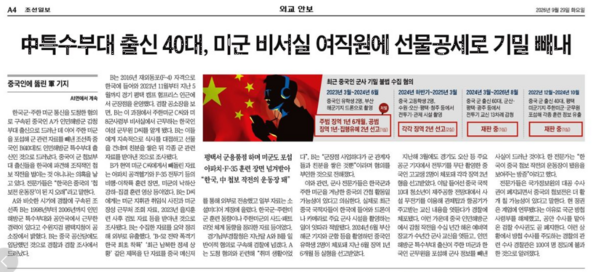
According to a prosecutor's indictment obtained by the Chosun Ilbo on the 29th, specific details regarding the military background of A, a Chinese national in his 60s, have come to light. The report revealed that A was a former Zhongxiao (lieutenant colonel equivalent) who served for approximately 40 years in an interception unit under the General Staff Department of the PLA in Beijing.
The fact itself that A is a former member of the Chinese military and was arrested while gathering military signals intelligence in South Korea was previously reported last month by AP, CNN, and the US military publication Stars and Stripes. AP reported, "A is accused of intercepting communications between South Korean and US fighter jets and air traffic control towers, and South Korean investigative authorities are looking into whether the gathered information was transmitted to Chinese authorities."
According to the indictment, A is accused of eavesdropping on military communications 13 times between March 2024 and August 2025 across various locations, including air bases in Gunsan (North Jeolla Province), Osan (Gyeonggi Province), and Gwangju, as well as Camp Humphreys in Pyeongtaek and a naval base in Busan. His method involved setting up signal receivers and antennas in hotel rooms close to control towers or runways to record communications between fighter pilots and air traffic controllers. Seven of the 13 instances were concentrated at Gunsan Airport, which is jointly used by the South Korean and US air forces.
Stars and Stripes reported, "During earlier police investigations, A installed a Software Defined Radio (SDR) receiver, an antenna, and a laptop in a hotel near Gunsan Airport to receive aviation communications." It added, "Police found that A had visited South Korea multiple times since January 2024, with some visits overlapping with joint South Korea–US military exercises; A claimed to police that listening to military communications was merely a personal hobby."
The audio files and frequency data collected by A were stored on an external hard drive totaling 13.9 TB. After departing for China, A re-entered South Korea in early August ahead of the joint South Korea–US military exercise "Ulchi Freedom Shield" (UFS), and was subsequently arrested while conducting eavesdropping from a hotel in Gunsan.
[This Time, Through "Human Intelligence"... Approaching Military Personnel Outside Camp Humphreys]
The theft of South Korean secrets by Chinese nationals did not end there. AP reported that "last month, two former Chinese military personnel were arrested in South Korea in separate incidents." CNN explicitly clarified that "there is no evidence that the two individuals acted together; they are entirely distinct cases."
The second suspect, B, a Chinese national in his 40s, ran a military surplus store near Camp Humphreys. According to Stars and Stripes, while operating the shop from November 2021 to May 2025, he approached South Korean personnel working inside the base, offering cash and gifts to obtain information related to base activities, including South Korea–US military exercises. The materials gathered by B reportedly included details on military drills, troop and weapon movements, and US military command information. Stars and Stripes, citing police statements, noted that "B collected information on US military weapon movements, photos of command posts, and change-of-command ceremonies."
The key distinction lies in the methods of intelligence gathering: one suspect intercepted electronic signals using antennas, while the other relied on human approach (HUMINT) to secure information. When CNN reached out to the Chinese Ministry of Foreign Affairs for comment, the ministry responded that it was unaware of the situation.
[Another Case Broke on the Same Day… “Bring Over Samsung’s Recipe”]
What makes this pattern even more concerning is that it extends beyond the military domain. In a statement obtained from investigative authorities by the JoongAng Ilbo on the 29th, testimony revealed that David Wang, the former CEO of CXMT—China's largest DRAM manufacturer—pressured South Korean engineers formerly with Samsung Electronics in 2016 to bring over Samsung's Process Recipe Plan (PRP) and equipment data.
A former Samsung Electronics manager surnamed Jeon, who was in charge of equipment investment at CXMT, testified that Wang pressured them by claiming he even possessed contacts to verify the authenticity of the Samsung data. At the time, CXMT executives reportedly used the code name "Yellow Mountain" to refer to Samsung Electronics.
A Process Recipe Plan (PRP) is no simple technical document. It serves as the actual "semiconductor manufacturing recipe," detailing the sequences, machinery, and parameter values across hundreds of DRAM production steps. The 18-nanometer DRAM process in question was a breakthrough technology developed world-first by Samsung Electronics through massive research and development investments. Jeon, who joined CXMT after 28 years at Samsung Electronics, was indicted for leaking and using the relevant technology without authorization; he was sentenced to seven years in prison in his first-instance trial in April 2025, and the case is currently under appeal.
[“No Investment Without 18-Nanometer Tech”… How Far Did the Chinese Government Intervene?]
The most sensitive revelation in recent reports stems from Jeon’s courtroom testimony. During court proceedings this month, Jeon testified, "During discussions with the Chinese government at the time, it was conveyed that unless 18-nanometer technology was secured, it would be difficult for CXMT to receive government investment funds." When prosecutors asked whether the Chinese government had sought the 18-nanometer technology from the beginning, Jeon answered affirmatively. If this statement is accurate, the key issue to be clarified in upcoming court sessions will be the nature of the link between the pressures exerted by CXMT management to acquire Samsung technology and the investment conditions set by the Chinese government.
[And 10 Years Later… CXMT Has Become the World’s No. 4 Player]
Viewing this solely as a 2016 technology leak case misses the broader picture. A decade later, CXMT’s market standing has completely transformed. According to Reuters, CXMT captured approximately 7.7% of the global DRAM market in 2025, rising to fourth place globally behind Samsung Electronics, SK Hynix, and Micron. The company expanded rapidly on the back of China's semiconductor self-reliance strategy, support from local governments and state capital, and a massive domestic market.
Seen from this perspective, the implications of the Samsung technology leak become far more serious. The issue is not merely whether a few South Korean engineers leaked technology in the past. It lies in the fact that a Chinese firm that aggressively acquired core South Korean technologies and talent has evolved in just ten years into a global competitor directly chasing South Korean chipmakers.
[The Espionage Act Has Changed… Spying for Foreign Nations Is Now Punishable]
South Korea belatedly addressed this legal loophole. Article 98 of the existing Criminal Act primarily defined espionage in relation to an "enemy state" (North Korea), drawing criticism that it was difficult to apply espionage charges to the collection of state secrets on behalf of countries with established diplomatic ties, such as China. However, under the Criminal Act revised this year, Article 98-2 was created to cover "espionage for foreign nations." Under this new provision, detecting, collecting, leaking, delivering, brokering, or aiding in the handling of state secrets under the instruction, solicitation, or communication with a foreign country or equivalent organization is punishable by imprisonment for a fixed term of three years or longer. The revised law took effect on September 13. Consequently, these new provisions cannot be applied retroactively to the alleged acts committed by A and B prior to that date.
[More Crucial Than the Law Is the "Counterintelligence System"]
While legal frameworks are updated, intelligence-gathering techniques are evolving rapidly. The National Intelligence Service’s (NIS) investigative authority over anti-communist and foreign intelligence operations was transferred to the police in 2024. South Korea's military counterintelligence structure was also reorganized this year. The government explains that dividing counterintelligence, security, and national security investigation functions aims to enhance expertise and democratic oversight. On the other hand, concerns persist that if information sharing and inter-agency coordination are insufficient during this functional dispersion, response times could lag. Therefore, what needs evaluation in light of these incidents is not a political assessment of specific organizational restructurings, but a practical one.
In an era where a former PLA interception expert sets up equipment in a hotel room to monitor military communications, the real question is how swiftly South Korea's counterintelligence apparatus can detect, track, and share intelligence across agencies.
[Why Times Insight]
The reason these cases cannot be brushed off as isolated misconduct by a few individuals lies in the backgrounds of the perpetrators and their methods of intelligence collection. One suspect was specified in the prosecutor's indictment as having served in a PLA interception unit for roughly 40 years. Another former Chinese soldier is accused of approaching personnel around Camp Humphreys to obtain military materials. Furthermore, court testimony revealed that the former CEO of China’s largest DRAM manufacturer directly pressured engineers from Samsung Electronics to hand over core manufacturing process data.
While current evidence alone may not definitively prove that these events constituted a single, coordinated intelligence operation directed by the Chinese government, the escalation in methods—moving from photographing military sites to conducting long-term electronic eavesdropping with specialized signal receivers—strongly points toward state-backed support. The approach of targeting military personnel directly for information has also surfaced. In the industrial realm, cases involving the theft of world-leading semiconductor manufacturing processes are leading to actual criminal trials.
Precisely as South Korea reshapes its legal and organizational frameworks, intelligence gathering methods are expanding from cameras to antennas, from base perimeters to personnel, and onto core national industrial technologies. Thus, the question these events pose to South Korea is straightforward: Are we still viewing "spies" merely as individuals climbing military fences or stealing paper documents?
An antenna in a hotel room can serve as an instrument of intelligence warfare. Cultivating long-term relationships with military personnel to acquire information is an established method of intelligence collection. Likewise, the semiconductor process technology carried inside the head of a single key engineer constitutes an asset directly tied to national security today.
Regardless of how China is defined diplomatically, South Korea must respond calmly and rigorously to the recurring pattern of incidents involving Chinese nationals and Chinese enterprises targeting South Korean military intelligence and advanced industrial technology. Counterintelligence should not be designed around feelings of affinity or hostility toward another nation, but around verified actions, capabilities, intentions, and our own vulnerabilities. That is the true warning embedded in these latest events.

-중국 푸단대학교 한국연구원 객좌교수
-전 EDUIN News 대표
-전 OUR NEWS 대표
-제17대 대통령직인수위원회 정책기획팀장
-전 대통령실 홍보기획비서관
-사단법인 한국가정상담연구소 이사장
-저서: 북한급변사태와 한반도통일, 2012 다시우파다, 선거마케팅, 한국의 정치광고, 국회의원 선거매뉴얼 등 50여권