Update2026.10.24 (토)

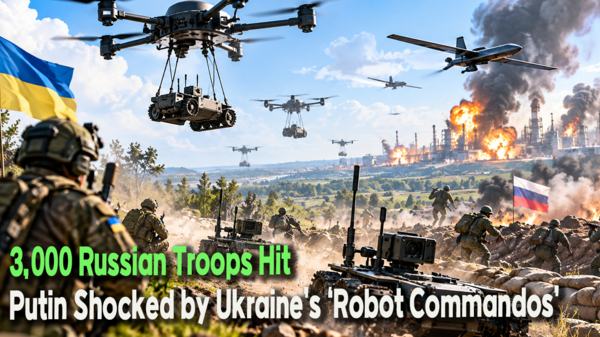
[Over 3,000 Russian casualties… The veil lifted on a secret operation]
“Over 3,000 Russian troops damaged.” This shocking figure was recently unveiled by Ukraine as the preliminary record of “Operation Vivaldi,” a campaign shrouded in secrecy for months. In restoring control over 125㎢ in northern Donetsk, Ukraine’s 3rd Corps deployed innovative tactics, using heavy bomber drones to drop kamikaze unmanned ground vehicles (UGVs) more than 10 km behind Russian front lines. As ground robots penetrate deep into Russian rear positions on the front lines and long-range drones strike oil refineries and industrial facilities inside Russia, the Kremlin finds itself locked in a new kind of war—forced to defend both the front and the homeland simultaneously.
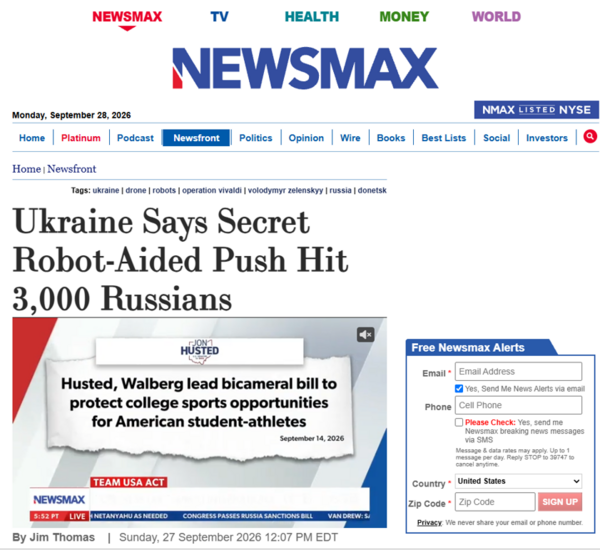
Newsmax reported in an article titled ‘Ukraine Hits 3,000 Russian Troops in Secret Robot-Backed Offensive’: “A months-long covert offensive by Ukraine’s 3rd Corps in the Donetsk region has inflicted over 3,000 Russian casualties and placed 125㎢ back under Ukrainian control.” Regarding this, Commander Andriy Biletsky of the 3rd Corps stated, “Following weeks of strict information control, we have publicly disclosed the existence of this offensive for the first time. The operation was named ‘Operation Vivaldi,’ derived from Antonio Vivaldi’s The Four Seasons.”
Summarizing the operational results released by Ukrainian forces, Phase 1 cleared 75 ㎢ where Russian forces had infiltrated and liberated 10 ㎢ of occupied territory. Phase 2 secured an additional 40㎢ by recapturing Shandryholove and Derylove while securing Drobysheve. Combining Phases 1 and 2 brings the total restored control area to 125㎢ , of which approximately 50㎢ represents territory recaptured directly from actual Russian occupation.
[The real shock: ‘Robot commandos’ dropped from the sky]
However, what captured global military experts’ attention during Operation Vivaldi was not just the casualty count of 3,000. It was the fact that robots literally dropped from the sky. Newsmax noted, “The 3rd Assault Brigade utilized heavy bomber drones to carry NC13 attack UGVs, dubbed ‘Gryphon,’ flying over 10 km past Russian front lines before dropping them. Named after a missing machine gunner from the unit, ‘Gryphon’ represents a historical tactical first—rather than infantry penetrating enemy lines to carry a robot, an uncrewed aerial system transported another uncrewed system deep into the Russian rear.”
Ars Technica also provided an in-depth analysis of the operation, reporting that “heavy bomber drones dropped explosive-laden ground vehicles more than 6 miles (10 km) behind Russian front lines, bypassing terrain constraints and Russian defense lines to strike rear supply networks.”
[More than just attacking… Robots opened paths through minefields first]
The mission of these robots was not limited to kamikaze strikes. According to Ars Technica, other ground vehicles deployed during Operation Vivaldi cleared anti-personnel mines along more than 30 km of movement routes ahead of advancing Ukrainian infantry. Robots took over high-risk missions typically assigned to two combat engineer companies. Within the 3rd Corps’ operational zone, ground robots reportedly handled nearly 60% of mine-clearing operations.
Ukraine’s strategic goal is clear: faced with manpower shortages relative to Russia, it aims to delegate hazardous human tasks to machines as much as possible. Drones conduct reconnaissance, drones and robots carry out attacks, and robots breach minefields first. Only then do infantry forces advance. The battlefield sequence itself is being fundamentally inverted—shifting from “a war where humans fight first with drone support” to “a war where drones and robots fight first, followed by human troops.”
[The real secret highlighted by ISW: They didn't target Russian infiltrators directly]
Even more noteworthy is a recent analysis released by the Institute for the Study of War (ISW). The core essence of Operation Vivaldi lies not merely in a single new robotic weapon, but in changing the fundamental methodology of engaging Russian forces.
According to ISW’s report, Ukrainian forces departed from traditional tactics—which involved immediately deploying troops to eliminate Russian infiltration units upon detection. Instead, they targeted Russian ATV and motorcycle units rushing to reinforce those infiltrators, severing supply routes and Ground Lines of Communication (GLOCs) first. Full-scale clearing operations were launched only after isolated Russian units in the rear suffered from ammunition shortages, supply depletion, and plunging morale. Combined with electronic warfare, destruction of command-and-control nodes, and deceptive operations, Ukrainian forces were able to penetrate areas housing Russian drone operators and electronic warfare personnel.
ISW evaluated this as an “innovative approach” with the potential to break away from static trench warfare and reintroduce tactical maneuverability to the battlefield. The significance of Operation Vivaldi thus extends beyond the 3,000 Russian casualties. By reversing Russia’s tactics of small-scale infiltration → reinforcement → stronghold acquisition, Ukraine used infiltrated units as bait to isolate them, cutting off incoming reinforcements and logistics at the source.
Furthermore, Operation Vivaldi is far from over. Following a briefing from Commander-in-Chief Mykhailo Drapatyi, President Zelensky stated, “Important achievements continue in Operation Vivaldi along the Lyman axis,” claiming that “10,660 Russian personnel were killed or wounded across the entire front line over the past week.”
[It’s not just the front line… ‘Drone terror’ spreads to the Russian mainland]
What presents an even greater burden for Putin is that this war is no longer confined within Ukrainian territory. Ukraine is actively targeting refineries, energy facilities, and industrial infrastructure deep inside the Russian mainland using long-range drones. On September 20, a massive drone attack—the largest aimed at Moscow since the start of the war—caused a fire at the Moscow Oil Refinery. The Financial Times (FT) analyzed that “Ukraine’s repeated strikes against Russian refining capacity are impacting not only Russia internally but also international diesel markets.”
On the front lines, ground robots penetrate Russian rear positions; hundreds to thousands of kilometers away, long-range drones strike energy and industrial infrastructure. From Moscow’s perspective, securing the front line contiguous with Ukraine is no longer sufficient to sustain the war. Russia now faces the crushing burden of a nationwide air defense effort to shield refineries, factories, warehouses, and logistical nodes scattered across its vast territory.
[Ultimately telling corporations: “Protect your own facilities”]
That burden is directly reflected in the financial expenditure of Russian enterprises. Citing data from Tenderplan, a procurement and bidding analytics firm, Russian business daily Vedomosti pointed out: “In the first half of this year, Russian companies spent 441.3 million rubles on anti-drone equipment—a 6.6-fold increase compared to the same period last year.” It added, “As ports, oil refineries, chemical plants, defense facilities, and warehouses become targets, corporations have begun purchasing their own drone detection and jamming equipment.”
The Kremlin has gone a step further. According to Reuters, Putin signed Presidential Decree No. 604 on August 24. Under this decree, if companies operating critical infrastructure fail to implement necessary security measures or if their drone defense measures prove ineffective—thereby threatening facility safety or normal operations—the government may introduce temporary administration over company assets by presidential decree. For Russian businesses, this means taking on not only the physical threat of facility destruction by drone strikes, but also the corporate risk of direct state intervention in management and asset control should the government deem their defenses inadequate.
[Why Times Insight: What’s scarier than ‘3,000 casualties’ is the fact that the nature of warfare is changing]
The most striking figure from Operation Vivaldi is undoubtedly the 'over 3,000 Russian casualties'. Yet from Russia's perspective, the true point of concern lies in the doctrine that generated that figure. To offset its manpower deficit, Ukraine is offloading high-risk tasks previously borne by soldiers onto machines. Drones perform reconnaissance, and secondary drones execute strikes. Heavy bomber drones transport ground robots 10 km behind front lines, where those UGVs clear minefields to forge pathways for advancing infantry.
The battlefield is shifting from sending humans first with drone support to letting drones and robots fight first while humans follow.
Moreover, as ISW’s analysis underlines, this evolution extends beyond novel weaponry. Ukrainian forces prioritized severing supply lines and reinforcement networks over directly engaging infiltrated Russian squads. By neutralizing isolated units once they are weakened, Ukraine minimizes infantry attrition while restoring operational mobility—explaining why ISW views Operation Vivaldi as an innovative approach capable of breaking static positional deadlock.
Conversely, the territory Russia must defend continues to expand. On the front lines, personnel must be continuously replenished; in the rear, refineries, logistics hubs, and industrial plants require constant protection. As state air defense systems prove insufficient, private enterprises are forced to procure their own counter-drone assets, while the Kremlin establishes legal mechanisms to place underperforming critical enterprises under temporary state management. The economic cost of war has breached military confines, cascading across Russian corporate balance sheets and the broader economy.
The signals sent by this operation carry significant weight. Suicide robots dropped 10 km behind enemy lines, long-range drone strikes reaching deep-seated refineries and logistics centers, and private firms pouring corporate capital into makeshift air defense networks.
The real shock of Operation Vivaldi goes far beyond the singular metric of 3,000 Russian casualties. While Ukraine pushes machines to the front line in place of human lives, the area Russia must defend and the costs it must absorb continue to multiply rapidly. For Putin, the burden of a protracted war has expanded beyond frontline attrition into a structural crisis encompassing national air defense, corporate liabilities, and state fiscal sustainability.


-중국 푸단대학교 한국연구원 객좌교수
-전 EDUIN News 대표
-전 OUR NEWS 대표
-제17대 대통령직인수위원회 정책기획팀장
-전 대통령실 홍보기획비서관
-사단법인 한국가정상담연구소 이사장
-저서: 북한급변사태와 한반도통일, 2012 다시우파다, 선거마케팅, 한국의 정치광고, 국회의원 선거매뉴얼 등 50여권