Update2026.10.24 (토)

[The Chinese CEO Contingent Missing from Xi Jinping’s Presidential Aircraft]
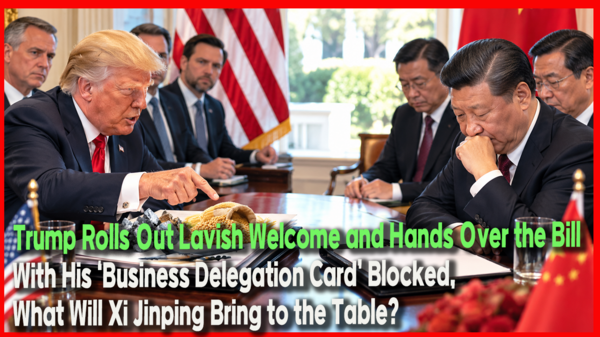
In Chinese President Xi Jinping’s first U.S. state visit in 11 years, what stands out most is not just the lavish red carpet. Rather, it is the absence of certain key figures on Xi’s presidential aircraft that speaks far more clearly to the underlying nature of this summit: the large-scale official delegation of business leaders that China had originally sought to bring along.
President Trump greeted Xi in person at Joint Base Andrews. At the White House, the U.S. side prepared an official welcoming ceremony involving 479 service members, a full military review, and even a celebratory flyover featuring a B-2 Spirit strategic bomber and four F-22 Raptor fighter jets. However, this top-tier protocol was entirely distinct from the economic and trade negotiations. What Washington was keenly focusing on was how much China would actually implement on the ground regarding its prior commitments, such as rare earth supplies and purchases of American agricultural products.
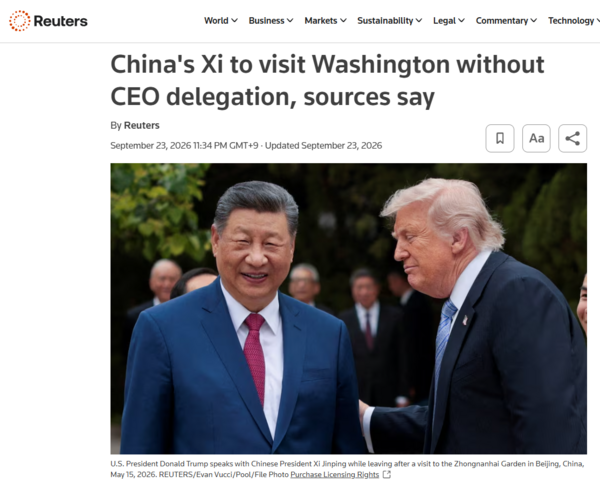
Reuters reported: “Xi arrived at Joint Base Andrews in Maryland to kick off his three-day state visit, but the large-scale official delegation of business leaders China had pursued did not travel alongside Xi”. Reuters drew significant attention by adding that “the official delegation list disclosed by China’s state-run Xinhua News Agency included top officials like Cai Qi, Director of the General Office of the CCP, and Foreign Minister Wang Yi, but notably lacked a corporate delegation”.
Just a few days earlier, the situation had looked quite different. Reuters reported that “China was coordinating with the U.S. side on a list of business leaders to accompany Xi during his visit, with candidates including BYD, CATL, Xiaomi, Gotion High-Tech, Hisense, Wanxiang Group, Bank of China, and COFCO.” The sticking point, however, was that several of these candidate firms were facing regulatory scrutiny or active investigations in the U.S. over alleged ties to the Chinese military, trade practices, technology transfers, or national security concerns. The U.S. side also maintained a negative stance toward hosting a U.S.-China CEO Roundtable.
That is not to say that Chinese corporate executives were completely absent from American soil. The South China Morning Post (SCMP) confirmed that “a small number of Chinese CEOs holding U.S. visas arrived in Washington separately from Xi’s official entourage.” While entities such as Alibaba, Xiaomi, CATL, and BYD were mentioned, it remained unconfirmed exactly which executives from which companies actually landed in Washington.
Even more intriguing was that their attendance at the White House State Dinner remained uncertain until the very last minute. According to the SCMP, the issue of Chinese corporate leaders attending the official function was raised during working-level consultations between U.S. Treasury Secretary Scott Bessent and Chinese Vice Premier He Lifeng. In short, rather than describing the situation as “the U.S. flatly banning Chinese executives from entering the country,” it is more accurate to say that Beijing’s initial plan to leverage a massive CEO delegation as Xi’s official economic mission fell through—leaving individual CEOs to travel to Washington independently while awaiting potential dinner invitations.
[Trump Brought His CEO Delegation, But China’s ‘Reciprocity’ Failed to Apply]
This contrast is all the more striking when compared to the situation in May, when President Trump visited China accompanied by a large cohort of prominent American business leaders. During Xi's reciprocal visit to the U.S., China attempted to form a corresponding corporate delegation, but ultimately failed to secure a similar official arrangement.
Conversely, top executives from major American technology firms were invited to the U.S. state events. Reuters reported that “ahead of the summit, leaders such as Jeff Bezos, Sundar Pichai, Sam Altman, Tim Cook, Elon Musk, Jensen Huang, and Michael Dell were slated to attend the state dinner”. The White House also officially announced that official delegations from both nations, along with corporate leaders and government officials, would attend the event.
Right here lies a crucial strategic shift embedded in this summit. In the past, large-scale Chinese corporate investments and business expansions in the U.S. could serve as an economic "gift package" in summit diplomacy. Today, however, Washington no longer views Chinese market entries in electric vehicles (EVs), batteries, AI, and advanced technology purely through the lens of economic investment. Indeed, leading up to the summit, the U.S. automotive industry urged the Trump administration to keep strict limits on Chinese automakers entering the U.S. market, citing both American jobs and national security interests simultaneously.
[A Two-Month Truce… What Trump Is Watching For Is ‘Implementation’]
With the room to leverage business delegations and investment deals constrained, what tools remain for Xi Jinping to move the needle with Trump? A hint was offered by an agreement reached on the eve of the summit. According to Reuters, the U.S. and China agreed to extend the existing trade truce by two additional months. Rather than securing a definitive, long-term settlement, both sides essentially bought an extra two months of time. Treasury Secretary Bessent noted that the two countries would use this window to pursue a broader trade agreement.
What Washington is monitoring above all is China’s actual execution of past promises. During the U.S.-China negotiations, Secretary Bessent and U.S. Trade Representative Jamieson Greer pressed China to follow through on its commitments regarding rare earth supplies and agricultural purchases. At the time, the U.S. side pointed out that although Beijing had agreed during the Beijing summit to buy an additional $17 billion in U.S. agricultural goods and 200 Boeing aircraft, parts of those agreements had yet to be fully implemented.
Soybeans, in particular, directly impact American farming communities—a core political constituency for Trump. According to Reuters, China has taken steps toward fulfilling its existing commitment to purchase 25 million metric tons of U.S. soybeans annually through 2028. However, non-soybean agricultural purchases and tariff adjustments remain subject to negotiation. Consequently, agricultural commodities like soybeans and sorghum, along with rare earths, resurfaced as key trade agenda items for this summit.
[Yet Xi Is Not Empty-Handed… The Rare Earths Card]
Still, it would be inaccurate to view these negotiations as a dynamic where the U.S. simply presents a unilateral bill for China to pay. Beijing possesses a formidable bargaining chip that Washington cannot easily dismiss: rare earth elements. Leading up to the summit, Reuters highlighted that “China controls up to 70% of global rare earth mining and over 85% of refining and processing capacity, and this overwhelming dominance in the supply chain continues to influence the degree of pressure the Trump administration can apply”. While the U.S. holds powerful cards in tariffs and high-tech export controls, China commands significant leverage in rare earths and manufacturing supply chains.
Thus, current U.S.-China negotiations are less about Trump issuing one-sided demands for Xi to accept, and more akin to a high-stakes tug-of-war where each leader holds leverage over the other’s vulnerabilities. Reuters similarly observed that “Xi entered this summit leveraging China’s massive trade surplus and dominant position in rare earths”.
[11 Years Ago, Xi Made Promises on This Very Ground]
Washington's acute sensitivity regarding China’s "promise fulfillment" is rooted in past experience. On September 25, 2015, during a joint press conference with President Obama in the White House Rose Garden, President Xi stated that Chinese construction activities in the Spratly Islands of the South China Sea “do not target or impact any country,” asserting that China “does not intend to pursue militarization.” This statement remains preserved in the official White House archives to this day.
In the years following, China constructed airstrips, radar installations, and military facilities on artificial islands across the South China Sea. Because of this precedent, there is a strong sentiment in Washington that any new agreement with China must be verified through tangible actions and compliance rather than mere declarations.
[Unyielding Position on the Taiwan Issue]
The structural divide between the two nations was also fully on display regarding the Taiwan issue. According to details of the summit released by Xinhua News Agency, “Xi directly requested that Trump handle the Taiwan issue with prudence and uphold a 'correct stance against Taiwan independence'.” This marked a demand from Beijing for a significantly more explicit political stance than Washington’s traditional phrasing.
Leading into the summit, speculation grew that Xi would strongly urge Trump to halt arms sales to Taiwan. Currently, a new arms sale package for Taiwan valued at approximately $14 billion awaits a formal decision. However, U.S. law dictates providing Taiwan with sufficient self-defense capabilities, and voices within Washington remain adamant that arms sales to Taiwan must not be used as a bargaining chip in bilateral trade negotiations.
[From B-2s to F-22s… Displaying U.S. Military Might Amid Top-Tier Hospitality]
Another defining visual of this state visit was the display of U.S. military power. According to the official schedule released by the White House, 479 U.S. service members were deployed for the welcoming ceremony. At the conclusion of the military review in the Rose Garden, a single B-2 Spirit stealth strategic bomber and four F-22 Raptor fighter jets flew over the White House. Officially, this flyover was staged as part of the state reception honors.
Yet, its political symbolism was undeniable. The highest level of diplomatic courtesy the U.S. could offer and its most advanced military hardware appeared simultaneously within the same frame. While there is no definitive ground to label this as direct "military intimidation" against Xi, it can certainly be interpreted as a carefully choreographed dual display of hospitality and sheer force.
[The Real Question Remaining Behind the Glamorous Welcome]
Ultimately, understanding this summit requires separating diplomatic protocol from actual policy realities. The fact that Trump offered Xi a lavish welcome does not mean U.S. technology export controls, investment restrictions, security reviews on Chinese firms, or Taiwan policy have evaporated. Conversely, China has not laid down its leverage in rare earths or manufacturing supply chains.
In a post-summit analysis, Reuters highlighted strategic competition between the two powers—alongside trade and AI—as a central focal point of the meeting. The true scorecard of this summit will likely be determined not by the glamour of the welcoming ceremony, but by what is actually executed in the days ahead.
[Why Times Insight]
The most symbolic moment of Xi Jinping’s visit to the U.S. may not have been the brilliant red carpet, but rather the absence of a corporate delegation in Xi's official entourage. China originally sought to include top business leaders from companies like BYD, CATL, and Xiaomi. In the end, however, some CEOs arrived in Washington separately, and their attendance at the state dinner remained a matter of last-minute coordination. This sequence of events signals that Chinese corporate investments and tech partnerships in the U.S. can no longer easily serve as diplomatic "sweeteners" in summit negotiations as they once did.
Still, it would be premature to conclude that Xi has been backed completely into a corner. Beijing holds powerful leverage in rare earths, and Washington remains mindful of potential Chinese supply chain retaliations. Thus, rather than a clear-cut victory for one side, this summit is better understood as a tactical pause—an opportunity for both leaders to gauge each other's cards while buying more time.
This makes Xi’s subsequent actions all the more crucial. The key watching point now is whether Beijing will demonstrate concrete action on past economic pledges—such as purchasing U.S. agricultural products and guaranteeing rare earth supplies—or make strategic shifts in broader geopolitical arenas like Iran or Russia to satisfy Washington. On the latter, no concrete agreements have been confirmed to date. Regarding Taiwan, while Xi is demanding a stronger commitment from Washington, how much U.S. policy will actually shift remains an entirely separate matter.
This brings us back to Trump’s elaborate ceremonial reception. The red carpet was an act of diplomatic hospitality, but it did not wipe away the ledger of economic negotiations. Once the fanfare involving B-2 bombers and F-22 fighters fades, the concrete issues—rare earths, agricultural purchases, market access, Taiwan, and tech restrictions—remain firmly on the table.
In the end, the real contest of this summit begins not on the White House red carpet, but after it is rolled away. Whether the unprecedented honors Xi received in Washington lead to a genuine turnaround in U.S.-China relations, or merely mark a temporary two-month ceasefire, ultimately depends on what both nations deliver through action.

-중국 푸단대학교 한국연구원 객좌교수
-전 EDUIN News 대표
-전 OUR NEWS 대표
-제17대 대통령직인수위원회 정책기획팀장
-전 대통령실 홍보기획비서관
-사단법인 한국가정상담연구소 이사장
-저서: 북한급변사태와 한반도통일, 2012 다시우파다, 선거마케팅, 한국의 정치광고, 국회의원 선거매뉴얼 등 50여권