
Update2026.10.24 (토)

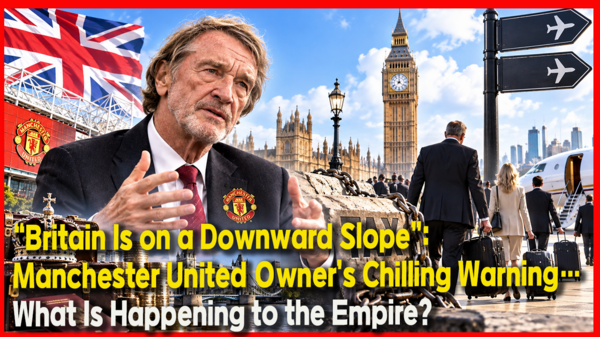
[“Tax Everyone to Death and They Will Eventually All Leave”]
In the United Kingdom—a nation that once ruled the high seas and global finance—world-renowned business leaders have begun to state publicly that "the country is on a downward slope." This goes beyond the scathing remarks of Jim Ratcliffe, co-owner of Manchester United. The number of millionaires in the UK has fallen to its lowest level since the global financial crisis, top-tier taxpayers are fleeing abroad, and the British government itself has admitted to a long-standing "hollowing out" of its military, embarking on a large-scale rearmament effort. The core issue is that Britain’s decline cannot be explained simply by taxes or the actions of any single political party. Rather, it stems from a convergence of political turmoil accumulated over a decade since Brexit, low growth, stagnant productivity, and mounting fiscal pressures all coming to a head at once.

The Guardian reported on September 20 that "unusually harsh criticism has erupted publicly within British business circles," adding that "Jim Ratcliffe, founder of chemical giant Ineos and co-owner of Manchester United, delivered a direct hit against Britain, claiming the nation is on a 'downward slope'." In a BBC interview on September 19, he asserted that "if you tax everyone to death, they will eventually all leave, and that is precisely what is happening today."
While acknowledging that Britain once built the world's largest empire and emerged victorious in two World Wars, Ratcliffe assessed that the current reality is the exact opposite. He argued that whereas wealth creators are applauded in the United States, public perception of wealth in the UK has turned hostile, with high taxes and heavy regulation pushing successful entrepreneurs and high-net-worth individuals overseas.
The Labour government immediately launched a counteroffensive. Bridget Phillipson, Chair of the Labour Party, pushed back by pointing out that "Ratcliffe lives as a tax resident in Monaco" and that "his assertions should be taken with a grain of salt," effectively dismissing his remarks as advice from a 'tax exile.' Ratcliffe's past status as a vocal supporter of Brexit was also brought back into the spotlight.
However, the key element to observe in this debate is not whether Ratcliffe or the Labour Party is right. The crucial point is that a prominent British business figure is openly pointing to national decline, and his warning coincides with tangible economic phenomena that cannot be easily brushed aside as mere complaints from a frustrated billionaire.
[Top Taxpaying Billionaires Have Started Packing Their Bags]
In fact, the flight of high-net-worth individuals from the UK has recently emerged as a significant economic and political issue. The Financial Times (FT) noted that "a series of ultra-wealthy figures, including hedge fund titan Chris Rokos and steel tycoon Lakshmi Mittal, have departed the UK." The FT further highlighted that "recently, Fred Done, founder of Betfred and widely considered one of Britain's top individual taxpayers, issued a strong warning that high tax burdens could drive wealthy individuals and businesses out of the country."
Statistical data paints an even more striking picture. According to the Millionaire Tracker report released in July by the Adam Smith Institute, the number of UK-resident adults with a net worth of £1 million or more was estimated at approximately 442,000 (adjusted for inflation to 2025 values). This represents a 7% decline from 2024 and marks the lowest figure recorded since the onset of the global financial crisis in 2008.
While the reduction to 442,000 cannot be attributed solely to 'millionaires fleeing the UK due to taxes,' it is undeniable that real asset price depreciation, low household savings rates, and the relocation of high-net-worth individuals abroad are all contributing factors. In this context, the Institute analyzed that "high current tax rates, fears of further tax hikes, non-domiciled tax reforms, and a lack of confidence in the business environment are driving the departure of the wealthy."
[What Is Even Scarier Than ‘High Taxes’ Is a ‘Stagnant Economy’]
What complicates Britain's predicament further is that while tax burdens rise, the economy fails to expand at a sufficient pace. The UK's Office for Budget Responsibility (OBR) estimates medium-term underlying productivity growth at a modest annual average of around 1.0%. The nation faces a structural mismatch: the social welfare, defense, and healthcare costs it must shoulder continue to climb, while the pace of economic growth needed to sustain them cannot keep up.
The OECD’s diagnosis was even more direct. In its UK Economic Survey released in July, the OECD noted that while the British economy is showing signs of improvement, growth remains sluggish. High energy prices, fiscal strain, weak productivity growth, and persistent regional disparities continue to weigh heavily on economic performance and living standards. The OECD projected that UK real GDP growth would slow from 1.4% in 2025 to 0.9% this year, before staging a modest recovery to 1.1% in 2027.
The tax burden is also highly likely to rise further. In its November forecast last year, the OBR projected that total tax revenues as a percentage of GDP (national accounts basis) will rise from 34.7% in 2024–25 to a record high of 38.3% by 2030–31. Ultimately, the fundamental problem confronting the UK economy is not simply that "taxes are high." The far greater issue lies in the structural collision between weak economic growth and productivity on the one hand, and the state's ever-expanding demand for revenue on the other.
[A Decade After Brexit, the Bill Is Still Outstanding]
Compounding these challenges are the lingering aftereffects of Brexit. In its July update this year, the OBR maintained its long-standing assumption that non-tariff trade barriers established following the UK's departure from the European Union will reduce long-term UK productivity by 4% compared to a scenario where the country had remained in the EU.
This presents an uncomfortable reality for Ratcliffe as well. Though he now aggressively criticizes British economic policy, Ratcliffe himself was among the prominent business figures who actively championed Brexit. In the end, the current state of the UK economy cannot be explained by the Labour government's recent tax increases alone, nor can it be blamed solely on Brexit. Instead, it is the result of multiple political and economic choices made since 2016 intertwining over time.
[More Than Just Economics… The British Government Admits to Military ‘Hollowing Out’]
One of the areas where Britain's long-term shifts are most symbolically evident is defense. The UK's Strategic Defence Review, published last year, contained strikingly blunt language: the British government explicitly conceded that its core military capabilities had suffered a prolonged period of "hollowing out" and declared that this process must be reversed.
The fact that the nation which once possessed the world's most formidable navy to sustain the British Empire has now officially declared an end to military "hollowing out" symbolizes the profound transformations of past decades. However, describing present-day Britain as a nation in continuous military contraction would be inaccurate. Rather, the country has entered a phase of extensive rearmament aimed at restoring weakened capabilities.
In June, the British government announced a £298 billion defense investment plan spanning the next four years. The plan aims to raise the defense budget from its previous annual level of roughly £54 billion to around £80 billion by 2029, making substantial investments in nuclear deterrence, drones, missiles, and next-generation combat systems. The government described this as the largest sustained increase in defense spending since the Cold War.
Furthermore, just six days ago, the UK Ministry of Defence reiterated its £298 billion investment plan, detailing specific allocations for long-range artillery, attack drones, and autonomous weapons systems for the Army. Thus, the pressing question for British defense is not simply why the military has shrunk, but why a major global military power now finds itself forced to expend vast financial resources to rebuild its basic state of warfighting readiness.
[Where Did Things Go Wrong for Britain?]
Pinning the blame on any single political party misses the core of the issue. The Brexit referendum and subsequent political volatility occurred under Conservative rule, during which economic growth and productivity failed to recover as hoped. Following the change in government, the Labour administration opted for policies that raised tax burdens to manage fiscal pressure, which in turn triggered pushback from businesses and high-net-worth individuals.
Therefore, Britain's current predicament is less the sudden creation of one government than an accumulated invoice for choices made over the past decade—and arguably over the decades following the Cold War. Low productivity, an aging population, rising welfare costs, post-Brexit trade barriers, energy challenges, the price of military revitalization, and the mounting tax burden needed to finance it all are now colliding simultaneously.
[Why Times Insight]
Perhaps the most significant phrase in Ratcliffe's remarks was not his commentary on taxes, but his statement that "Britain is on a downward slope." Naturally, this assertion need not be accepted as an absolute objective truth. Ratcliffe maintains his tax residency in Monaco and supported Brexit, while the Labour government has its own valid arguments in disputing his claim.
Nonetheless, his warning draws widespread attention because it aligns with a notable number of objective warning signs. The count of millionaires has dropped to its lowest point since the global financial crisis, while some top taxpayers and high-net-worth individuals are leaving the country. Economic growth and productivity remain sluggish, and the economic costs of Brexit continue to mount. On defense, the government has openly acknowledged years of military "hollowing out" and is committing massive funds to reverse it.
In a democracy, long-term policy directions are ultimately shaped through elections, referendums, and party competition. Concluding that "the British public chose decline" would be an overstatement. A more accurate assessment is that "Britain is currently paying the price for the political and economic choices it has made over recent decades."
The decline of the British Empire did not happen overnight. The fundamental challenge facing Britain today is whether it can forge a sustainable social consensus on how to prioritize among economic growth, welfare, taxation, investment, immigration, social cohesion, defense, and fiscal balance.
Thus, the question raised by Ratcliffe carries greater weight than it might initially appear. Is the nation that was once the world's leading power undergoing a temporary rough patch, or is it facing sustained long-term structural pressures? And to reverse this trajectory, what costs and choices must British society be willing to bear? These two questions elevate the 'Ratcliffe debate' from a simple dispute over wealth taxation into a fundamental discussion about the future of the United Kingdom as a nation.


-중국 푸단대학교 한국연구원 객좌교수
-전 EDUIN News 대표
-전 OUR NEWS 대표
-제17대 대통령직인수위원회 정책기획팀장
-전 대통령실 홍보기획비서관
-사단법인 한국가정상담연구소 이사장
-저서: 북한급변사태와 한반도통일, 2012 다시우파다, 선거마케팅, 한국의 정치광고, 국회의원 선거매뉴얼 등 50여권