


Update2026.10.24 (토)

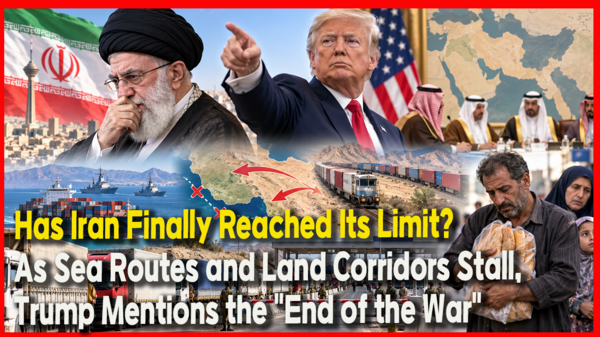
[Blocked Sea Routes Force a Pivot to Land… Yet Trucks Are Stalled at Every Border]
Is the conflict between the United States and Iran reaching a critical inflection point? Iran—which had redirected its trade logistics toward overland transit corridors, Caspian Sea routes, and freight rail bound for China to bypass the U.S. naval blockade—is now facing severe economic pressure as bottlenecking chokes its borders. Food inflation has surged 128% year-on-year, and in the impoverished neighborhoods of Tehran, families buying basic staples like bread on credit have become an increasingly common sight. At this precise moment, U.S. President Donald Trump publicly mentioned the "end of the war" and is scheduled to meet with Gulf state leaders next week to deliberate on the post-war Middle Eastern order.
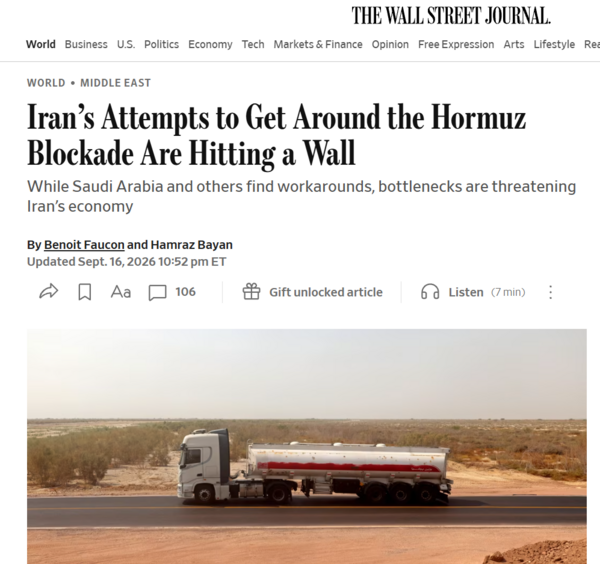
As U.S. naval blockades in the Strait of Hormuz severely restricted maritime transport, Iran rerouted cargo through overland networks linking Pakistan, Türkiye, Turkmenistan, and Afghanistan. However, border roads and customs infrastructure were instantly overwhelmed by the massive influx of cargo, triggering severe freight disruptions along major border checkpoints. Agricultural produce is rotting at border crossings, while major export commodities—such as iron ore, cement, and liquefied gas—remain completely stranded.
Thousands of trucks are queued along the Turkish border, with clearance taking up to several weeks for some shipments. Border facilities with Pakistan similarly lack the processing capacity to handle the surge in vehicular traffic. The core issue is not that Iran’s overland corridors are entirely severed, but rather that existing infrastructure cannot absorb the massive cargo volume redirected from maritime routes, turning its bypass channels into new operational bottlenecks.
[Caspian Sea Routes and Freight Rail to China Fully Mobilized, but Fall Short]
Iran has not remained passive. Tehran significantly increased maritime trade across the Caspian Sea and expanded freight rail operations connecting Tehran to Xi'an, China. However, economic viability remains the fundamental obstacle: land logistics are substantially more expensive than sea transport, and passing through sequential customs checkpoints adds administrative costs and time delays. These compounding bottlenecks and transit costs are placing an immense additional strain on the Iranian economy.
A broader vulnerability lies in the reality that Iran's alternative logistics routes depend heavily on the political and security conditions of neighboring countries. While maritime routes face direct U.S. military pressure, land routes rely on the customs capacity and border policies of Pakistan, Türkiye, and Iraq. Consequently, shifting cargo to land corridors cannot fully offset the impact of a naval blockade. The Strait of Hormuz blockade has evolved from an oil export restriction into a systemic mechanism driving up logistics costs across the entire Iranian economy.
[“Unable to Buy Bread or Cheese”… The War Reaches the Dinner Table]
The most immediate burden of this crisis falls directly onto the dining tables of the Iranian populace. According to data from the Statistical Center of Iran, year-on-year inflation for food, beverages, and tobacco reached approximately 128% in August, with edible oils surging 258.2%. Labor representatives assert that the prices of daily necessities—such as rice and cooking oil—have escalated at even steeper rates.
Conditions on the ground reflect an escalating humanitarian strain. Iranian labor advocate Ali Torghasivan noted that in the past, a worker could at least afford bread and cheese, but now even that basic standard is out of reach. Reports indicate that in low-income districts of Tehran, households are relying on store credit not only for meat and groceries, but for basic bread as well. Iran’s official monthly minimum wage stands at approximately 166.3 million rials, equivalent to roughly $72 on the open market.
[Foreign Investment Dries Up, Jobs Disappear]
Key indicators of economic outlook—investment and employment—are showing critical stress. Tahmoures Lahouti, Iran's Deputy Minister of Industry, stated that virtually no new foreign direct investment has been recorded since the start of the current Iranian calendar year (March 21). He explained that attracting foreign capital remains virtually impossible under ongoing sanctions and stringent trade restrictions.
The labor market is suffering similar dislocations. Reports indicate that the industrial sector lost approximately 630,000 jobs in the first quarter alone. Labor analyses further reveal that social security enrollments dropped by nearly 1 million over the past year. While the official unemployment rate hovers around 7%, that metric fails to capture the true reality of a shrinking labor force as growing numbers of citizens drop out of the market entirely.
[At That Exact Moment, Trump Mentioned the "End of the War"]
Just as economic pressures on Tehran reach a critical threshold, significant strategic signals are emerging from Washington. President Trump made remarks regarding the war with Iran, expressing hope that "the war is heading toward its end," while claiming that "Iran wants to negotiate."
However, with the conflict now in its seventh month, there are no immediate, concrete signs of an imminent formal ceasefire. Therefore, rather than interpreting Trump’s statement as a signal of immediate termination, it is more accurately read as an indication that Washington has begun formally evaluating its exit strategy.
[More Critical Than "Ending the War" Is "The Day After"]
President Trump is slated to meet with leaders and senior officials from Gulf Cooperation Council (GCC) nations—including Saudi Arabia, the UAE, Qatar, Bahrain, Kuwait, and Oman—on the sidelines of the UN General Assembly in New York next week. Crucially, the agenda extends beyond the immediate mechanics of terminating hostilities. Sources indicate that the U.S. is actively formulating a post-war "day-after" strategy for the region.
This initiative is part of a broader policy framework. The U.S. administration had previously begun drafting a post-war Middle East blueprint. Discussions include strengthening regional security alliances among U.S. partners to contain Iran and expanding the normalization of relations between Israel and neighboring Arab states. Reports also suggest Trump recently informed aides that he intends to pursue a broader geopolitical framework in the Middle East once active combat subsides.
[Meeting the Houthis Separately: Washington Decoupling Fronts]
In a parallel development, U.S. officials held direct, closed-door talks with a delegation from Yemen’s Houthi movement in Oman. This contact signals an effort by Washington to decouple and manage the Houthi issue separately rather than treating it as an indivisible component of the broader war with Iran.
Nevertheless, concluding that the conflict is near an end would be premature. Commercial shipping through the Strait of Hormuz remains heavily constrained, and clashes between Houthi forces and Saudi Arabia persist. Most importantly, there is no guarantee that Iranian leadership will accept Washington's terms simply due to mounting economic distress. Analysts have noted that while severe economic strain significantly weakens Iran, economic hardship does not automatically translate into immediate strategic concessions from Tehran.
[Why Times Insight]
The core question in the Middle East right now is not merely "When will the war end?", but rather "Why is Trump discussing the post-war order at this specific juncture?"
Iran attempted to circumvent the naval blockade via land corridors, but border infrastructure cannot absorb the sheer volume of trade. Food inflation has climbed to 128%, basic staples are being bought on credit, and new foreign direct investment has ground to a complete halt. U.S. pressure has penetrated far beyond Iranian military targets, impacting household supply chains, employment, and national logistics.
At this exact moment, Washington is invoking the "end of the war," convening Gulf allies to draft "day-after" strategies, and opening a separate communication channel with the Houthis. The central strategic dynamic to monitor going forward is whether the U.S. is attempting to isolate and manage individual operational theaters, leveraging economic and military pressure to pivot from active conflict toward structured negotiations and regional realignments.
While it remains early to declare a definitive end to the conflict, the core focus in Washington has noticeably begun shifting from how to intensify military strikes on Iran to how to structure the Middle East after the conflict. The upcoming meeting between Trump and GCC leaders in New York represents a vital milestone in this evolving transition.

-중국 푸단대학교 한국연구원 객좌교수
-전 EDUIN News 대표
-전 OUR NEWS 대표
-제17대 대통령직인수위원회 정책기획팀장
-전 대통령실 홍보기획비서관
-사단법인 한국가정상담연구소 이사장
-저서: 북한급변사태와 한반도통일, 2012 다시우파다, 선거마케팅, 한국의 정치광고, 국회의원 선거매뉴얼 등 50여권



