Update2026.10.24 (토)

[The U.S. Rejects MBS’s Request and Sits Down with the Houthis]
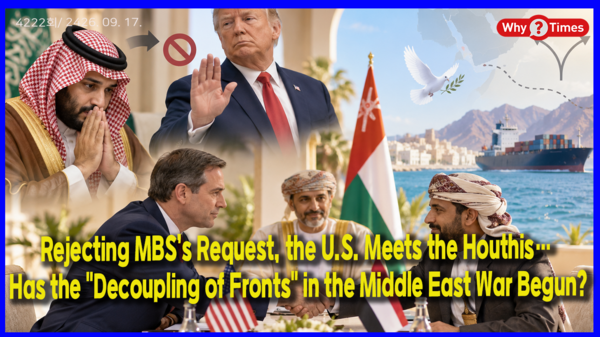
A scene has emerged requiring a fundamental reassessment of America’s Middle East strategy. Driven into a corner by the unstoppable momentum of the Houthis, Saudi Arabia urgently requested military assistance from the U.S.. However, the Donald Trump administration rejected direct military intervention. Just days later, U.S. officials secretly sat down with senior Houthi representatives in Oman, the very group engaged in active warfare with Saudi Arabia.
Even more striking is the message the Houthis reportedly conveyed to Washington: "We will not attack American vessels and will maintain the 2025 ceasefire with the United States." Is the U.S. seeking not to eradicate the Houthis, but rather to decouple "America’s war" from "Saudi Arabia’s war"? When paired with President Trump’s statements on the same day expressing hope that the war with Iran is heading toward its conclusion, this secret meeting serves as a critical signal indicating the future direction of the Middle East conflict.
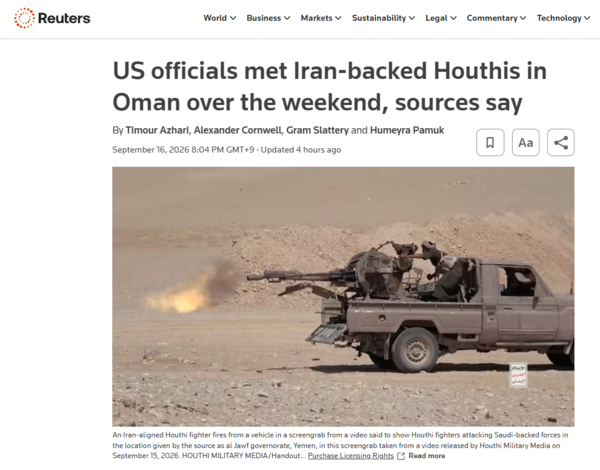
On September 16 (local time), Reuters cited five sources familiar with the matter reporting that "U.S. officials held a closed-door meeting with Houthi representatives in Muscat, Oman, last weekend." According to three sources, the venue was the U.S. Embassy in Muscat, with the Omani government—a long-time regional mediator—facilitating the talks.
According to Reuters, the Houthi delegation included Mohammad Abdulsalam and Abdelmalik al-Ajiri, both subject to U.S. sanctions. Abdulsalam, in particular, is a key figure who has long operated out of Muscat to manage the Houthis' external negotiations. While the U.S. Department of State did not directly confirm the meeting itself, it reiterated that protecting freedom of navigation in the Red Sea and preventing the spread of terrorism remain core U.S. national interests.
Indiatimes
To understand the full significance of this meeting, one must look back a few days prior. As the Houthis launched a massive offensive along the Red Sea coast, Saudi Crown Prince Mohammed bin Salman (MBS) requested direct U.S. military support from President Trump. However, Washington drew a clear line against launching direct strikes on the Houthis, limiting its involvement to intelligence sharing and targeting assistance. On September 14, MBS met Brad Cooper, Commander of U.S. Central Command (CENTCOM), in Jeddah to discuss regional developments, including the Houthi crisis.
Saudi Arabia asked the U.S. to strike the Houthis, but Washington declined. Just days later, U.S. diplomats sat down with those same Houthis. This sequence of events explains why the talks in Muscat were met with deep sensitivity in Riyadh.
Indiatimes
[The Houthi Condition: "We Will Not Touch American Ships"]
More critical is the substance of the talks. According to two sources, the Houthi delegation expressed that they have no intention of attacking U.S. vessels and intend to continue honoring the ceasefire agreed upon with Washington in 2025. A Yemeni source added that the Houthis communicated a position that they would refrain from attacking U.S., Israeli, and other commercial vessels, concentrating their military engagement solely on Saudi shipping. However, the U.S. government has not confirmed this as a formal new agreement.
From a strategic perspective, the message the Houthis delivered to Washington is relatively simple: "If you do not join Saudi Arabia’s war against us, we will not fight you."
Reuters noted that if this dynamic materializes, it effectively splits the conflict into two distinct operational theaters: one being the bilateral war between the Houthis and Saudi Arabia, and the other encompassing U.S. direct interests in Red Sea navigation and the broader conflict with Iran. For Washington, this secures the safety of its maritime assets without opening a new front against the Houthis. For the Houthis, it secures the operational space to battle Saudi Arabia without facing direct U.S. military force.
[The Houthis’ Surprise Advance: Saudi Intelligence Network Breached]
The timing of these contacts adds another layer of urgency. The Houthis recently executed a sweeping offensive along Yemen’s Red Sea coastline, capturing key areas including the Port of Mokha and advancing as far as Perim Island, a vital strategic chokepoint at the entrance of the Bab el-Mandeb Strait. Analysts evaluated this offensive as one of the most severe military setbacks for Saudi Arabia in Yemen in recent years.
According to Reuters, while the Houthis mobilized a substantial force, Saudi Arabia and its Yemeni proxy allies failed to detect the preparation. Saudi-backed Yemeni forces collapsed in the face of the assault, leaving behind weapons provided by the U.S. and Saudi Arabia, which were subsequently captured. The issue extends far beyond territory lost; it exposes both a glaring Saudi intelligence failure and the structural weakness of its proxy forces.
By securing strategic footholds such as Perim Island, the Houthis have dramatically expanded their military leverage over Bab el-Mandeb. This strait serves as a global maritime artery connecting the Red Sea to the Gulf of Aden. With the Strait of Hormuz destabilized by the war with Iran, the strategic imperative of securing Red Sea routes has become paramount for Saudi Arabia.
[Why the U.S. Is Reluctant to Engage in Another War with the Houthis]
This raises a central question: Why is the U.S. refusing to launch direct strikes against the Houthis despite the explicit request from its ally, Saudi Arabia?
Part of the background lies in Washington's prior experience in direct conflict with the group. The Trump administration re-designated the Houthis as a Foreign Terrorist Organization (FTO) in early 2025 and conducted large-scale military operations against them in the Red Sea. However, by May of that year, mediated by Oman, the U.S. and the Houthis established a de facto non-aggression ceasefire.
Israel Hayom
Consequently, Washington's top priority may not be the complete elimination of the Houthi movement, but rather deterring them from targeting U.S. shipping and international commercial traffic. The State Department’s response to Reuters—reaffirming freedom of navigation in the Red Sea and counter-terrorism as core U.S. interests—clearly reflects this hierarchy of priorities.
[President Trump’s Remarks on the Same Day]
What makes these secret contacts even more notable are comments made by President Trump regarding the war with Iran on September 16. Trump expressed hope that the seven-month conflict between the U.S. and Iran is moving toward a resolution. Furthermore, reports indicate that Trump intends to meet with leaders or foreign policy officials from Gulf Cooperation Council (GCC) nations—including Saudi Arabia, the UAE, Qatar, Bahrain, Kuwait, and Oman—on the sidelines of the UN General Assembly to discuss post-war strategy.
This leads to a crucial question regarding America's strategic calculus: As the U.S. seeks an exit strategy from its war with Iran, does it have any rational incentive to open a new conflict front against the Houthis in Yemen?
If Washington is attempting to contain the Houthi conflict within manageable bounds while concentrating its resources on resolving the Iran issue and shaping the post-war regional order, the Muscat contact should not be viewed as an isolated incident. Instead, it appears linked to a broader effort to reduce active fronts across the Middle East. (To be sure, the U.S. government has not officially confirmed that its contact with the Houthis is part of a broader exit strategy for the Iran war.)
[Why Times Insight: Is the U.S. Unwilling to Fight "Saudi Arabia’s War"?]
The core takeaway from the U.S.-Houthi secret meeting is not whether Washington views the Houthis favorably or unfavorably. The fundamental issue is how the U.S. defines the boundaries of its own direct war.
If the Houthis attack American vessels or blockade international shipping routes in the Red Sea, it directly touches upon vital U.S. interests. However, whether the U.S. military should re-enter the conflict in Yemen simply because the Houthis are fighting Saudi Arabia is an entirely different matter. In practice, Washington has maintained a firm boundary against direct military involvement requested by MBS while simultaneously keeping diplomatic communication channels open with the Houthis.
Moreover, as President Trump publicly signals the potential conclusion of the Iran war, opening a new operational front in Yemen would directly contradict Washington's war-termination blueprint. This highlights a growing likelihood of a "decoupling of fronts": so long as the Houthis leave American shipping untouched, the U.S. will refrain from intervening directly in the Houthi-Saudi war. While not a formal public treaty, this operational logic clearly emerges from the recent actions of both Washington and the Houthis.
If this dynamic takes firm hold, Saudi Arabia finds itself in an exceptionally precarious position. The Houthis have secured critical coastal strongholds around Bab el-Mandeb, and the vulnerability of Saudi-aligned Yemeni proxy forces has been laid bare. Yet, its most powerful security partner, the United States, is declining direct military intervention. As Reuters analyzed, the recent Houthi offensive exposed both Saudi vulnerability and the clear limits of U.S. protection.
Ultimately, the fundamental question posed by the secret meeting in Muscat is not whether "the U.S. has abandoned Saudi Arabia." Rather, it is whether the U.S. is redrawing the operational boundaries of where it is willing to fight directly in the Middle East.
If the Saudi-Houthi war falls outside those boundaries, the Muscat talks represent a strategic signal to Crown Prince Mohammed bin Salman that is every bit as troubling as the Houthis' rapid advance on the battlefield.

-중국 푸단대학교 한국연구원 객좌교수
-전 EDUIN News 대표
-전 OUR NEWS 대표
-제17대 대통령직인수위원회 정책기획팀장
-전 대통령실 홍보기획비서관
-사단법인 한국가정상담연구소 이사장
-저서: 북한급변사태와 한반도통일, 2012 다시우파다, 선거마케팅, 한국의 정치광고, 국회의원 선거매뉴얼 등 50여권