Update2026.10.24 (토)

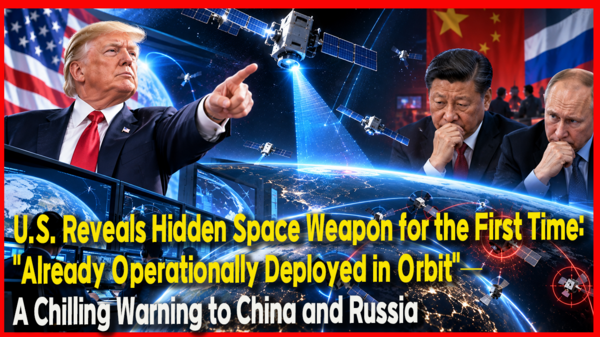
[U.S. Air Force Secretary: "On-Orbit Space Control Weapons Already Operating"—Unveiled for the First Time in History]
The United States has finally played a long-hidden card in space warfare. For the first time, it has officially acknowledged that "space control weapons"—designed to protect U.S. forces and space assets from hostile attacks—are already in Earth's orbit and operationally deployed. What makes this even more significant is that this secret was not leaked by accident, but deliberately disclosed by the U.S. for China and Russia to hear. Following land, sea, air, and cyber, space is now entering the realm of actual battlefields in the U.S.–China–Russia military competition.
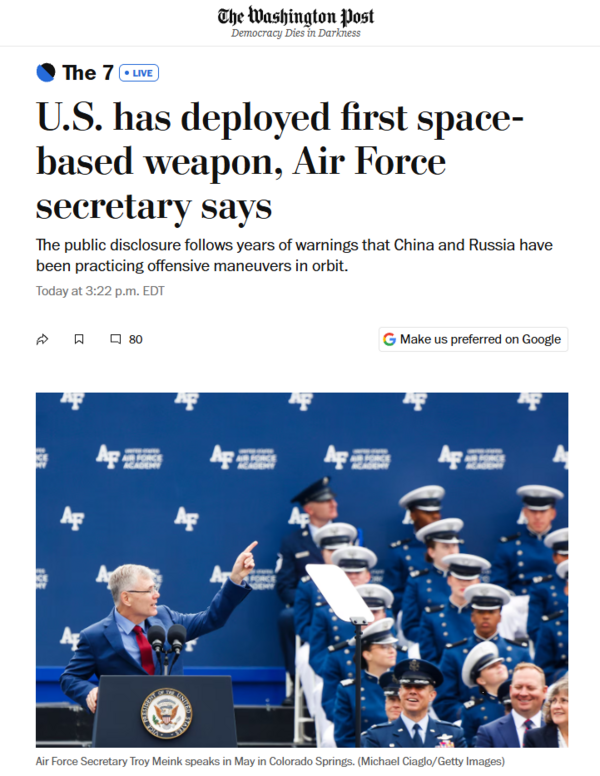
The Washington Post reported on the 15th: "Secretary of the Air Force Troy Meink announced during his keynote address at the Air & Space Forces Association's (AFA) Air, Space & Cyber Conference in National Harbor, Maryland on the 14th that 'the Space Force now possesses on-orbit space control weapons capable of defending the joint force from adversary actions.'" The report drew significant attention by emphasizing: "The most important word in this announcement is neither 'development' nor 'testing'—it is that they are already 'on-orbit'."
The Washington Post further noted: "This is the first time a senior U.S. official has so directly disclosed the existence of actual space weapons operated by the U.S. in Earth's orbit." It added, "While the U.S. has long warned about the anti-satellite weapons and orbital strike capabilities of China and Russia, it maintained strict silence regarding what countermeasures it possessed—and that silence was broken directly by the Air Force Secretary."
[What's More Chilling: "He Did Not Say What It Was"]
However, Secretary Meink kept the most critical details thoroughly under wraps. The Washington Post stated: "He did not disclose how many weapons exist, when they were launched, which orbits they occupy, or how they counter adversary space assets." It continued, "He did not even reveal whether they are kinetic weapons that physically destroy adversary satellites or non-kinetic weapons that disable functions via electronic warfare."
Secretary Meink made it clear that this ambiguity was intentional. Speaking to reporters after the presentation, he said the disclosure was deliberate and that the phrasing was "very carefully considered." He explained: "Revealing the existence of the weapon aids deterrence, but disclosing specific testing or performance capabilities actually does not help deterrence."
In effect, the message delivered to China and Russia is: "We will let you know we have space weapons, but we will not tell you what they are or how they operate." The very uncertainty—preventing rivals from accurately calculating America's actual response capabilities—becomes a component of deterrence itself.
[Why Disclose Now? Meink Directly Named China and Russia]
Why, then, did the U.S. break the silence it had maintained until now? Secretary Meink effectively provided the answer himself. He asked reporters rhetorically: "Does anyone question that China and Russia have been developing these types of weapons?" For over a decade, U.S. officials have warned about orbital weapon developments and aggressive maneuvers by China and Russia. Now, the U.S. has moved beyond simply tracking and warning against adversary threats, beginning to publicly showcase the existence of its own counter-capabilities.
In modern warfare, satellites are far more than simple reconnaissance tools. A vast portion of modern military operations—including missile early warning, satellite communications, positioning, navigation, and timing (PNT) data, precision strikes, battlefield surveillance, and target acquisition—depends heavily on space assets. If eyes and ears in space are paralyzed, advanced weaponry on the ground loses much of its effectiveness.
Consequently, 'Space Control' is not merely a defensive concept limited to protecting U.S. satellites. Relevant U.S. doctrine encompasses both defensive actions to protect friendly space capabilities and offensive actions to deny adversary space capabilities. While the specific functions of the newly disclosed assets remain classified, it has become clear that the U.S. has entered a stage where both offense and defense are considered in space.
[China Has Already Grappled a Satellite and Moved It to Another Orbit]
One of the rivals the U.S. has been particularly wary of is China. In 2022, China's Shijian-21 (SJ-21) satellite approached the end-of-life Chinese Compass G2 satellite in geostationary orbit (GEO) and towed it into a so-called "graveyard orbit" far above normal GEO altitude. SJ-21 then detached from the satellite and returned to near-GEO altitude.
The core issue lies in the dual-use nature of this technology. When used to clear dead domestic satellites, it serves as space debris removal and satellite servicing technology. However, if deployed against an uncooperative foreign satellite, it can transform into a military threat.
That said, there is no need to overinterpret this single event, as no evidence confirmed that SJ-21 was acting with military intent at the time. Experts at the time noted that while the observed maneuvers were indisputable, separate judgment was required regarding China's intentions. It is precisely this blurring of lines between peacetime satellite servicing technologies and wartime offensive tools that represents one of the most dangerous characteristics of today's space race.
[Russia Joins the Fray: Space Is No Longer a 'Sanctuary']
Russia is likewise a primary target of U.S. vigilance. U.S. authorities have continuously warned that Russia and China are developing on-orbit weapons, and Secretary Meink directly cited both nations during his announcement. In particular, Rendezvous and Proximity Operations (RPO)—approaching and tracking adversary satellites at close range—have emerged as a new variable in space warfare. While RPO can be used for peaceful purposes like satellite repair, inspection, and debris removal, if repurposed militarily, it can evolve into an ability to monitor or disable enemy satellites.
Regarding this, The Washington Post noted: "This disclosure by the U.S. carries a strong warning tone toward China and Russia." It emphasized: "If you approach or attack U.S. satellites, the U.S. can respond within the very same space environment." The U.S. has placed on the table for the first time the exact card it had previously kept hidden.
[Even More Surprising: The 'Next Card' Is Also Being Prepared Rapidly]
This announcement should not be viewed solely as an isolated event introducing a mystery space weapon. At the same event, Secretary Meink also disclosed the development status of Space-Based Interceptors (SBI), a key asset in the Trump administration's "Golden Dome" missile defense initiative. He revealed that "from the initial contract to the 'flight-ready hardware' stage, SBI took less than a year."
Of course, this does not mean immediate operational deployment of SBI. The U.S. Space Force is pursuing a phased development and testing path, aiming to potentially achieve initial operational capability by 2028. The crucial factor here is the speed of development.
Furthermore, the newly acknowledged "on-orbit space control weapon" and the SBI represent two distinct systems. One is a capability already in orbit to counter hostile space activities, while the other is a core component of Golden Dome being developed to intercept incoming missiles from space. In short, the U.S. is entering a phase where it simultaneously operates deployed space warfare assets while building out future space-based missile defense networks.
[Why Times Insight—What the U.S. Disclosed Is a 'Shift in Strategy' Rather Than Just a 'Weapon']
The true significance of this announcement does not rest solely on what secret weapon the U.S. placed into orbit. What matters more is that the U.S. determined it no longer needs to conceal the weapon's existence. Previously, the basic dynamic of space warfare involved the U.S. tracking and issuing warnings about Chinese and Russian anti-satellite capabilities. This time, however, the U.S. directly declared: "We, too, are already operating weapons in orbit." This indicates that America's space deterrence strategy is transitioning to a new stage.
Calculations for China and Russia have become correspondingly complex. In the past, if they attacked a U.S. satellite, they only had to calculate how the U.S. might retaliate from land, sea, air, or cyber domains. Now, they must also calculate what immediate countermeasures the U.S. could execute within space itself. Yet, the U.S. disclosed neither what the weapon is, nor how many exist, nor where they are located. This deliberate uncertainty is likely the primary deterrent effect the U.S. intends to achieve.
One thing has become clear: the U.S. is no longer at the stage of merely saying "we will develop space weapons in the future." It has already placed operational assets into orbit and has begun utilizing that very fact as a strategic weapon. Joining land, sea, air, and cyber, space is no longer just a passive domain supporting terrestrial warfare—it has become a critical new "high ground" that must be commanded to decide the outcome of war.
Through this announcement, the U.S. effectively declared to China and Russia: "We are not making space weapons. We have already put them in space." Ultimately, what the U.S. unveiled was not merely a single secret weapon, but a signal that the era of space warfare has officially begun.

-중국 푸단대학교 한국연구원 객좌교수
-전 EDUIN News 대표
-전 OUR NEWS 대표
-제17대 대통령직인수위원회 정책기획팀장
-전 대통령실 홍보기획비서관
-사단법인 한국가정상담연구소 이사장
-저서: 북한급변사태와 한반도통일, 2012 다시우파다, 선거마케팅, 한국의 정치광고, 국회의원 선거매뉴얼 등 50여권