Update2026.10.24 (토)

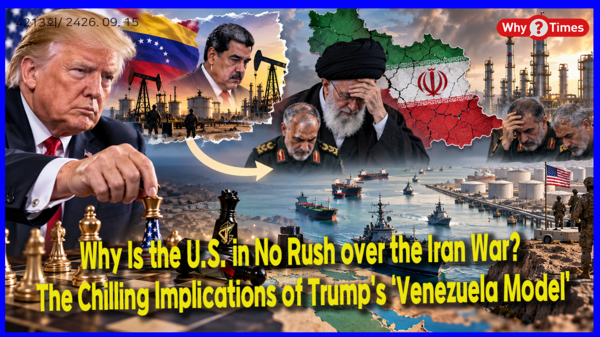
[Trump Finally Speaks: “Iran Could Be Like Venezuela”]
How far does the United States intend to push its military posture in Iran? Emerging signals diverge significantly from the initial narrative—that operations would conclude once the Strait of Hormuz was reopened and Iran’s nuclear program neutralized. U.S. President Donald Trump remarked that the U.S. might remain in Iran to secure crude oil, drawing a direct comparison to Venezuela. This shift suggests Washington's overarching goal may extend beyond a quick exit to maximizing pressure on Iranian hardliners and restructuring Iran’s post-war governance and energy order.
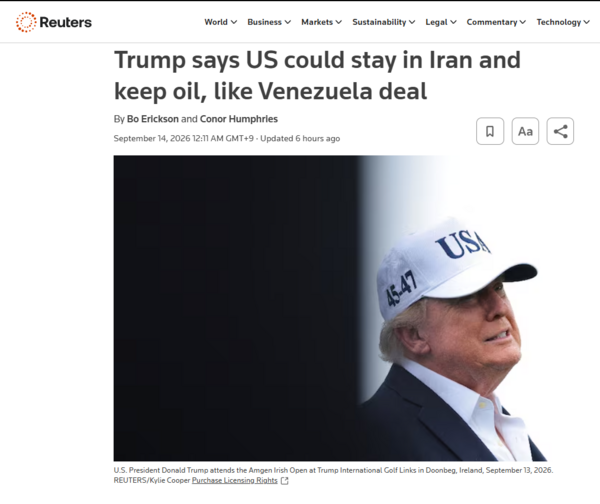
Speaking to reporters during a visit to Ireland on September 14, President Trump addressed the eventual conclusion of the conflict while introducing a notable caveat. Reuters reported that while the U.S. plans to withdraw, Trump cited one exception: staying behind to control oil assets, explicitly referencing Venezuela. Trump asserted that revenues generated from Venezuelan operations had offset military costs multiple times over, implying a similar framework could be applied to Iran.
Trump also projected that active combat could wrap up within the year—potentially shortly after the U.S. midterm elections in November—and predicted a substantial drop in gasoline prices once hostilities end. Crucially, Washington is now explicitly linking its military exit strategy directly to Iranian oil resources. Beyond destroying nuclear sites and restoring transit through Hormuz, the administration is actively framing long-term geopolitical and economic leverage over Iran as a viable option.
[Why Is Washington De-emphasizing Hormuz?]
Concurrently, a subtle shift has emerged in Washington’s operational priorities regarding the Strait of Hormuz. CNN reported on September 13, citing multiple sources, that the Trump administration advised Gulf allies that future negotiations with Iran should prioritize dismantling Tehran’s nuclear apparatus rather than focusing solely on reopening maritime shipping lanes. This does not indicate a complete U.S. withdrawal from maritime security, but it reflects a strategic decision to center diplomatic leverage on neutralizing core nuclear capabilities while delegating local transit disputes.
This distinction is significant. If reopening Hormuz were the primary objective, Washington would lead direct bilateral negotiations to quickly restore maritime traffic. Instead, the U.S. is decoupling the nuclear program from the shipping crisis—leaving Oman and Gulf partners to manage regional transit terms while Washington concentrates on permanently mitigating Iran's strategic capabilities.
[What Does the U.S. Consider a Successful End to the War?]
This raises a fundamental question: What specific end-state does Washington require before declaring the conflict resolved? If maritime access were the sole objective, securing Hormuz would suffice. If halting nuclear development were the only target, a verifiable nuclear pact would end combat. Yet Trump’s open commentary regarding a post-war physical or economic presence aimed at oil assets demonstrates that the White House envisions an outcome broader than a standard ceasefire.
When the White House launched military operations under Operation Epic Fury, its declared mission set was not limited strictly to nuclear infrastructure. Official objectives encompassed dismantling ballistic missile inventory, degrading naval capabilities, and severing ties with regional proxy networks. From the outset, the strategic design sought to neutralize all mechanisms through which Iran projects regional power.
[The Real Meaning of the ‘Venezuela Model’ Beyond Oil]
Interpreting the ‘Venezuela Model’ strictly as an oil-grab overlooks a broader strategic framework. By linking Venezuela and Iran, Trump pointed toward a strategy of systematically degrading hostile ruling structures, establishing a compliant economic or political equilibrium, and using national energy resources as strategic leverage.
In Iran, hardline factions centered around the Islamic Revolutionary Guard Corps (IRGC) are deeply entrenched across military, political, and economic institutions. Ceasing hostilities without dismantling these networks leaves open the possibility that missile, nuclear, and maritime threats will resurface. Consequently, ensuring that hardliners permanently lose the capacity to threaten regional security serves as a primary condition for ending the campaign.
This does not imply that Washington's goal is the immediate establishment of a Western-style democracy. The administration has stopped short of framing forced democratic nation-building as an explicit military goal. The pragmatic baseline is not a democratic Iran, but an Iran structurally incapable of wielding nuclear weapons, ballistic missiles, or maritime blockades against global interests.
[Does Time Favor Iran as the War Drags On?]
This context clarifies why the U.S. maintains intense military pressure despite a prolonged timeline. Extended conflict imposes clear costs on Washington and the global economy; Brent crude surged 3% on September 14 to exceed $107 per barrel following attacks on Saudi Arabia’s East-West Pipeline according to Reuters reporting. Energy market instability presents real constraints.
However, continued pressure systematically exhausts Iran's domestic economy and military infrastructure. Rather than accepting an early, indecisive truce, Washington's strategic calculation favors reducing the combat capacity and political authority of Iranian hardliners prior to final negotiations. The nature of post-war Iran takes precedence over the speed of the exit.
[Oman Talks Abruptly Postponed: Hormuz Solution Recedes]
Diplomatic avenues faced further disruption on September 14 when scheduled talks in Oman between Iran and Gulf representatives were unexpectedly postponed. Omani Foreign Minister Badr Albusaidi announced the delay, with Reuters confirming mutual agreement between Muscat and Tehran. The meeting was set to address maritime transit protocols in the strait.
Simultaneously, regional instability continues to expand beyond Hormuz. With strikes impacting Saudi pipeline infrastructure and Houthi forces expanding operations near the Bab-el-Mandeb Strait, critical energy bypass routes are experiencing concurrent vulnerability.
[Key Questions for South Korea]
These shifts carry direct implications for South Korea as it evaluates potential maritime security contributions in the region. If the U.S. mission were limited strictly to safeguarding commercial navigation, operational parameters and exit criteria would remain relatively straight-forward. However, if Washington's campaign expands into long-term containment and post-war structural management, Seoul must rigorously evaluate the scope, purpose, and timeline of any operational involvement.
[Why Times Insight]
President Trump’s references to the ‘Venezuela Model’ reflect a broader vision regarding post-war regional order rather than an isolated remark on energy assets. A narrow resolution limited to freezing nuclear sites while leaving existing power structures intact risks a resurfacing of maritime and missile crises within a few years.
Under Washington's current approach, maintaining sustained military and economic pressure to degrade the operational capabilities of the IRGC offers a more durable strategic outcome. The reference to Venezuela signals an intention to leverage post-conflict economic and energy structures to maintain long-term strategic posture.
Because the White House has not formally committed to full-scale regime change or democratic nation-building, the underlying objective centers on neutralizing Iran's capacity to leverage nuclear or maritime threats. Ultimately, the true test of this strategy will emerge when formal peace negotiations begin, as the specific terms imposed on missile programs, proxy networks, IRGC assets, and oil management will reveal the full framework of Washington's post-war strategy.

-중국 푸단대학교 한국연구원 객좌교수
-전 EDUIN News 대표
-전 OUR NEWS 대표
-제17대 대통령직인수위원회 정책기획팀장
-전 대통령실 홍보기획비서관
-사단법인 한국가정상담연구소 이사장
-저서: 북한급변사태와 한반도통일, 2012 다시우파다, 선거마케팅, 한국의 정치광고, 국회의원 선거매뉴얼 등 50여권