


Update2026.10.24 (토)

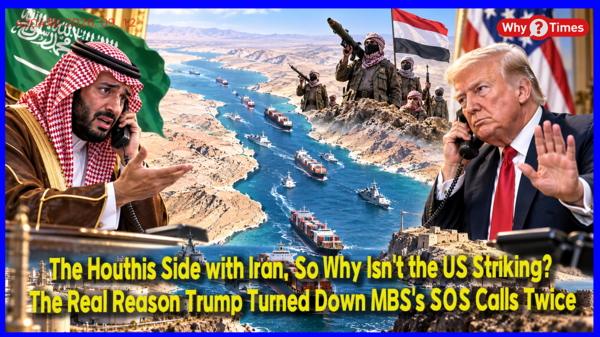
[Bin Salman Calls SOS Twice in One Day—But Trump Says “NO”]
If the Houthis are a core ally of Iran, why is the United States refraining from direct military strikes? As tension mounts around the Strait of Hormuz, the extension of Houthi threats into the Bab el-Mandeb Strait could undermine the broader US pressure campaign against Iran. Yet, when Saudi Crown Prince Mohammed bin Salman (MBS) placed two desperate calls to US President Donald Trump requesting immediate US airstrikes on Houthi targets, Trump refused. Explaining this choice as merely "staying focused on Iran and Hormuz" leaves key questions unanswered. What lies behind Trump’s outright rejection of MBS's urgent appeal?
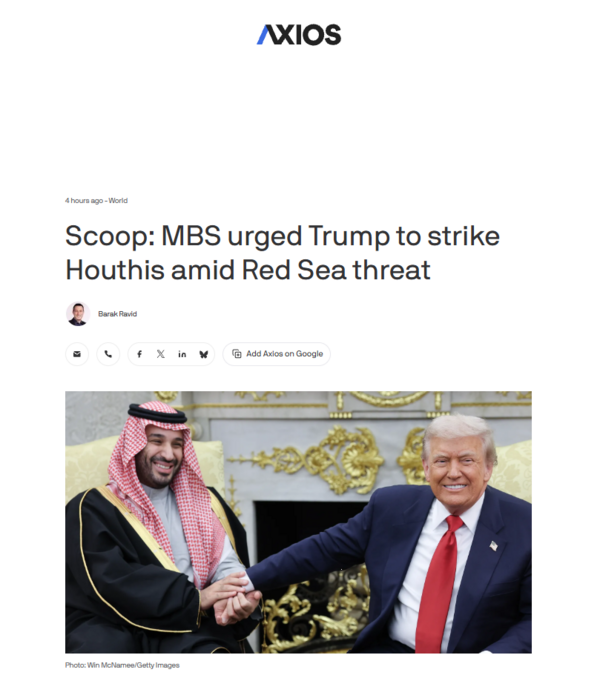
Axios reported, citing two US officials, that Crown Prince Mohammed bin Salman called President Trump twice in a single day. In the first call, MBS described the Houthi advance and the retreat of Saudi-backed Yemeni government forces. Hours later, in a second call, he requested direct US airstrikes against the Houthis. Trump rejected the request, with US officials clarifying that Washington currently has no plans to engage in direct military action against the group.
This does not mean Washington has abandoned Riyadh entirely. Axios noted that the US is stepping up support by providing intelligence and targeting data for Saudi Arabia’s own operations. However, a senior administration official emphasized that while Washington's priority remains keeping the Red Sea open, resolving the broader Yemeni conflict falls to regional allies. The line is clear: Washington will supply intelligence and logistics, but it will not fight Saudi Arabia’s war.
[Bin Salman’s Shift in Two Months: From “Just Support Us” to “Strike Them Directly”]
The urgency of the situation is reflected in MBS’s dramatic change in posture over two short months. When Saudi Arabia conducted airstrikes on Sanaa Airport, Trump backed the military action, though Riyadh stopped short of requesting direct US military intervention. Fast-forwarding to today, MBS’s direct plea for US military involvement highlights the swift speed of the Houthi offensive in western Yemen.
The Houthis seized the strategic Red Sea port city of Mokha, located roughly 80 kilometers from the Bab el-Mandeb Strait. Citing Yemeni government sources, Reuters reported that Houthi forces advanced toward the Hanish Islands, rapidly expanding their influence over maritime transit through the strait. A further push toward Dhubab and Perim Island would grant the Houthis overwhelming military leverage over passing commercial traffic.
[As Hormuz Freezes, Bab el-Mandeb Becomes Saudi Arabia’s Lifeline]
The Bab el-Mandeb Strait is no longer functioning under normal conditions. With maritime traffic through the Strait of Hormuz severely disrupted, Saudi Arabia has increasingly relied on rerouting crude oil from its eastern oilfields via the East-West Pipeline to Yanbu port on the Red Sea. Vortexa estimated Yanbu's crude and condensate exports at approximately 3.7 million barrels per day, while Kpler placed the volume near 2.9 million bpd. As Hormuz falters, the Red Sea serves as Saudi Arabia's primary economic outlet.
A practical blockade of Bab el-Mandeb by the Houthis would trigger a nightmare scenario for Riyadh: a disruption at Hormuz to the east combined with a choked outlet in the Red Sea to the west. Following the fall of Mokha and ongoing maritime clashes near Hormuz, Brent crude futures surged over 6%, closing above $107 per barrel as energy markets began pricing in the simultaneous disruption of both choke points.
[The Houthis Act for Iran—So Why Refrain from Striking?]
The strategic alignment between the Houthis and Iran compounds the dilemma. Reuters characterized the Houthi offensive along the Red Sea as a "second front" in the wider confrontation with Tehran. By expanding territorial control along the coast, the Houthis offer Tehran secondary strategic leverage in Bab el-Mandeb to complement its posture in Hormuz.
This raises a central paradox: if the Houthis align with Iran and directly threaten Bab el-Mandeb, why does Washington refrain from attacking them? The official line from the White House points to maintaining focus on Iran proper and the Strait of Hormuz without opening additional military fronts. Yet behind this public rationale lies a calculated strategic formula.
[Why Times Insight]
The primary key to understanding Trump's stance lies in the distinction between "eliminating the Houthis" and "defending Bab el-Mandeb." Washington's core national interest is safeguarding freedom of navigation in international waters, not eradicating the Houthi movement entirely. The explicit statement from senior US officials—that Washington will safeguard Red Sea shipping while leaving regional land conflicts to local partners—underlines this calculation.
Current shipping data reflects this distinction. Reuters, citing Kpler tracking data, reported that while commercial transit through Hormuz dropped to single digits, 26 cargo vessels successfully traversed Bab el-Mandeb on the same day. Though Hormuz faces severe disruption, Bab el-Mandeb remains open for commercial navigation—providing a concrete reason for Washington to avoid direct ground and air entanglements in Yemen.
Second, Washington is seeking to avoid a "second-front trap" set by Tehran. Direct US intervention in Yemen would allow Iran to use a low-cost proxy to divide American military focus between two separate theaters. The Houthis do not need to defeat US forces symmetrically; continuous drone, missile, and asymmetric naval strikes would force the US military to expend high-cost interceptors, naval vessels, and aircraft indefinitely.
Third, and most importantly, Trump's policy shifts financial and operational accountability back to Saudi Arabia. Bab el-Mandeb represents an immediate existential interest for Riyadh, given its reliance on Yanbu to bypass Hormuz. From Trump's perspective, if Bab el-Mandeb is a Saudi economic lifeline, the burden of ground operations belongs to Riyadh and its regional partners, supported by US intelligence and target coordination.
This posture avoids entangling American forces in an Iranian proxy war, while forcing Tehran to bear the continuous financial and material cost of sustaining the Houthi offensive. Rather than falling into a proxy war trap, Washington leaves its regional allies to manage land defenses while concentrating primary firepower directly against Iran and the main bottleneck at Hormuz.
Trump's response to MBS's appeals does not signal an abandonment of Saudi Arabia, but rather a strict division of labor: Washington manages the strategic containment of Iran and the primary shipping routes at Hormuz, while Riyadh and its coalition handle regional ground conflicts in Yemen.
The critical threshold for this policy remains the operational status of Bab el-Mandeb itself. As long as commercial traffic flows through the strait, Washington will maintain its current posture. However, should the Houthis successfully establish a total maritime blockade at Bab el-Mandeb, the crisis would transition from a regional security issue for Saudi Arabia into a direct threat to global commerce, altering the tactical calculus for US military intervention.

-중국 푸단대학교 한국연구원 객좌교수
-전 EDUIN News 대표
-전 OUR NEWS 대표
-제17대 대통령직인수위원회 정책기획팀장
-전 대통령실 홍보기획비서관
-사단법인 한국가정상담연구소 이사장
-저서: 북한급변사태와 한반도통일, 2012 다시우파다, 선거마케팅, 한국의 정치광고, 국회의원 선거매뉴얼 등 50여권



