Update2026.10.24 (토)

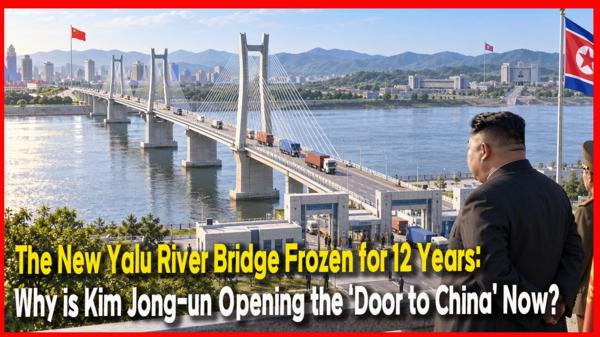
[Reuters: "Opening of the New Yalu River Bridge, Stalled for 12 Years, Imminent"]
The New Yalu River Bridge, which sat functionally idle in the middle of the Yalu River for 12 years, is finally preparing to open. Completed by China at immense expense in 2014, the bridge remained closed for over a decade because North Korea failed to build its connecting infrastructure. Earlier this year, however, construction on the North Korean side accelerated rapidly, bringing its customs and border inspection facilities to near completion. The core issue is not simply that the bridge is finished, but why Kim Jong-un is opening this symbol of Sino-North Korean distrust right now.
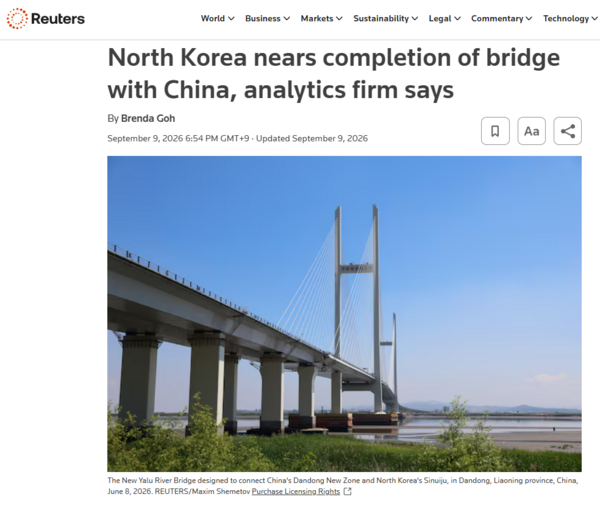
Reuters quoted South Korean satellite imagery analytics firm SI Analytics, stating that "structural work on the customs and immigration facility on the North Korean side of the New Yalu River Bridge is nearly complete". North Korea carried out customs facilities, road paving, and perimeter landscaping at a rapid pace in recent months—a movement SI Analytics characterized as Pyongyang's tactical "speed battle". While Beijing and Pyongyang have not announced an official opening date, satellite evidence indicates regular cross-border traffic is near.
Commercial satellite imagery from 38 North aligns with this assessment. Roofs have been installed on major warehouses, and external construction on key complex buildings and support facilities is largely complete. Internal roads are paved, landscaping is underway, and a new gateway structure with visible vehicle activity stands where the bridge touches North Korean soil. 38 North noted that this sudden progress strongly signals the bridge is finally entering regular operational status.
[Why Couldn't This Bridge Open for 12 Years?]
The New Yalu River Bridge began as a symbol of Sino-North Korean economic cooperation. Spanning roughly 3 kilometers between Dandong and Sinuiju, the project cost approximately 2.2 billion yuan (around $350 million), fully funded by China. Expected to open in October 2014, it was designed as a major logistics artery to relieve congestion on the aging Sino-Korean Friendship Bridge.
When the target opening arrived, problems surfaced. While China had completed the main bridge structure, North Korea failed to construct its connecting access roads and customs facilities. Consequently, the October 2014 opening was postponed indefinitely.
For years, it remained a "bridge to nowhere". 38 North observed that without North Korean administrative and transport infrastructure, the bridge could not function as a border crossing, leaving a $350 million asset stranded in midair.
[Was It Just a Money Issue? Bordering on Worsening Bilateral Ties]
A practical cause for the delay was funding for North Korea's infrastructure. RFA reported that work halted in 2014 due to disagreements over who would pay for the North Korean side, only resuming in earnest in early 2025 following new Chinese investments.
However, financial disputes alone do not explain a 12-year standstill. Reuters highlighted that North Korea's repeated nuclear tests and the resulting friction in Sino-North Korean relations played a major role. Pyongyang's nuclear and missile development, coupled with Beijing's enforcement of international sanctions, caused severe strains in bilateral politics—a deep freeze that directly overlapped with the bridge's abandonment.
[Another Reason North Korea Suspiciously Eye-balled China]
Security distrust also weighed heavily on Pyongyang. Kyodo News reported on leaked Chinese People's Liberation Army (PLA) documents outlining contingency plans for a crisis in North Korea, including border monitoring, reconnaissance, blockades, and refugee management. The Diplomat similarly analyzed these plans as PLA emergency response scenarios for severe internal chaos in North Korea.
Although Beijing dismissed the authenticity of these reports, the mere possibility that China evaluated military and border interventions during a North Korean crisis reinforced Pyongyang's strategic reluctance to trust Beijing fully.
[The New Yalu River Bridge Was Not Merely an 'Economic Bridge']
While the bridge serves as a major trade artery between Dandong and Sinuiju, it also presents a four-lane highway connecting Northeast China directly into northwestern North Korea. Though there is no evidence China built it for military conquest, North Korean leadership evaluated both its economic utility and its security implications. A high-capacity transit corridor carries dual potential: economic opportunity and strategic vulnerability.
Viewed in this light, the prolonged delay was more than a construction hitch. To China, the bridge was a new artery into North Korea's economy; to North Korea, it was a conduit for overwhelming Chinese economic influence. The bridge became the starkest symbol of the Kim Jong-un era's paradox toward Beijing: economically necessary, but politically perilous.
[Kim Jong-un Unlocks the Gate in 2026]
The stagnant project accelerated dramatically in 2026. According to RFA, following a resumption of preliminary work in 2025, construction on the North Korean side surged into a high-speed push over a four-month period.
Crucial diplomatic momentum accompanied this shift. Chinese President Xi Jinping visited Pyongyang, marking his first visit in seven years. According to Reuters and Xinhua, Xi and Kim agreed to expand practical cooperation across trade, agriculture, technology, and infrastructure, including reopening border crossings and restoring direct flight and rail links.
[A More Telling Scene: The Bridge to Russia Opened the Very Same Week]
The timing of the New Yalu River Bridge's completion is particularly notable because North Korea and Russia officially opened their first dedicated road bridge just days earlier.
According to Reuters, this 1-kilometer, two-lane road bridge creates the first direct overland highway link between North Korea and Russia. Agreed upon during Vladimir Putin's visit to Pyongyang in 2024 and launched in 2025, it is capable of handling up to 300 vehicles and 2,850 people daily, effectively diversifying North Korea's overland transport away from total reliance on China.
[China to the West, Russia to the East: Kim Jong-un's New Calculus]
Comparing these two bridges clarifies Kim Jong-un’s broader strategy. To the west, a four-lane logistics route to China is nearing operation; to the east, a direct road to Russia is now open. Pyongyang is expanding its continental land connections on both flanks simultaneously. Reuters likewise noted the strategic significance of North Korea expanding its connectivity to both China and Russia simultaneously.
China has no intention of losing North Korea to Russia's sphere of influence. Marking the anniversary of North Korea's regime, Xi Jinping sent a message to Kim stressing China's firm commitment to developing bilateral ties and strengthening strategic guidance. On the same day, Putin sent his own greeting pledging to deepen their comprehensive strategic partnership.
[Why Times Insight]
The core takeaway of the New Yalu River Bridge is not merely its physical completion, but why a border link abandoned for over a decade is opening right now.
Previously, Beijing was an indispensable sponsor that Pyongyang nevertheless deeply distrusted. Today, Kim Jong-un possesses a robust alternative in Moscow. Secure in his Russian alignment, Kim can reopen economic channels with China without fearing asymmetric subjugation.
Opening the New Yalu River Bridge does not signify renewed blind trust in Beijing; rather, it shows North Korea has engineered a geopolitical environment where it can leverage Chinese economic benefits safely. By balancing market access and investment from China in the west against military and energy cooperation with Russia in the east, Pyongyang maximizes its diplomatic leverage. Moving from single-country dependence to dual-power maneuvering, Kim Jong-un is opening two bridges to expand his own strategic space between two rival powers.


-중국 푸단대학교 한국연구원 객좌교수
-전 EDUIN News 대표
-전 OUR NEWS 대표
-제17대 대통령직인수위원회 정책기획팀장
-전 대통령실 홍보기획비서관
-사단법인 한국가정상담연구소 이사장
-저서: 북한급변사태와 한반도통일, 2012 다시우파다, 선거마케팅, 한국의 정치광고, 국회의원 선거매뉴얼 등 50여권